-
Call Now
1800-102-2727


Linear Equations

An equation is defined as the combination of alphabets, numbers and operators. A linear equation is a first-degree equation with a maximum power of one on all variables. In a linear equation, the numbers are coefficients and constants. They represent fixed quantities. The alphabets (variables) are symbols that stand for unknown or changing quantities.
Linear Equations in One Variable Definition
Based on the definition of linear equations, understanding linear equations in one variable is simple. These equations have one alphabet or variable.
- The graphical representation of a linear equation is always a straight line.
- There is only one solution.
- The line's horizontal or vertical direction depends on the variable type.
Standard Form of Linear Equations in One Variable
The standard form of a linear equation in one variable is:
where
x is the variable
a and b will be replaced with numbers
Also, a is a coefficient of variable x
b is a constant term
Examples:
3x + 4 = 2
2x + 9 = 31
The standard form of a linear equation can also be understood with the help of a word problem.
Suppose Sam has 5 oranges. He adds some bananas to them and gives the fruit basket to Tia. The total number of fruits in the basket is 9.
Let the number of bananas be x.
Now, we can represent the situation as a linear equation:
5 + x = 9
Here, 5 represents the oranges, x represents the bananas, and their sum equals the total fruits. To solve for x, we rearrange the equation:
x = 9 − 5
So, Sam added 4 bananas to the basket.
Step for Solving Linear Equations in One Variable
- Form the equation – Keep variables on one side and constants on the other.
- Simplify constants – Use basic operations (addition, subtraction, multiplication, division).
- Isolate the variable – Bring the variable to one side of the equation.
- Solve and simplify – Perform the final calculation to get the value of the variable.
Let us understand through equation 4x + 4 = 20
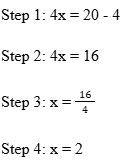
Hence, the variable will be 2.
Linear Equations in Two Variables
A linear equation in two variables is an equation where two different alphabets (variables) are used, each having a maximum power of one.
- The highest power of both variables is 1.
- The graph of such an equation is always a straight line in the coordinate plane.
- The solution is represented as an ordered pair (x, y).
- There are infinitely many solutions that satisfy the equation.
Standard Form of Linear Equations in Two Variables
The general form is:
ax + by + c = 0
where:
x, y → variables
a, b → coefficients (cannot both be zero)
c → constant term
Example equations:
- 2x + 3y = 6
- x − y + 4 = 0
- 5x + 2y − 10 = 0
The standard form of a linear equation in two variables can also be understood with the help of a word problem.
Riya buys 2 pencils and 3 erasers. The total cost is ₹18. What is the cost of each?
Let the cost of a pencil be x, and the cost of an eraser be y.
The situation can be expressed as:
2x + 3y = 18
This is a linear equation in two variables (x and y).
Steps for Solving Linear Equations in Two Variables
To solve such equations, we usually take two equations together (simultaneous equations).
- Substitution Method – Replace one variable in terms of the other.
- Elimination Method – Eliminate one variable by adding/subtracting equations.
- Cross-Multiplication Method – Use the formula for solving pairs directly.
Let’s take the pair:
2x + 3y = 18 .......... (i)
x + y = 7 ............ (ii)
Substitution Method
Step 1: From x + y = 7, express x
x = 7 − y
Step 2: Substitute into 2x + 3y = 18:
2(7 − y) + 3y = 18
14 − 2y + 3y = 18
−2y + 3y = 18 − 14
y = 4
Step 3: Substitute y = 4 into equation (ii)
x+y=7
x + 4 = 7
x = 3
Solution:
(x, y) = (3, 4)
Elimination Method
Step 1: Equations are:
2x + 3y = 18 .......... (i)
x + y = 7 ............ (ii)
Step 2: Multiply (ii) by 2:
2x + 2y = 14 .......... (iii)
Step 3: Subtract (iii) from (i):
(2x + 3y) − (2x + 2y) = 18 − 14
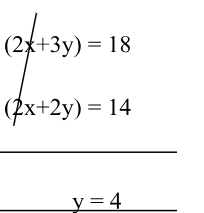
y = 4
Step 4: Substitute y = 4 into (ii):
x + 4 = 7
⇒x=3
Solution:
(x,y)=(3,4)
Cross-Multiplication Method
For equations:
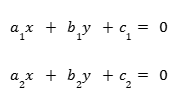
The formula is as follows:

Convert equations:
2x + 3y − 18 = 0
x + y − 7 = 0
a₁ = 2, b₁ = 3, c₁ = −18
a₂ = 1, b₂ = 1, c₂ = −7
Applying these to the formula:
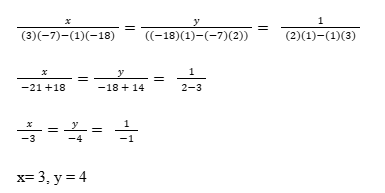
Solution:
(x, y) = (3, 4)
Summary
Linear equations in one variable are the simplest equations. They are easy to understand and effortlessly solvable through the rearrangement of the numbers. Linear equations in two variables extend the same concept but involve two unknowns. They always represent a straight line on a graph and have infinitely many solutions. To find a unique solution, we solve two equations together using substitution, elimination, or cross-multiplication methods.
FAQs
Q1. What is the standard form of linear equations in one variable?
The standard form is ax + b = 0, where a ≠ 0.
Q2. How many solutions do linear equations in one variable have?
Exactly one solution.
Q3. What is the graphical representation of a linear equation in two variables?
It is always a straight line on the Cartesian plane.


 Call Now
 Let's Chat
 Share
Share