-
Call Now
1800-102-2727


Geometry of Complex Numbers

Imagine navigating a maze, where each turn holds a new mathematical concept waiting to be discovered. Just like a maze, the realm of mathematics presents intriguing puzzles and intricate paths to explore. This article will journey through the captivating world of complex numbers, specifically focusing on their geometric interpretation. Aspiring JEE candidates and students in 11th and 12th grades can unravel the mysteries and applications of geometry in complex numbers.
Table of Contents
What is the Geometry of Complex Numbers?
The geometry of Complex Numbers deals with studying geometric properties and relationships associated with complex numbers. Complex numbers, denoted by the form
"a + bi," where "a" and "b" are real numbers and "i" represents the imaginary unit, possessing both real and imaginary components. This branch of mathematics provides a powerful tool to visualize and analyze mathematical concepts using the complex plane, where real numbers are plotted on the x-axis and imaginary numbers are plotted on the y-axis.
The Geometric Interpretation
The geometric interpretation of complex numbers goes beyond mere algebraic manipulation. By representing complex numbers as points in the Argand plane, we unlock a visual understanding of their properties and relationships. Here are some key points to deepen our understanding of the geometric interpretation:
Modulus and Argument: A complex number's modulus, represented by the symbol |z|, indicates how far away from its origin is in the Argand plane. It is calculated as:
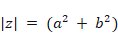
Where, z is the square root of the sum of the squares of its real and imaginary components. The angle between the positive real axis and the line between the origin and the complex number is represented by the argument, denoted by arg(z).
Trigonometric operations can be used to find the argument:  ,
,
accounting for the complex number's quadrant.
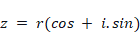
Polar Form: Complex numbers are represented by their modulus and argument when expressed in polar form. An illustration is:
 ,
,
Where, r is the modulus and is the argument.
Calculations involving multiplication and exponentiation are made easier by this form's simple depiction of complex numbers.
Geometric Operations: Using geometric interpretation, we can see how different operations on complex numbers affect them. Complex number addition and subtraction are vector operations where the output vector is created by joining the initial points. Scaling and rotating are both involved in the multiplication of complex numbers. The product's argument is the sum of its arguments, and the modulus is the product of its moduli. The original complex number is scaled and rotated to get the quotient when dividing complex numbers.
Geometry and Symmetry: Algebra and geometry are profoundly connected by complex numbers. The Argand plane is a simple framework for comprehending translations, rotations, and reflections. Specific operations on complex numbers can be used to depict geometric transformations. Complex numbers can be used to define symmetry operations like reflection and rotation, showcasing the elegant way geometry and complex analysis interact.
Additional Points:
The geometric interpretation of complex numbers extends to the concept of complex functions and their mappings in the complex plane, leading to the study of complex analysis.
The Argand plane can be extended to higher dimensions, allowing for the visualization of complex numbers as points in three-dimensional or n-dimensional spaces.
Geometric properties of complex numbers, such as the argument principle and the Schwarz lemma, play crucial roles in advanced mathematical topics like complex geometry and conformal mapping.
Examples
Example 1: Find the sum of the complex numbers z₁ = 3 + 4i and 
Solution: We add their real and imaginary parts separately to find the sum of two complex numbers.
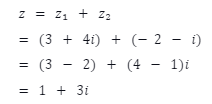
Therefore, the sum of z₁ and z₂ is 1 + 3i.
Example 2: Determine the product of the complex numbers z₁ = 2 + i and z₂ = -3 + 4i.
Solution: To find the product of two complex numbers, we use the distributive property and perform multiplication of the real and imaginary parts separately.
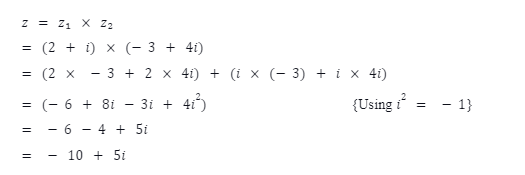
Therefore, the product of z₁ and z₂ is -10 + 5i.
Example 3: Given the complex number z = 1 - 3i, find its modulus and argument.
Solution: The modulus of a complex number is the distance between the origin and the point representing the complex number in the Argand plane.

Facts
- The distance between two complex numbers in the Argand plane equals their difference's modulus (magnitude).
- The product of two complex numbers corresponds to their magnitudes and the sum of their arguments.
- The complex conjugate of a complex number, obtained by changing the sign of its imaginary part, corresponds to a reflection across the real axis.
Theorems
- The Fundamental Theorem of Algebra states that every non-constant polynomial equation with complex coefficients has at least one complex root.
- De Moivre's Theorem provides a formula to raise complex numbers to integer powers and compute their corresponding arguments.
- The Argand-Gauss Theorem states that every non-zero complex number has a unique polar representation.
Practice Problems (MCQs)
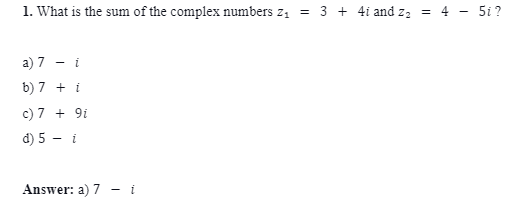
Explanation: We add their real and imaginary parts separately to find the sum of two complex numbers. In this case, adding z₂ to z₁ gives,
(3 + 4) + (4 - 5)i = 7 - i.
- What is the product of the complex numbers z₁ = 4 + 3i and z₂ = 4 - 3i ?
- a) 1
- b) 7
- c) 25
- d) -7 + 24i
Answer: c) 25
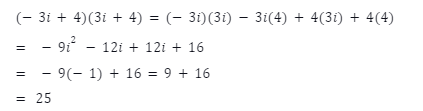
Explanation: To find the product of two complex numbers, we use the distributive property and multiply the real and imaginary parts separately. Multiplying z₁ and z₂ gives
- Given the complex number z = 1 + 3i, what is its modulus and argument?
- a) Modulus: 4, Argument: -1.25 radians
- b) Modulus: 3, Argument: 25 radians
- c) Modulus: √10, Argument: 25 radians
- d) Modulus: 1, Argument: 3 radians
Answer: c) Modulus: √10, Argument: 1.25 radians
Explanation: The modulus of a complex number is the distance between the origin and the point representing the complex number in the Argand plane.
The modulus is |z| = √(1² + (3)²) = √10. 
Frequently Asked Questions
Q1. What applications of geometry do complex numbers have?
Complex numbers can be represented geometrically as points in the Argand plane, which enables the visual understanding of operations, transformations, and symmetries.
Q2. Is it possible to visualize complex numbers as three-dimensional points?
Two-dimensional objects known as complex numbers can only be represented as points in the complex plane, sometimes referred to as the Arand plane.
Q3. What connection exists between a complex number's modulus and argument?
The argument of a complex number denotes the angle between the positive real axis and the line connecting the origin and the complex number, while the modulus of a complex number denotes the distance of the complex number from the origin in the Argand plane.

 Call Now
 Let's Chat
 Share
Share