-
Call Now
1800-102-2727


Geometrical Optics Formula Sheet

Light rays, as they interact with optical systems, form the basis of geometrical optics. Understanding the fundamental formulae in this field is crucial for NEET, JEE and High school students. From reflection and refraction to lens equations and Fermat’s principle, this article provides a concise and comprehensive overview of the key formulae in geometrical optics. Strengthen your knowledge, solve practice problems, and excel in your optical studies.
Table of Contents
- What is Geometrical Optics?
- Reflection and Refraction: Laws and Formulae
- Lens Formula and Thin Lens Equation
- Magnification Formula
- Total Internal Reflection
- Snell's Law
- Fermat's Principle
What is Geometrical Optics?
Geometrical optics is a branch of optics that treats light as a ray and studies its behaviour in terms of reflection, refraction, and the formation of images by optical devices. It simplifies the complex nature of light by considering it as a series of straight lines called rays. These rays interact with various surfaces, such as mirrors and lenses, allowing us to understand and predict how light behaves in different optical systems.
Reflection and Refraction: Laws and Formulae
In geometrical optics, reflection and refraction are fundamental phenomena that specific laws and formulae can describe. Let's look at the key equations for reflection and refraction:
Reflection:
The angle of incidence (i) equals the angle of reflection (r) according to the Law of Reflection.
It can be stated mathematically as:
|
i = r |
Refraction:
- Snell's Law: Snell's Law states that the ratio of the sine of the angle of incidence (i) to the sine of the angle of refraction (r) equals the ratio of the two media's velocities or refractive indices. It can be stated mathematically as:
|
n1sin(i) = n2sin(r) Where, n1 and n2 are the refractive indices of the initial and final media |
- Snell's Law (Alternative Form): The ratio of light velocity in the first medium (v1) to light velocity in the second medium (v2) is equal to the sine of the angle of incidence (i) to the sine of the angle of refraction (r). It can be stated mathematically as:
|
|

- Critical angle: The critical angle (
 ) is the angle of incidence where the angle of refraction is 90 degrees (light flows down the interface). It is calculated using the equation:
|
Where, n is the initial medium's refractive index. |

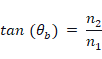
- Brewster's Law: Brewster's law states that when light is incident on a medium at Brewster's angle (
 ), the reflected light is polarised perpendicular to the plane of incidence. Mathematically, it can be given as:
|
Where n₁ and n₂ are the refractive indices of the initial and final media |
Lens Formula and Thin Lens Equation
The lens formula and thin lens equation are essential formulae used to analyse and predict the behaviour of lenses in geometrical optics. They define the mathematical relationships between a lens's object distance (u), image distance (v), and focal length (f).
The lens formula is as follows:
|
Where, f denotes the focal length of the lens, v the image distance (the distance between the created image and the lens), And, u the object distance (the distance between the object and the lens). |
The thin lens equation, obtained from the lens formula, is as follows:  (same)
This equation takes into account the signs of the distances (u, v, and f). Distances to the left of the lens are considered negative, whereas distances to the right are considered positive. The focal length (f) of a lens can be positive for converging (convex) lenses and negative for diverging (concave) lenses.
Magnification Formula
The magnification formula is critical in determining the size and direction of pictures produced by optical devices. It quantifies the size difference between the item and the image and indicates whether the image is enlarged or reduced in comparison to the object. The magnification formula takes into account the picture height to object height ratio. It can calculate the size of the picture created by lenses or mirrors.
In geometrical optics, the magnification (m) formula is determined by whether the optical system is formed by a lens or a mirror. Here are the magnification formulas for both cases:
Magnification by a Lens:
The magnification formula for a lens relates the height of the image (hi) to the height of the object (ho) and is given by:
|
|

Note: The negative sign indicates an inverted image, while a positive value represents an upright image.
Magnification by a Mirror:
The magnification formula for a mirror also relates the height of the image (hi) to the height of the object (ho) and is given by:
|
|

Like lenses, the negative sign indicates an inverted image, while a positive value represents an upright image.
Total Internal Reflection
Total internal reflection occurs when light travelling from a denser medium to a less dense medium encounters an angle of incidence greater than the critical angle. Instead of refracting, the light reflects back into the denser medium, resulting in the complete reflection of light rays. This phenomenon has various practical applications, including fibre optics communication and the functioning of optical prisms.
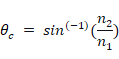
Critical Angle Formula:
The critical angle (θc) is the angle of incidence at which the refracted ray lies along the boundary between two media. It can be calculated using the following formula:
|
Where, n1 is the refractive index of the medium from which light is incident, and n2 is the refractive index of the medium into which light is refracted. |
Snell's Law for Total Internal Reflection:
Snell's law describes the relationship between the angles of incidence and refraction when light passes from one medium to another. The angle of refraction for total internal reflection is 90 degrees. Snell's law is expressed as:
|
Where, n1 and n2 are the refractive indices of the respective media, θ1 is the incidence angle, and θ2 is the refraction angle. |
Fermat's Principle
Fermat's principle, often known as the principle of least time, holds that light travels the shortest path between two places. This principle is a fundamental notion in geometrical optics, allowing us to predict the path light will travel when it interacts with different optical systems. We can analyse the behaviour of light rays and calculate their ideal pathways to their destinations by comprehending Fermat's principle.
Fermat's principle is not related with any mathematical formulas. Instead, it is a concept that governs how light rays behave in various optical systems. Certain equations and notions connected to Fermat's principle, on the other hand, can be utilised to analyse light's trajectories. These are some examples:
Snell's Law: It describes the angles of incidence and refraction that occur as light travels from one medium to another.
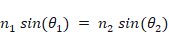 is the mathematical equation.
Where n1 and n2 are the two media's refractive indices, and 1 and 2 are the angles of incidence and refraction, respectively.
Path of Least Time: Light rays follow the path that takes the least amount of time to travel between two places, according to Fermat's principle. The path can be found by considering many paths and calculating the time light takes to travel along each path. Light follows the path that takes the least amount of time.
Principle of Reversibility: According to Fermat's principle, light's path is reversible. This means that if a ray of light takes the shortest path from point A to point B, the path travelled by a ray of light from point B to point A will likewise be the same. This principle ensures that light rays obey the laws of reflection and refraction.
Solved Examples
Example 1: A diverging lens has a focal length of -20 cm. An object is placed 30 cm in front of the lens. Determine the position and nature of the image formed.
Answer: The image is virtual and located 60 cm behind the lens.
Explanation: In a diverging lens, the focal length is negative.
Using the lens formula,  , where f is the focal length, v is the image distance, and u is the object distance,
We can calculate the image distance.
Plugging in the given values (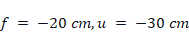 ),
),
We get 
Solving for v, we find v = - 12 cm.
Since the image distance is negative, the image is virtual and located 12 cm on the same side as the object.
Example 2: Light passes from air (refractive index 1.00) into a medium with a refractive index of 1.50. If the angle of incidence is 60 degrees, calculate the angle of refraction.
Answer: The angle of refraction is approximately 40.8 degrees.
Explanation: Using Snell's Law, 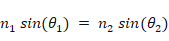 ,
,
Plugging in the given values (n1 = 1.00, n2 = 1.50, θ1 = 60 degrees),
We can solve for θ2. Rearranging the equation, we have  .
.
Substituting the values, 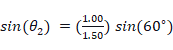 .
.
Evaluating this expression, we find 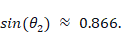
Taking the inverse sine, we get  ≈ 40.8.
Example 3: A converging lens forms a real image twice the object's size. If the object distance is 20 cm, determine the lens's image distance and focal length.
Answer: The image distance is 40 cm, and the focal length is also 40 cm.
Explanation: The magnification formula is given by magnification (m) =  , where v is the image distance, and u is the object distance.
Plugging in the given values (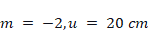 ),
),

Practice Problems
1: A concave lens has a focal length of -10 cm. An object is placed 20 cm in front of the lens. Determine the position and nature of the image formed.
- a) The virtual image is located 10 cm in front of the lens.
- b) The image is real and located 10 cm in front of the lens.
- c) The image is virtual and located 30 cm behind the lens.
- d) The image is real and located 30 cm behind the lens.
Answer: c) The virtual image is located 30 cm behind the lens.
Explanation: A concave lens has a negative focal length.
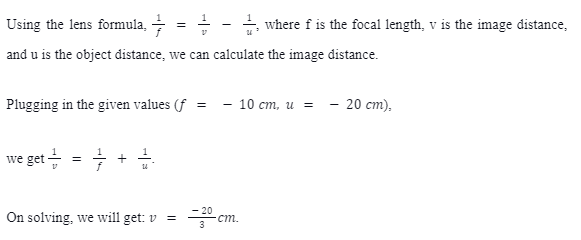
Since the image distance is negative, the image is virtual and located 30 cm on the same side as the object.
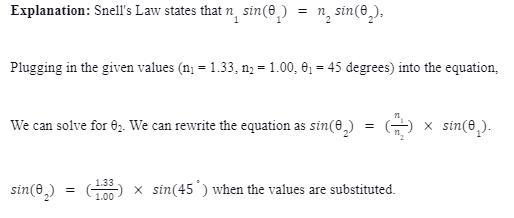
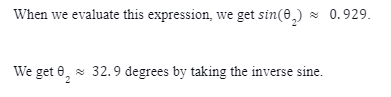
2: Light travels from water (refractive index 1.33) into air (refractive index 1.00) at an incident angle of 45 degrees. Calculate the angle of refraction.
- a) 25.2 degrees
- b) 32.9 degrees
- c) 45.0 degrees
- d) 56.3 degrees
Answer: b) 32.9 degrees
3: A converging lens provides a -2.5 magnification virtual image. Determine the image distance and focal length of the lens if the object distance is 15 cm.
- a) The focal length is -10 cm, and the image distance is -6 cm.
- b) The focal length is 10 cm, and the image's distance is -6 cm.
- b) The focal length is -10 cm, and the image distance is 6 cm.
- d) The focal length is 10 cm, and the image distance is 6 cm.
Answer: a) The focal length is -10 cm, and the image distance is -6 cm.
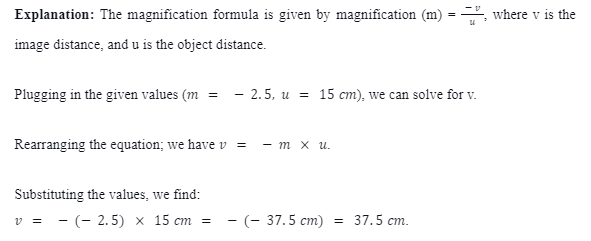
Since the image distance is positive, the image is virtual.
The focal length of a converging lens is positive for a real image but negative for a virtual image.
Therefore, the focal length of the lens is -10 cm.
Frequently Asked Questions
Q1. What is the difference between reflection and refraction?
Reflection is the bouncing back of light when it strikes a surface, whereas refraction is the bending of light when it passes from one medium to another.
Q2. How does the lens formula help in determining the position of the image?
The lens formula relates the object distance, image distance, and focal length of a lens, allowing us to calculate and predict the position of the image formed by the lens.
Q3. What is the critical angle, and how does it relate to total internal reflection?
The critical angle is the angle of incidence that produces an angle of refraction of 90 degrees. When the angle of incidence exceeds the critical angle, total internal reflection occurs, and the light is reflected back into the denser medium.

 Call Now
 Let's Chat
 Share
Share