-
Call Now
1800-102-2727


Functions and Their Types

Mathematics brings along functions that serve as the building blocks to help decipher and describe the intricate patterns and relationships found in the world around us. They serve as a rule or a process that takes an input and produces a corresponding output. Explore different types of functions and their applications.
Table of Contents:
What is a Function?
The relationship between two sets of elements, the domain and the range, is described mathematically as a function. Simply put, it gives each input value from the domain a different output value. The symbol for a function is f(x), where "x" stands for the input value and "f(x)" stands for the corresponding output value. Understanding numerous mathematical ideas and effectively addressing challenging issues requires understanding functions.
Types of Functions
Linear Functions: One-degree polynomial functions are linear functions. With "m" denoting the line's slope and "c" denoting its y-intercept, it has the mathematical expression f(x) = mx + c. Linear functions provide a straight line on a graph and change steadily.
Quadratic Functions: Quadratic functions are those of degree two polynomials. They can be calculated using the formula f(x) = ax2 + bx + c, where "a," "b," and "c" are constants. Quadratic functions have a wide range of applications in physics, engineering, and optimisation. They take the shape of a parabolic curve when graphed.
Exponential Functions: These functions have the formula f(x) = ax, where "a" is a positive constant. These functions display rapid growth or decline and are commonly used to simulate population increase, compound interest, and radioactive decay.
Trigonometric Functions: Functions, such as sine, cosine, and tangent, connect triangle angles and side ratios. They are commonly used in domains that research periodic phenomena, such as physics, engineering, and others.
Examples of Functions
Linear Function Example: Consider a linear function 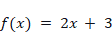
For each input value x, the corresponding output value is obtained by multiplying x by 2 and adding 3.
For example, when x = 2,
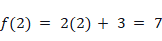
Quadratic Function Example: Suppose we have a quadratic function 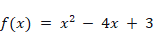
By substituting different values of x, we can calculate the corresponding output values.
For x = 2,
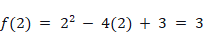
Exponential Function Example: Consider an exponential function f(x) =  .
.
When x = 3,
f(3) = 23 = 8.
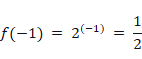
Similarly, for x = -1,
Solved Examples
Example 1: Consider the linear function f(x) = 2x + 3. Find the value of f(4).
Answer: The value of f(4) is 11.
Solution: To find the value of f(4), we substitute x = 4 into the given function:
f(4) = 2(4) + 3
= 8 + 3
= 11
Example 2: Find its roots in the quadratic equation f(x) = x² - 4x + 3.
Answer: The roots of the quadratic equation f(x) = x² - 4x + 3 are x = 3 and x = 1.
Solution: To find the roots of the quadratic equation f(x) = x² - 4x + 3,
We set the equation equal to zero:
x² - 4x + 3 = 0
Next, we factorize the quadratic equation:
(x - 3)(x - 1) = 0
Setting each factor equal to zero, we have:
x - 3 = 0 --> x = 3
x - 1 = 0 --> x = 1
Example 3: Evaluate the exponential function f(x) = 2x when x = 3.
Answer: The value of f(3) is 8.
Solution: To evaluate the exponential function f(x) = 2x when x = 3,
We substitute x = 3 into the given function:
f(3) = 23
=
= 8
Did You Know?
Did you know that functions were first introduced in ancient Greece? Along with magnitudes and ratios, the Greek mathematician Euclid introduced functions. With the help of mathematicians like Descartes and Fermat, the modern formalization process started in the 17th century.
Did you know that functions can have more than one input and output? Multivariable or vector-valued functions are mathematical functions that can accept numerous inputs and produce several outputs. They simulate complicated systems in physics, engineering, and computer science.
Did you know that functions are more than just numbers? Functions can perform operations on a variety of mathematical objects. In set theory, for example, functions can translate input sets into output sets. Functions in programming can interact with strings, arrays, and other data structures. Functions have many uses in mathematics and computer science.
Practice Problems:
Which of the following is the value of f(x) = 3x + 2 when x = 4?
a) 10
b) 14
c) 16
d) 20
Answer: b) 14
Explanation: Substitute x = 4 into the given function:
f(4) = 3(4) + 2 = 14
Q2. The roots of the quadratic equation f(x) = x² - 5x + 6 are:
a) x = 2, x = 3
b) x = -2, x = -3
c) x = 2, x = -3
d) x = -2, x = 3
Answer: a) x = 2, x = 3
Explanation: Solve the quadratic equation by factoring:
f(x) = x² - 5x + 6 = 0
(x - 2)(x - 3) = 0
Setting each factor equal to zero, we find:
x - 2 = 0 --> x = 2
x - 3 = 0 --> x = 3
Q3. What is the value of f(x) = 5x when x = 2?
a) 10
b) 15
c) 20
d) 25
Answer: d) 25
Explanation: Substitute x = 2 into the given function:
f(2) = 52 = 25
Frequently Asked Questions:
Q1: What distinguishes a quadratic function from a linear function?
Answer: When graphed, linear functions have a degree of one and result in a straight line. When graphed, quadratic functions have a degree of two and have the shape of a parabolic curve.
Q2: What are some instances of exponential functions in the real world?
Answer: Population expansion, compound interest, radioactive decay, and the spread of illnesses are examples of exponential functions.
Q3: What physics applications exist for trigonometric functions?
Answer: In physics, trigonometric functions are used to explain the motion of objects, compute forces and velocities, and represent waveforms.

 Call Now
 Let's Chat
 Share
Share