-
Call Now
1800-102-2727


Distance Between Two Parallel Lines: Definition, Properties, and Examples

The idea of the distance between two parallel lines is extremely important in mathematics and has many practical applications. Knowing this distance helps us to understand the links between parallel lines and their application in real-world circumstances. Calculating the distance between parallel lines is essential whether one wants to determine the minimum distance between two railway tracks, the best site for buildings in building construction, or the most effective cable routing in electrical engineering.
Table of Contents
- What are parallel lines?
- Properties of parallel lines
- How to find the distance between two parallel lines?
- Practice Problems
- FAQs
What are Parallel Lines?
Parallel lines are a fundamental geometric notion. Parallel lines on a plane are those that never intersect, regardless of their length. They keep a steady spacing between each other during their whole length. Parallel lines are shown with an arrow sign () or by putting "||" next to them.
Properties of Parallel Lines
Parallel lines have various distinguishing characteristics that are useful in their identification and successful application:
1. Never intersect: The most important attribute of parallel lines is that they never intersect, no matter how far they reach. This separates them from other kinds of lines.
2. Equal slopes: Parallel lines have the same slope, suggesting that they have the same inclination or steepness. By comparing the slopes of two lines, we may determine if they are parallel.
3. Corresponding angles: Many similar angles are created when a transversal line joins parallel lines. These angles have identical measurements, linking crossing lines' angles.
How to Find the Distance Between Two Parallel Lines
Determining the distance between two parallel lines necessitates a grasp of parallel line attributes and equations. The steps below illustrate a general method for calculating the distance:
1. The first step in finding the distance between parallel lines is identifying their equations. Express the equations of the given lines as y=mx+c, where m is the slope and c is the y-intercept. This form facilitates comparison and calculation.
2. Subtract the y-intercepts of the two lines to find the difference in y-intercepts. This calculation yields the vertical distance between the parallel lines, which remains constant throughout their length.
3. Divide the difference in y-intercepts by the square root of the sum of the squares of the parallel lines' slopes to get the perpendicular distance between them. This division produces the perpendicular distance, which provides information about the distance between the lines.
By following these procedures, we may precisely calculate the distance between parallel lines and acquire a better grasp of their connection and location.
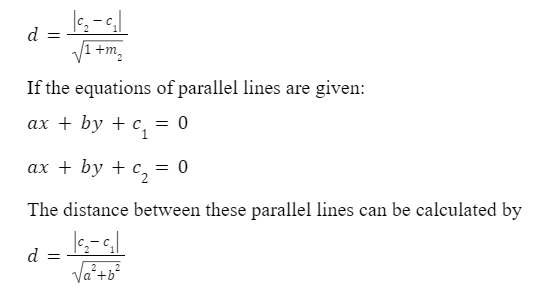
Formula to Calculate Distance Between Two Parallel Lines
The slope intercept for lines is given as:

The distance between can be calculated by
Practice Problems
Q1. The perpendicular distance between two parallel lines is measured using which of the following
a. One of the parallel lines
b. Both parallel lines
c. The line segment connects two points on the parallel lines
d. The x-axis
Answer: c. The line segment connecting two points on the parallel lines
The distance between two parallel lines can be calculated by using the equation of these lines or the slope-intercept of these lines passing through a point.
Q2. Which of the following assertions concerning the distance between two parallel lines is correct?
a. It is always positive
b. It can be negative
c. It is zero
d. It depends on the slope of the lines
Answer: a. It is always positive
The distance between two parallel lines can not be negative. 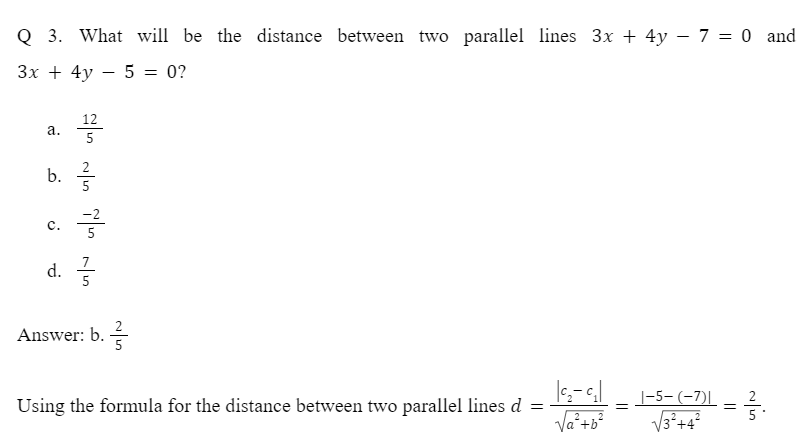
FAQs
Q1. Can parallel lines have y-intercepts that different?
Ans. No, parallel lines cannot have different y-intercepts. As their slopes are the same, so are their y-intercepts. The distance between two parallel lines is determined by the difference in their y-intercepts, which is a constant. This feature of parallel lines is constant and helps identify a set of parallel lines.
Q2. What are the practical applications of the distance between two parallel lines?
Ans. The distance between two parallel lines has several applications across industries, making it an important topic of study. Architects, in particular, rely heavily on the concept of parallel lines for the design processes. Parallel lines are used by architects when designing structures like highways, buildings, and bridges to maintain alignment and symmetry.
Q3. Can a set of parallel lines have slopes that differ in value?
Ans. No, two parallel lines cannot have different slopes. Parallel lines are different from another set of lines because their slopes are the same. This indicates that they have the same inclination, which makes them parallel to each other. Two lines that will differ in the same can never be parallel.

 Call Now
 Let's Chat
 Share
Share