-
Call Now
1800-102-2727


Direct and Inverse Variations

You must have seen a water tank in your house, and many times, you have also filled it with water. Have you noticed that when you turn on the pump (or borewell, as some may call it), the amount of water in the tank increases, but when you are using water from the tank, the amount of water decreases? You see, this is an example of Direct and Inverse Variations.
Table of Contents:
- What is Direct Variation?
- Applications of Direct Variations
- What is Inverse variation?
- Applications of Inverse Variations
- Solved Problems
- Frequently Asked Questions
What is Direct Variation?
In the above example, where we are filling the tank with water using a pump, the amount of water increases in the tank. This is an example of Direct Variation. The amount of water in the tank is in Direct variation with the water entering through the pump.
When the ratio of two variables gives a constant number, we call the relation between the two variables a Direct Variation.
In other words, if we have two variables, then a direct variation arises when, with the increase of one variable, there is a corresponding increase in the other variable. Similarly, a decrease in one variable causes a corresponding decrease in the other variable.
Suppose that we have two variables, x and y. By direct variation, we represent their relationship as:
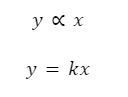
Where k is a constant value.
We represent it graphically, as shown below:
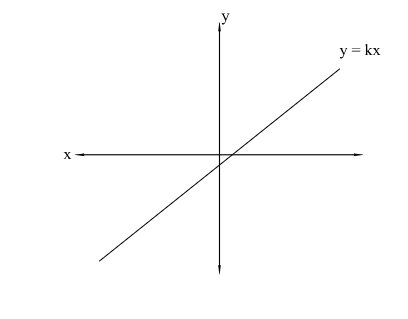
Often, we use the word proportional or variation without the word direct. In the end, they mean the same thing.
Applications of Direct Variations
In our day-to-day lives, we often notice variations in the values of multiple quantities depending on the variations in the values of other quantities.
Some applications of direct variations in our day-to-day lives are given below-
- The amount of heat transferred is directly proportional to the temperature change.
- The marks obtained by a student are directly proportional to the hard work he or she has done.
- The distance covered by a car is directly proportional to its speed.
- The acceleration produced by a car is directly proportional to the change in its velocity.
- The cost of vegetables is directly proportional to their weight or even their freshness.
What is Inverse Variation?
We started with an example where we started that when we use water from the water tank, the amount of water in it decreases. This is an example of Inverse Variation.
When the value of one quantity increases and causes a parallel decrease in the value of another quantity, we call it Inverse Variation.
In simple words, Inverse Variation means that two quantities behave oppositely to each other.
Suppose that we have two variables, x and y. Mathematically, we represent the inverse relation between these two as:


We represent it graphically, as shown below:
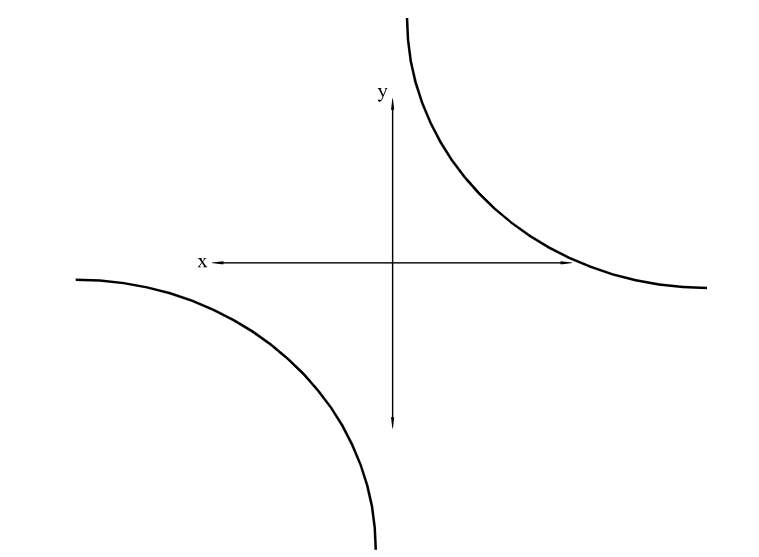
Applications of Inverse Variations
- The number of days required to complete the work is inversely proportional to savings.
- The acceleration is inversely proportional to time.
- The acceleration of a body is inversely proportional to its weight.
- The battery power is inversely proportional to its usage time.
- The number of mistakes in work is inversely proportional to practice.
Solved Problems
Q1. The fuel consumption of a bike is 25 litres of petrol per 90 km. What distance can the car cover with 5 litres of petrol?
Solution:
25 litres of fuel is consumed to cover a distance of 90 km.
1 litre of fuel is consumed to cover a distance of  km.
km.
5 litres of fuel is consumed to cover a distance of  km.
km.
Q2. Hema types 500 words for half an hour. How many words can she type in 6 minutes?
Solution:
In 30 minutes, she can type 500 words
In 1 minute, she can type  words.
In 6 minutes, she can type 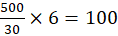 words.
Q3. If 50 metres of cloth costs ₹5000, how many metres can be bought for ₹1758?
Solution:
For ₹5000, we can buy 50 metres of cloth.
In ₹1, we can buy  metres of cloth
In ₹1758, we can buy 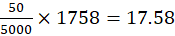 metres of clothing.
Frequently Asked Questions
Q1. How is an inverse variation used in real life?
Answer: There are many real-life examples of inverse variation. For example-
1. The acceleration of the body is inversely proportional to the weight of the body.
2. The battery power is inversely proportional to the time for which it is used.
3. The number of mistakes in work is inversely proportional to practice.
Q2. What is direct variation important for?
Answer: Direct variation can be beneficial for knowing relationships in which one variable grows or decreases proportionally to another.
Q3. What are the uses of inverse variation?
Answer: Inverse variation can be used to look into relationships in which one variable rises while the other declines correspondingly. It is used in physics, finance, and science.

 Call Now
 Let's Chat
 Share
Share