-
Call Now
1800-102-2727


Adjoint and Inverse of a Matrix

Adjoint and Inverse of a Matrix
Imagine you are given a complex problem requiring solving a linear equation system. How can you efficiently tackle this challenge? The answer lies in matrices and their transformative properties. In this article, we will explore the fundamental concepts of the adjoint and inverse of a matrix, which play crucial roles in matrix algebra. Let's dive into the world of matrices and discover their remarkable capabilities.
Table of Contents:
- What is a Matrix?
- What is the Adjoint of a Matrix?
- What is the Inverse of a Matrix?
- Types of Matrices
- Did You Know?
- Frequently Asked Questions
- Practice Problems
What is a Matrix?
A matrix is a rectangular array of numbers or symbols arranged in rows and columns. It is a fundamental mathematical tool used to represent and solve systems of linear equations, transform geometric shapes, and perform various operations in diverse fields such as physics, computer science, and economics. Matrices provide a concise and efficient way to manipulate data and perform calculations in linear algebra.
What is the Adjoint of a Matrix?
The adjoint of a matrix is a fundamental concept in matrix algebra. For a square matrix, the adjoint is obtained by taking the transpose of its cofactor matrix. Each element of the adjoint matrix is the corresponding cofactor of the original matrix, obtained by applying a specific formula. The adjoint matrix holds significant importance in various matrix operations, including finding the inverse of a matrix.
What is the Inverse of a Matrix?
The inverse of a matrix is a special matrix that, when multiplied by the original matrix, yields the identity matrix. In other words, if A is a square matrix and A-1is its inverse, then A A-1 = I, where I represent the identity matrix. The inverse of a matrix allows us to solve linear equations, perform division in matrix operations, and establish relationships between different variables in a system.
Types of Matrices
Square Matrix: A matrix in which the number of rows equals the number of columns.
Rectangular Matrix: A matrix in which the number of rows is not equal to the number of columns.
Diagonal Matrix: A square matrix in which all the elements outside the main diagonal are zero.
Identity Matrix: A square matrix in which all the elements on the main diagonal are ones, and all other elements are zeros.
Upper Triangular Matrix: A square matrix in which all the elements below the main diagonal are zeros.
Lower Triangular Matrix: A square matrix in which all the elements above the main diagonal are zeros.
Symmetric Matrix: A square matrix that remains unchanged when transposed (the elements across the main diagonal are the same).
Skew-Symmetric Matrix: A square matrix in which the elements change sign when transposed (the elements across the main diagonal negate each other).
Zero Matrix: A matrix in which all the elements are zeros.
Scalar Matrix: A diagonal matrix with all diagonal elements equal.
Hermitian Matrix: A square matrix that is equal to its conjugate transpose.
Unitary Matrix: A square matrix in which the product of the matrix and its conjugate transpose is the identity matrix.
These different matrices possess unique characteristics that make them useful for various mathematical operations and applications in diverse fields.
Did You Know?
|
Frequently Asked Questions:
Q1. Can every matrix have an inverse?
Answer: No, not every matrix has an inverse. Only non-singular square matrices, meaning their determinant is nonzero, have an inverse. If a matrix is singular, it does not have an inverse.
Q2. How do you calculate the adjoint of a matrix?
Answer: To calculate the adjoint of a matrix, follow these steps:
- Find the cofactor matrix of the original matrix.
- Take the transpose of the cofactor matrix to obtain the adjoint matrix.
- Each element of the adjoint matrix is the corresponding cofactor of the original matrix.
Q3. Are the adjoint and inverse of a matrix always the same?
Answer:No, the adjoint and inverse of a matrix are not always the same. The adjoint of a matrix is obtained by taking the transpose of its cofactor matrix. In contrast, the inverse of a matrix is a matrix that, when multiplied by the original matrix, yields the identity matrix. Although the adjoint and inverse of a matrix are related, they are different concepts.
Practice Problems:
Q1: What is the adjoint of the matrix B = [[2, 1], [4, 3]]?
a) [[2, 1], [4, 3]]
b) [[3, -1], [-4, 2]]
c) [[3, -2], [-4, 2]]
d) [[2, -1], [-4, 3]]
Answer: c) [[3, -2], [-4, 2]]
Explanation: To obtain a matrix's adjoint, first compute the cofactor matrix and then take its transpose. B's cofactor matrix is [[3, -2], [-4, 2]. Taking the cofactor matrix's transpose yields the adjoint, which is [[3, -2], [-4, 2]].
Q2: Determine the invertibility of the matrix C = [[5, 7], [2, 3]]. Find its inverse if it is.
a) C has an invertible inverse [[-3, 7], [2, -5]].
b) C cannot be inverted.
c) C has an invertible inverse [[-5, 7], [2, -3]].
d) C is invertible, with the inverse being [[3, -7], [-2, 5]].
Answer: b) C cannot be inverted.
Explanation: To find out if a matrix is invertible, we must look at its determinant. The determinant of matrix C in this example is 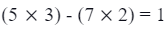 , which is not equal to zero. As a result, matrix C is not invertible.
Q3: Find the inverse of the matrix D = [[-1, 2, -3], [4, -5, 6], [-7, 8, -9]].
- a) [[1, -2, 3], [-4, 5, -6], [7, -8, 9]]
- b) [[1, 2, -3], [-4, -5, 6], [-7, -8, 9]]
- c) [[1, -2, 3], [4, -5, 6], [-7, 8, -9]]
- d) [[1, 2, 3], [4, 5, 6], [7, 8, 9]]
Answer: a) [[1, -2, 3], [-4, 5, -6], [7, -8, 9]]
Explanation: There are several ways for determining the inverse of a matrix, including Gaussian elimination and the adjoint approach. In this situation, the inverse of matrix D is [[1, -2, 3], [-4, 5, -6], [7, -8, 9].

 Call Now
 Let's Chat
 Share
Share