-
Call Now
1800-102-2727


3D Geometry- Types, Properties, Examples

3D Geometry- Types, Properties, Examples
Imagine a world that exists completely on a flat surface. Now, envision a realm where intensity, height, and breadth intertwine to form a multidimensional space. Welcome to the fascinating realm of 3D geometry, wherein shapes and figures exist in 3-dimensions. In this article, we embark on an enlightening journey via the intricacies of 3D geometry, unveiling its ideas, houses, and applications.
Table of Contents:
- What is 3D Geometry?
- Types of 3D Shapes
- Real-Life Examples of 3D Geometry
- Key Properties and Theorems in 3D Geometry
- Frequently Asked Questions
- Practice Problems
What is 3D Geometry?
Studying objects in terms of length, width, and height is known as three-dimensional geometry. It permits us to properly draw close and manage real-world objects by going beyond the standard flat shapes of 2D geometry. 3-D geometry helps us to research and look at the spatial interactions among distinct factors by fusing coordinates, vectors, and equations.
Types of 3-d Shapes
Different shapes come to life in 3-D geometry, each with its own characteristics. Pyramids, cubes, spheres, cylinders, cones, and cylinders are common 3D shapes. Realising these shapes and their homes is critical to resolving and following tough geometry problems in actual-world contexts.
Real-Life Examples of 3D Geometry
Architecture and Construction: Architects require 3-d geometry to construct buildings, bridges, and other systems. They can use geometric concepts to construct visually stunning and structurally sound systems.
Industrial Design: Manufacturers create anything from furniture to motors using 3-d geometry. They can ensure the entirety is in place, practical, and attractive.
Computer Graphics and Animation: The entertainment industry heavily relies on 3-d geometry to create realistic computer-generated imagery (CGI) in movies, video games, and virtual reality stories.
Key Properties and Theorems in 3-D Geometry:
The Pythagorean Theorem is still valid in a 3-dimensional space. This rule states that the square of a right-angled triangle's hypotenuse, the side opposite the right angle, is the same as the sum of the squares of the other two aspects.
Euler's Formula: A polyhedron's faces (F), edges (E), and vertices (V) are all related by Euler's formula. The equation V - E + F = 2 is written down. Prisms, pyramids, and cubes are only a few examples of those polyhedra.
Surface Area: A 3D item's general surface place is the same as the sum of all of its face regions. Numerous formulations are available for estimating the floor place of different forms, including cubes, cylinders, spheres, and cones.
Volume: The quantity of space a three-D object occupies depends on its extent. Similar to those that measure surface region, several equations exist to decide the volume of various forms, including cubes, cylinders, spheres, and prisms.
Geometric Entities: New factors, traces, or shapes may be created via crossing or greater geometric entities, including planes, strains, or paperwork. Understanding these essential 3-D geometrical statistics and theorems lays a foundation for investigating and resolving 3-dimensional area issues.
Frequently Asked Questions:
Q1. What is the significance of 3D geometry in computer graphics?
- 3D geometry is crucial in computer images as it is the muse for developing realism and immersive visual reports. Professionals in laptop images can version and render 3-dimensional gadgets using three-D geometry, simulate lights and shading, and produce convincing animations and computer graphics for movement snap shots, video games, and digital truth settings. It allows the advent of rich digital worlds and characters that immerse viewers in fact.
Q2. How is 3-D geometry utilised in 3-D printing?
- In 3D printing, normally referred to as additive manufacturing, three-D geometry is critical. A computer 3D version is a layer-by-means of layer transformed into a tangible issue in this technique. These models are designed and produced using 3D geometry, which specifies the intended items' precise sizes, forms, and structures. Engineers and designers can nicely depict complex paperwork, minute info, and inner systems using 3D geometry using specialised software, ensuing in genuine and extraordinary 3D-revealed things.
Q3. Can you offer an example of the utility of 3D geometry in engineering?
- The design and analysis of mechanical components and assemblies is one prominent example of how 3D geometry is used in engineering. To generate unique element representations of things like engines or structural components, engineers rent 3D geometry. They might also simulate and look at how those pieces behave below extraordinary situations using 3D geometry concepts, assuring appropriate match, capability, and structural integrity. To efficiently communicate and make picks at some point in the product improvement system, engineers need the help of three-D geometry for visualising and conveying layout standards.
Practice Questions:
Q1. Which formulation may be used to calculate the volume of a cylinder?
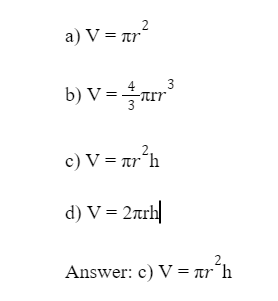
Explanation: The components to calculate the volume of a cylinder are given via V = πr2h, where r is the radius of the bottom, and h is the height of the cylinder.
Q2. Which shape has all its faces as congruent ordinary polygons?
- A) Sphere
- b) Cube
- c) Cone
- d) Cylinder
Answer: b) Cube
Explanation: A dice is a three-dimensional shape with six congruent rectangular faces. Each face of a dice is a regular polygon with the same side lengths and angles.
Q3. What is the surface region of a sphere with a radius of five cm? (Take π ≈ 3.14)
- a) 314 cm2
- b) 628 cm2
- c) 125 cm2
- d) 78.5 cm2
Answer: b) 628 cm2
Explanation: The components to calculate the floor place of a sphere is given with the aid of A = 4πr^2. Substituting the radius (r = 5 cm) into the system, we get A = 4 × 3.14 × 52 = 628 cm2.


 Call Now
 Let's Chat
 Share
Share