-
Call Now
1800-102-2727


Zeolites

Detergents make water softer. Petroleum transforms into useful fuels. All of this is possible with the assistance of a common solution. And that solution is found in zeolites. The crystalline aluminosilicates feature small pores capable of capturing or exchanging ions. Due to their unique structure, zeolites are our “molecular sieves.” Their popular name.
For students, zeolites hold significance as they link concepts of inorganic chemistry, environmental chemistry, and industrial applications. Let’s examine them thoroughly.
What are Zeolites?
These are hydrated aluminosilicates of sodium, potassium, calcium, and barium. The ores are microporous. Their place of natural occurrence is in volcanic rocks. But some also make them synthetically.
They have a 3D crystalline framework with pores of molecular dimensions. The general formula is: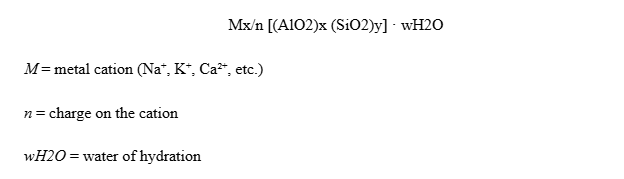
Structure of Zeolites
The mineral is made of SiO4 and AlO4 tetrahedra linked by oxygen atoms. The replacement of Al³⁺ with Si⁴⁺ results in a negative charge.
This charge is countered by cations that can be exchanged, such as Na⁺, K⁺, or Ca²⁺. These cations can enter and exit pores without damaging the structure. Because of this, zeolites act as ion exchangers.
Types of Zeolites
The following are the main types:
- Natural Zeolites
- Found in volcanic rocks and sedimentary deposits.
- Examples: Clinoptilolite, Chabazite, Natrolite.
- Synthetic Zeolites
- Prepared industrially under controlled conditions.
- Examples: Zeolite A, Zeolite X, ZSM-5.
- More uniform pore size and greater stability than natural forms.
Properties of Zeolites
- Microporous structure with uniform pore size.
- High surface area – excellent for catalysis.
- Ion-exchange capacity – useful in softening water.
- Heat resistance – stable at high temperatures.
- Selectivity – can separate molecules based on size and shape.
Functions and Uses of Zeolites
The main function include the following:
1. Water Softening
- Hard water contains Ca²⁺ and Mg²⁺ ions.
- Zeolite replaces them with Na⁺ ions.
- This prevents scaling in pipes and improves soap efficiency.

2. Catalysis
- Employed in the oil sector for breaking down hydrocarbons.
- ZSM-5 transforms linear hydrocarbons into branched and aromatic substances (crucial for high-octane fuels)
3. Molecular Sieves
- Due to their uniform pores, zeolites function as molecular sieves.
- They are able to distinguish gases such as O2, N2, and CO2.
4. Environmental Uses
- Remove heavy metals like Pb²⁺, Cd²⁺ from wastewater.
- Trap radioactive ions in nuclear waste.
5. Detergents and Household Uses
- Synthetic detergents use zeolites to soften water instead of phosphates (eco-friendly).
Zeolites at a Glance
| Feature | Details |
|---|---|
| Nature | Crystalline aluminosilicates |
| Structure | 3D framework of AlO4 and SiO4 tetrahedra |
| General Formula | Mx/n [(AlO2)x (SiO2)y] · wH2O |
| Key Property | Ion-exchange + Molecular sieve |
| Examples | Zeolite A, Zeolite X, ZSM-5 |
| Uses | Softening water, catalysis, detergents, and pollution control |
Summary
These aluminosilicate minerals feature porous structures. They serve as molecular sieves and ion exchangers. Water softening, cleaning agents, catalysis, and environmental management applications. ZSM-5 is essential to the breakdown of petroleum.
Recall: Zeolites = Environmentally friendly + Versatile
Frequently Asked Questions (FAQs)
Q1. Why are zeolites called molecular sieves?
A. The pores present in zeolites are very small. They can allow only molecules of certain sizes to pass. This makes them act like a sieve.
Q2. Which zeolite is used in water softening?
A. Zeolite A (also called Permutit) is used in domestic and industrial softening of water.
Q3. What is the role of ZSM-5 in the petroleum industry?
A. ZSM-5 acts as a catalyst for converting straight-chain hydrocarbons into branched and aromatic hydrocarbons, which improves fuel quality.
Q4. How are zeolites eco-friendly compared to phosphates in detergents?
A. Phosphates cause water pollution (eutrophication). Zeolites replace them in detergents because they are safer for the environment.
Q5. Can zeolites remove radioactive substances?
A. Yes. Zeolites can trap radioactive ions like strontium and caesium from nuclear waste due to their ion-exchange ability.
Q6. Are zeolites naturally occurring or synthetic?
A. They are both. Some occur naturally in volcanic rocks, while many are made synthetically for uniform pore size and industrial uses.


 Call Now
 Let's Chat
 Share
Share