-
Call Now
1800-102-2727


Types of Unit Cells - Definition of Crystal Lattice, Primitive Unit Cell, FCC, BCC, ECC

Have you ever seen any construction of a building? You must have observed that bricks are arranged in a repeating pattern to build the structure of a building. Now imagine a crystalline solid as the building and its smallest portion as a brick. It is very important to study the smallest portion of a crystalline solid as its arrangement determines the overall geometry of the solid and some important properties of solids. This smallest portion is known as the unit cell. So, let’s find out what is crystal, crystal lattice, unit cells, and different types of unit cells.
Table of Content
- Definition of Crystal Lattice
- What is Unit Cell?
- Types of Unit Cell
- Practice problems
- Frequently Asked Questions-FAQ
Definition of Crystal Lattice
A solid material in which the constituent particles (molecules, atoms, or ions) are arranged in an ordered pattern extending in all three spatial dimensions is known as a crystal lattice.

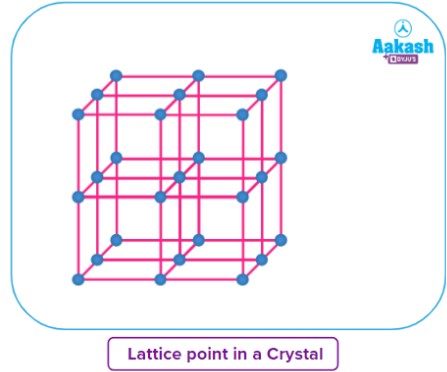
The Centre of an atom/ion/molecule in a crystal is represented by a point/dot (.) known as the lattice point. Lattice points are joined together by a straight line in a crystal lattice. By connecting these straight lines we can get a 3-D view of the structure. This 3-D arrangement is called crystal lattice also known as Bravais lattices. The number of nearest neighbours of a particle in a crystal lattice is known as its coordination number.
What is Unit Cell?
It is the smallest portion of a crystal lattice. Unit cells repeat themselves in three dimensions to
generate the entire crystal lattice. You can consider unit cells as a brick of a building that is arranged together in a 3-D to give the structure of the building.

Parameters of a unit cell
There are six important parameters of a unit cell: three edge lengths (a, b, and c) and three angles (, & ) between edges.
a, b, and c = edge lengths of the unit cell.
a = angle between edges b and c.
b = angle between the edges a and c.
c = angle between the edges b and a.

Types of Unit Cell
Unite cells can be classified as follows:

Primitive Unit Cell
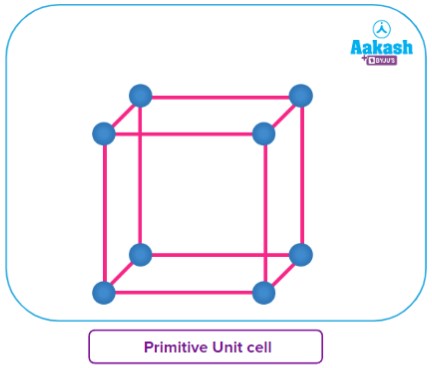
When the constituent particles are present only at the corner positions of a unit cell, it is known as a primitive unit cell. One constituent particle is present at each corner of a primitive unit cell.
Centred unit cell or non-primitive unit cell
When in a unit cell one or more constituent particles are present at positions other than corners (like face centres, body centres etc.) along with the corner particles, then the unit cell is known as a centred unit cell. Three major types of centred unit cells are given as follows:
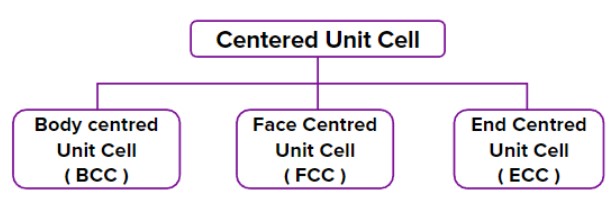
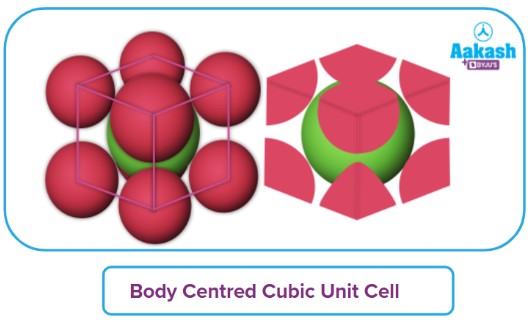
Body-Centred unit cell (BCC)
In BCC, the constituent particles are present at the eight corners of the unit cell and also at the body centre of the unit cell.

Face-Centred unit cell (FCC)
In FCC, constituent particles are present at the eight corners of the unit cell and also at the centre of six faces of the unit cell.

End-Centred unit cell (ECC)
In ECC, constituent particles are present at the eight corners of the unit cell and also at the centre of any two opposite faces of the unit cell.

Recommended Video: Crystal Lattice & Unit Cell
Practice problems
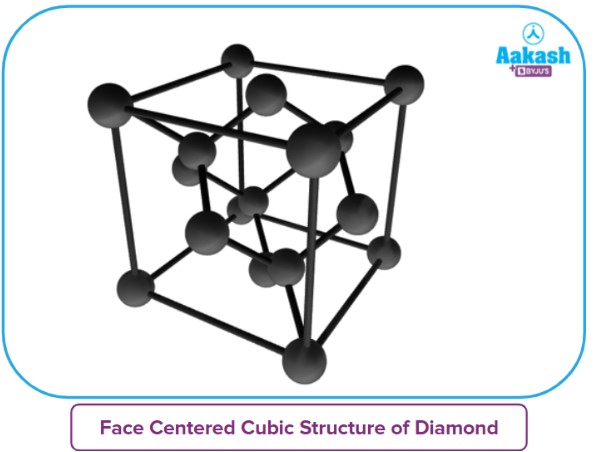
Q 1. Crystal of diamond crystallises in which type of lattice structure?
a. FCC
b. BCC
c. ECC
d. None of the above
Answer: (A)
Solution: Diamond is an allotrope of carbon where one carbon atom is connected to 4 other carbon atoms through covalent bonding. Hence, diamond is a covalent crystalline solid. The hybridization of carbon atoms in diamond is sp3. Each carbon atom is tetrahedrally arranged to form a giant network having FCC arrangement.
Q 2. The lattice in a pure crystal can’t be occupied by:
a. Molecule
b. Ion
c. Electron
d. Atom
Answer: (C)
Electron is a subatomic particle that is present inside the atom. In the case of a pure crystal, all the lattice points are generally occupied by an atom, molecule, or ions.
Q 3. What is the coordination number of atoms in a BCC?
a. 1
b. 8
c. 2
d. 4
Answer: (B)
The coordination number of an atom in a crystal is the number of constituent particles which are the immediate neighbours of that atom in a crystal. The coordination number of an atom in BCC is 8.
Q 4. Which of the parallelograms in the figure given below can be taken as unit cells?

a. Only A
b. A, B and C
c. A and D
d. A, D and E
Answer: (D)
A unit cell is the basic repeating structure of any solid, when they are repeated it forms a crystal lattice.
In the case of ‘A’ when repeated can form the crystal lattice.
In the case of ‘B’ when repeated can not form the crystal lattice as atoms are outside the unit cell.
In the case of ‘C’ when repeated can not form the crystal lattice as atoms are entirely inside the unit cell. If we repeat this unit cell, the structure which we will get is different from the original one.
In the case of ‘D’ when repeated can form the crystal lattice as it contains only one atom inside so it will form the proper crystal structure.
In the case of ‘E’ when repeated can form the crystal lattice as ‘E’ unit cell is just a lateral shape of ‘A’.
Frequently Asked Questions-FAQ
Q 1. State the difference between crystal lattice and unit cell.
Answer:
|
Crystal Lattice |
Unit Cell |
|
Crystal Lattice can be defined as the three-dimensional geometrical arrangement of constituent particles in a solid. |
It is the smallest repeating portion of a crystal, which is arranged in a repeated pattern to form a crystal structure or crystal lattice. |
Q 2. Do all solids form crystal lattices?
Answer: No, crystalline solids have long-range order whereas in the case of amorphous solids the arrangement of particles has a short-range order. Hence, the crystal lattice is only found in crystalline solids.
Q 3. Are the space lattice and unit cell the same?
Answer: No, space lattice is the three-dimensional arrangement of crystals that are constituted by unit cells. In other words, we can say that unit cells arrange themselves in a repeating pattern to create a space lattice.
Q 4. What exactly is the lattice point in a crystal structure?
Answer: In simple words lattice points are coordinates or positions where the particle resides. These lattice points are arranged in an ordered fashion to give a lattice structure.
Related Topics
|
Types of solids |
Crystalline solids |
|
Crystal defects |
Crystal systems & Bravais Lattice |
|
Contribution of Atoms in a Unit Cell |
Voids |

 Call Now
 Let's Chat
 Share
Share