-
Call Now
1800-102-2727


Sulphuric Acid (H2SO4) - Preparation, Properties, Uses, Practice Problems and FAQ

Would you like to pay a visit to our neighbouring planet, Mr. Venus?
Interestingly, it is one of the brightest objects in the sky. It can always be found in close proximity to the Sun. It has the nicknames "Morning Star" and "Evening Star" because it rises and sets every day! According to scientists, Venus rotates backwards. This indicates that the Sun rises in the west and sets in the east on Venus.
But, before you say yes or no, let me provide you with some additional information about Mr. Venus' atmosphere. The atmosphere of Venus is entirely covered by carbon dioxide and thick white clouds of sulphuric acid. You wouldn't survive a trip to the planet's surface because you wouldn't be able to breathe the air. You'd be crushed by the massive weight of the atmosphere. And you'd burn up in temperatures hot enough to melt lead.
So let’s stay back for now until we find a safer way to go on a space trip, and take a closer look at what this ‘sulphuric acid’ really is and how it affects our lives on earth, with its inherent features. This would help us better understand sulphuric acid- the principal protector of Venus, closely monitoring and preventing invaders from entering the planet!
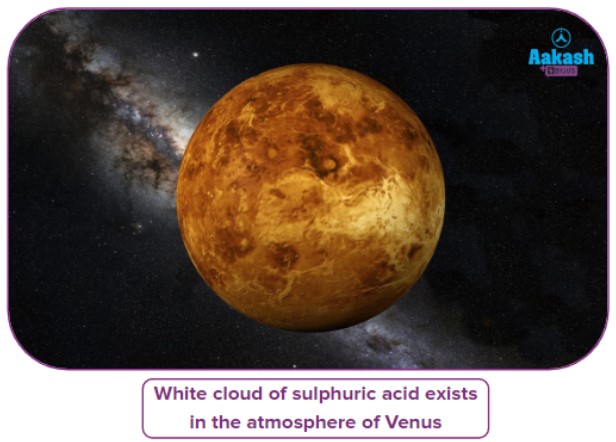
TABLE OF CONTENTS
- Sulphuric Acid - Introduction
- Structure
- Preparation - Contact Process
- Physical Properties
- Chemical properties
- Uses
- Practice Problems
- Frequently Asked Questions - FAQ
Sulphuric Acid - Introduction
Sulphur forms a number of oxoacids such as H2SO3, H2SO4, H2S2O7 and H2S2O8 etc. Some of these acids are unstable and cannot be isolated. Sulphuric acid is the most important and widely used oxoacid of sulphur.
Sulphuric acid (H2SO4) is a colourless, thick, corrosive, and oily liquid that is also known as hydrogen sulphate or oil of vitriol. Because it is manufactured in such huge amounts all over the world, sulphuric acid is referred to as the "king of chemicals."
It was discovered in the 8th century by Jabir ibn Hayyan. The usage of sulphuric acid per capita has been used as a measure of a country's technological progress. The world's largest producer, the USA, produces well over 39 billion kg each year. It is the most cost-effective acid in quantity.
Hydrogen sulphate, is generated industrially by reacting water with SO3, which is made by combining sulphur dioxide and oxygen in a chemical reaction called the contact or chamber process. Consumption of sulphuric acid is often used to monitor a country's degree of industrialization.
Structure
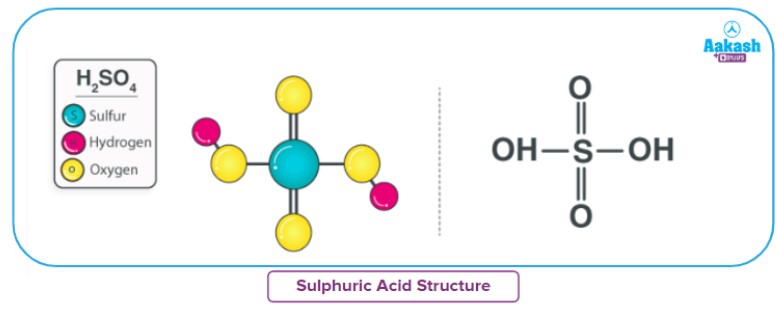
Sulphuric acid is a sulphur oxoacid that consists of two oxo and two hydroxyl groups joined covalently to a central sulphur atom. It is a tetrahedral molecule with sulphur at the centre. Sulphur is present in its highest oxidation state i.e., +6 in sulphuric acid. It is a diprotic acid as it can give two hydronium ions on dissociation. Therefore it’s n-factor is 2.
H2SO4 ⇌ 2H+ +SO42-
Preparation - Contact Process
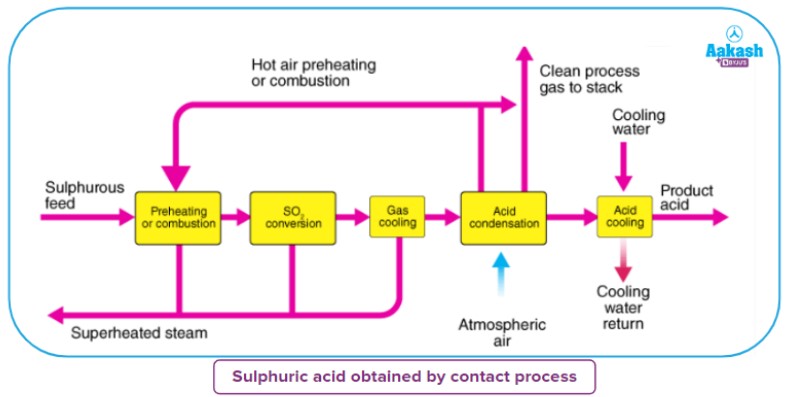
Step 1: Preparation of Sulphur Dioxide
SO2 is prepared by burning sulphur or sulphide ores in the presence of excess air so that the product combines with oxygen, which is helpful for the next stage.
S(s) + O2 (g) → SO2(g)
Step 2: Preparation of Sulphur Trioxide
Sulphur trioxide is formed when sulphur dioxide reacts with oxygen in a ratio of 1:1 at a temperature of 400 – 450°C and a pressure of 1-2 atm in the presence of V2O5 as a catalyst. This reaction is reversible and exothermic in nature. Low temperatures (not too low) and high pressure are the favourable conditions for maximum yield.

Step 3: Preparation of Concentrated Sulphuric Acid
The SO3 formed is first made to react with concentrated sulphuric acid. Sulphur trioxide cannot be dissolved in water directly as it leads to the formation of fog. The product obtained after SO3 reacts with conc. Sulphuric acid is known as oleum. The oleum obtained is then dissolved in water to obtain concentrated sulphuric acid.
conc. H2SO4 + SO3(g) → H2S2O7(l) [Oleum]
H2S2O7(l) +H2O(l) → 2H2SO4
The sulphuric acid obtained by contact process is 96–98% pure
Physical Properties
- Sulphuric acid is a colourless, viscous (dense), oily liquid.
- The molar mass of H2SO4 is 98.079 g/mol-1 and the equivalent mass is half of the molar mass since its n-factor is 2 due to the presence of two replaceable hydrogen ions.
- The density of sulphuric acid is 1.84 g/cm3.
- Its boiling point is 337 °C and its melting point is 10 °C.
- Anhydrous sulphuric acid has a dielectric constant of around 100 and is a very polar liquid. It is perhaps the most important heavy industrial chemical, with large-scale uses in a wide range of industries.
- It undergoes intermolecular hydrogen bonding.
- It has a high boiling point (337˚C), and this is because of intermolecular hydrogen bonding, which increases the force of attraction between the molecules.
- It is acidic. 33.5% Sulphuric acid (H2SO4) has a pH of 0.5, which is the same as the sulphuric acid used in lead-acid batteries.
- It turns blue litmus red.
- It results in a constant boiling mixture. The combination contains 97.3% acid and boils at. As a result, boiling cannot concentrate aqueous sulphuric acid beyond 97.3%.
- In damp air, it produces a lot of fumes.
- It causes severe burns when it comes into contact with the skin.
Chemical Properties
- Due to its strong affinity for water vapour, pure sulphuric acid does not exist naturally on Earth. As a result, it is hygroscopic and readily absorbs water vapour from the air. Because it is an oxidant with strong dehydrating properties, concentrated sulphuric acid is extremely corrosive to other materials, such as rocks and metals.
- Sulphuric acid is strongly acidic. It ionises in two steps.
H2SO4 (aq) + H2O (𝓁) ⇌ H3O+ (aq) + HSO4-(aq) Ka1= very large (K> 10)
HSO4- (aq) + H2O (𝓁) ⇌ H3O+ (aq) + SO42- (aq) Ka2= 1.2 × 10⁻²
- The larger value of Ka1 means that H2SO4 is largely dissociated into H+ and HSO4- ions. Greater dissociation constant means stronger acid.
- Sulphuric acid forms two series of salts, normal salts like sodium sulphate and copper sulphate and acidic salts like sodium hydrogen sulphate.
- Hot conc.H2SO4 is a moderately strong oxidising agent. It can oxidise both metals and non-metals, with itself getting reduced to SO2.
Cu (s) + 2H2SO4 (conc.) CuSO4(aq) + SO2(g) + 2H2O (aq)
S (s)+ 2H2SO4 (conc.) 3SO2(g) + 2H2O (aq)
C(s) + 2H2SO4 (conc.) CO2(g) + 2SO2(g) + 2H2O (aq)
- Sulphuric acid has hygroscopic properties, meaning it can absorb and retain moisture from its surroundings. This property makes it an effective dehydrating agent because it can absorb and retain moisture from the environment, keeping it dry.
- Sulphuric acid has a sulfonating action on various organic compounds. Sulphonic acids are formed when concentrated sulphuric acid reacts with a variety of organic molecules, such as benzene, toluene, and others. Benzene and its derivatives undergo electrophilic aromatic substitution on reacting with sulphuric acid, to produce sulphonic acids.
C6H6+H2SO4 → C6H5SO3H+H2O
- It is capable of forming insoluble sulphates that can be precipitated out. For example, when used with aqueous solutions of barium and lead, it produces insoluble sulphates that precipitate.
H2SO4 (dil.)+BaCl2 (aq)→BaSO4 (s)↓+2HCl (aq)
- Sulphuric acid is known to exhibit charring action. Sulphuric acid removes hydrogen and oxygen from carbohydrates and sugar, and all that is left is carbon, which resembles burnt sugar and is brown in colour. This is known as the charring action of sulphuric acid.

Uses
- Sulphuric acid is a very useful industrial chemical, and its manufacturing is a strong indication of a country's industrial strength.
- H2SO4 is mostly utilised in the "wet method" for producing phosphoric acid. Phosphoric acid (H3PO4) is utilised in the production of phosphate fertiliser. This process utilises phosphate rock, and about 10 crore tonnes are processed each year.
- The steel and iron industries use sulphuric acid in huge amounts to remove rust and oxidation before selling them to the automotive and big appliance industries.
- It's the most common acid catalyst for converting cyclohexanone oxime to caprolactam, which is used to make nylon.
- It is used to make hydrochloric acid (HCl) through the Mannheim process.
- H2SO4 is widely employed in petroleum refining, for example, as a catalyst in the reaction of isobutane with isobutylene to produce isooctane, a chemical that boosts gasoline's (petrol) octane rating.
- In industrial processes, sulphuric acid is commonly utilised as a dehydrating or oxidising agent.
- Acidic drain cleaners, which are used to remove hair, oil, tissue paper, and other materials, typically include high concentrations of sulphuric acid.
- It has huge applications in metallurgy. Example: For cleaning metals before enamelling, electroplating, and galvanising.
- It has vivid utility in the leather industry, in detergent manufacturing, in the oil and gas sectors.
- It is the most important laboratory reagent for research and development.
- Before harvesting, potato farmers hire specialists to spray their fields, usually with the sulphuric acid solution, causing the green tips to die back and blacken within a day or two. This allows the stems to dry out and avoid being tangled in the harvesting equipment.
- Chemotherapy medicines are used to treat cancers of various sorts. Because cancer cells are more vulnerable to DNA damage than normal cells, cancer cells are killed by the destruction of their DNA during chemotherapy. Alkylation of DNA is the term for this process, and alkylating antineoplastic medicines are the drugs employed. H2SO4 is utilised in the production of these medicines.
Practice Problems
Q 1. What is the importance of sulphuric acid in the chemical industry?
Answer: Sulphuric acid is used in the chemical industry to make a variety of organic chemicals, including organic acids like nitric acid and hydrochloric acid, as well as sulphur-containing salts and other compounds. Sulphuric acid is also used in the production of highly effective alkylating agents such as dimethyl sulphate and a variety of other sulphuric acid esters and diesters. These alkylating agents are also used in a variety of chemical synthesis reactions and in the induction of chemical mutagenesis.
Q 2. What is the role of H2SO4 in colour and pigment sector?
Answer: Sulphuric acid is one of the ingredients needed to make explosives. TATP (Triacetone triperoxide) is an explosive made from the basic raw materials hydrogen peroxide, acetone, and sulphuric acid.
Sulphuric acid has numerous applications in the pharmaceutical industry. It is used as a solvent in the chemical synthesis of a wide range of chemicals, including active pharmaceutical ingredients.
Q 3. Sulphuric acid is readily soluble in:
a. Hexane
b. Benzene
c. Ethanol
d. Water
Answer: Sulphuric acid has a strong affinity for water. It is so hygroscopic that it absorbs even water vapour from the atmosphere. So, option D) is the correct answer.
Q 4. Oleum is obtained by:
a. Distilling conc.H2SO4
b. Mixing SO2 with conc.H2SO4
c. Mixing SO3 with conc.H2SO4
d. None of the above
Answer: The SO3 formed from SO2 in the second step of the Contact process is made to react with concentrated sulphuric acid. Sulphur trioxide cannot be dissolved in water directly as it leads to the formation of fog. The product obtained after this reaction is known as oleum.
conc. H2SO4 + SO3(g) → H2S2O7(l) [Oleum]
Frequently Asked Questions - FAQ
Q 1. Is sulphuric acid dangerous?
Answer: Hydrogen sulphate is a corrosive compound that is harmful to the skin, eyes, teeth, and lungs. Severe exposure to H2SO4 can even cause death. Hydrogen sulphate exposure can cause damage to workers. The extent of exposure is determined by the dose, duration, and type of job performed.
Q 2. Why is acid rain harmful?
Answer: Most ponds and lakes would have a value of pH about 6.5 if pollution and acid rain were not present. However, acid rain has caused numerous ponds and lakes in the northeast USA and elsewhere to have much lower pH values. Furthermore, aluminium discharged into the soil ultimately finds its way into ponds and lakes. This rise in aluminium levels and acidity can be dangerous for aquatic animals.
Q 3. Why should we not dilute sulphuric acid by pouring water into the acid?
Answer: When diluting an acid, it is preferable to add the acid to water instead of the water to the acid. Since adding water to a concentrated acid is exothermic, as it releases a large amount of heat, it can cause an explosion, and acid may spurt and cause burns on the skin, clothing, and other body parts. As a result, adding acid to water is safe, but adding water to acid is not.
Q 4. Is phosphorus pentoxide more dehydrating than sulphuric acid?
Answer: Yes, it is more dehydrating because it can dehydrate sulphuric acid by removing a water molecule and produce SO3.
P4O10 (s)+6H2SO44(aq) 4H3PO4(aq) + 6SO3(g)
Related Topics
|
Compounds of Boron |
Potassium |
|
Electronegativity |
Alkali Metals |
|
Modern Periodic Table |
Sodium Chloride |

 Call Now
 Let's Chat
 Share
Share