-
Call Now
1800-102-2727


Successive Electron Gain Enthalpy - General Trends, Practice Problems, FAQ

If you were given the task of eating your favourite pizza to your heart's content, how many do you think you could eat in one sitting?
Is it really only one pizza? Two? Three? Or maybe even more?
However, you must come to a complete halt when you are beyond full and your capacity is totally filled!
So is the case with atoms too! They can sometimes accept electrons or be made to accept electrons, more than one. Now, each time an atom accepts an electron, it loses or gains some energy. For multiple electron gain, each electron gaining step is associated with some energy change which is termed electron gain enthalpy. This is of great use in determining the atom's nature, stability, valence electron count, reactivity etc.
TABLE OF CONTENTS
- Successive Electron Gain Enthalpies
- General Trends in Electron Gain Enthalpy
- Practice Problems
- Frequently Asked Questions - FAQ
Successive Electron Gain Enthalpies
- Successive electron gain enthalpy is defined as the enthalpy change associated with the successive steps, when an anion (formed initially from a neutral gaseous atom upon accepting electrons), further accepts electrons to form a polyanionic species.
- If an anion, for example, accepts another electron to form a di-negative anion, the enthalpy change associated with that step is called the second electron gain enthalpy.
- The enthalpy change for the addition of a second electron to an initially neutral atom is invariably positive because electronic repulsion outweighs the nuclear attraction.
- The second and the subsequent electron gain enthalpies are always positive.
Example I: When an electron is added to the sulphur atom to form S- ion, it releases energy whereas energy is required when another electron is added to S- ion to form S2- ion.
First electron gain enthalpy: This corresponds to the energy change involved in gaining one electron by an isolated neutral gaseous atom.
S + e- → S- (g) (∆egH = -200 kJ mol-1)
(energy is released)
Second electron gain enthalpy: This corresponds to the energy change involved in gaining one electron by a monovalent gaseous anion.
S- (g) + e- →S- (g) (∆egH = +590 kJ mol-1)
(energy is absorbed)
Example II: When an electron is added to the oxygen atom to form O- ion, it releases energy whereas energy is required when another electron is added to O- ion to form O2- ion.
First electron gain enthalpy:
O (g) + e- → O- (g) (∆egH = -142 kJ mol-1)
(energy is released)
Second electron gain enthalpy:
O-(g) + e- →O2-(g) (∆egH =+844 kJ mol-1)
(energy is absorbed)
General Trends in Electron Gain Enthalpy
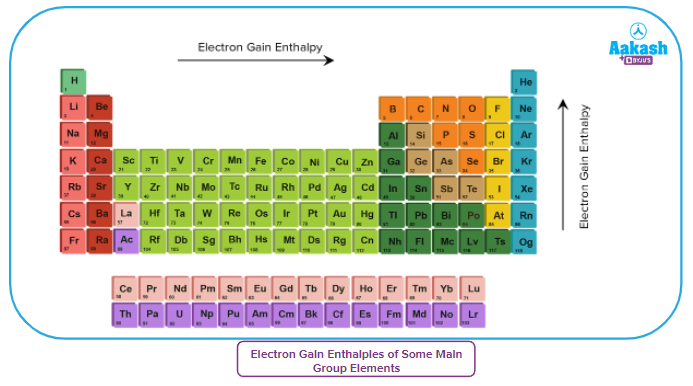
- In general, the electron gain enthalpy becomes more negative on moving from left to right in a period with the increase in atomic number, while it becomes less negative on moving down the group.
- This is because of the increased effective nuclear charge on moving left to right of a period. Therefore it is easier to add an electron to a smaller atom.
- Effective nuclear charge is defined as the actual amount of positive (nuclear) charge experienced by an electron in a multi-electron atom.
- As we move down a group, ∆eg H becomes less negative due to the increase in atomic size.
- Also, the added electron would be at a larger distance from the nucleus.
Practice Problems
Q1. For which set of elements in a group, electron gain enthalpy values are positive?
Answer: Electron gain enthalpy values are positive for the following:
- Inert gas elements (octet complete)
- Alkaline earth metals (exceptionally high for Be and Mg) due to fully filled s- orbitals and hence have no tendency to accept an additional electron
- Nitrogen (half-filled outermost orbital)
This is due to the stability of half and fully-filled orbital making it have positive electron gain enthalpy.
Q2. Will the second electron gain enthalpy of oxygen be positive, less negative or more negative?
Answer: When a second electron needs to be added to a monovalent oxygen anion, it experiences coloumbic force of repulsion and hence additional energy needs to be supplied in order to make it gain a second electron. So the second electron gain enthalpy should be positive.
First electron gain enthalpy:
O (g) + e- → O- (g) (∆egH = -142 kJ mol-1)
(energy is released)
Second electron gain enthalpy:
O-(g) + e- →O2-(g) (∆egH =+844 kJ mol-1)
(energy is absorbed)
Q3. Find out which is the least stable ion among the given ones:
A. Li-
B. Be-
C. B-
D. C-
Answer: Let’s find out by checking their corresponding ground state electronic configurations, and how the addition of one electron can lead to stability or destability.
Li: 1s22s1
Adding one more electron to Li will give it extra stability as 2s orbital gets completely filled.
Be: 1s22s2
Addition of one electron to Be will disrupt its fully-filled stable 2s orbital. Hence Be- will be the least stable.
B: 1s22s22p1
Adding one electron to 2p orbital will neither stabilise nor destabilise the atom to a great extent.
C: 1s22s22p2
Addition of one electron to C will make it achieve 2p3 configuration which is a half-filled configuration. Thus, it will provide it with extra stability.
So, the order of electron affinity is: Be < Li < B < C.
Hence, Be-releases energy on the removal of an electron while other anions absorb energy before giving up an electron. Hence Be- is the least stable and readily releases an electron. So option (b) is the right answer.
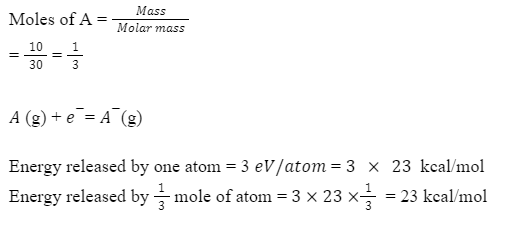
Q4. The electron gain enthalpy of a hypothetical element ‘A’ is -3 eV/atom. How much energy in kcal is released when 10 g of ‘A’ is completely converted to A- ions in the gaseous state? (Take 1 eV/atom = 23 kcal/mol, molar mass of A = 30 g)
Answer:
Frequently Asked Questions - FAQ
Question 1. How is the order of electron gain enthalpy linked to that of electron affinity?
Answer: Electron affinity is the extent to which an atom attracts the additional electrons. The order of electron affinity will be the same as negative electron gain enthalpy, whereas the order of electron gain enthalpy will be the opposite of electron affinity.
Question 2. What is the relation between effective nuclear charge and electron gain enthalpy?
Answer: The magnitude of electron gain enthalpy increases with the increase in effective nuclear charge(Zeff). This is due to an increase in the nuclear pull exerted on the outer electrons/incoming electrons. This increase in the force of attraction towards the nucleus increase the magnitude of electron gain enthalpy released.
Question 3. What is the electron affinity of inert gases, is it positive, negative or zero?
Answer: The electron affinity of inert gases is zero. This is due to the fact that they have an octet configuration in their outermost shell and hence they have no affinity toward any incoming electron.
Question 4. Why is the electron affinity value of chlorine, higher than that of fluorine?
Answer: We know that atomic size increases down the group. Due to the presence of a third shell in chlorine, its size is greater than fluorine. Fluorine faces interelectronic repulsion from the incoming electrons, whereas chlorine has space to accommodate electrons. Hence, the electron affinity value of chlorine is higher than that of fluorine.
Related Topics
|
Electron Gain Enthalpy |
Ionisation Enthalpy |
|
Electronic configuration |
Electron affinity and Electron gain enthalpy |
|
Factors affecting Electron Gain Enthalpy |
Mendeleev’s Classification |
|
Metallic and Non-metallic Character |
Modern Periodic Table |

 Call Now
 Let's Chat
 Share
Share