-
Call Now
1800-102-2727


Smelting - Introduction, History, Process, Base Metals, Environmental Impacts, Practice Problems & FAQs

Do you ever extract paneer at your home? I guess everyone loves the delicious paneer when it is cooked with a variety of ingredients.
My question for you is how did you extract the paneer? You must have applied any technique to extract paneer from milk. There are many methods of doing this but the ultimate aim is to extract paneer from milk. We simply pour a few drops of lemon which is easily available at everyone’s house.
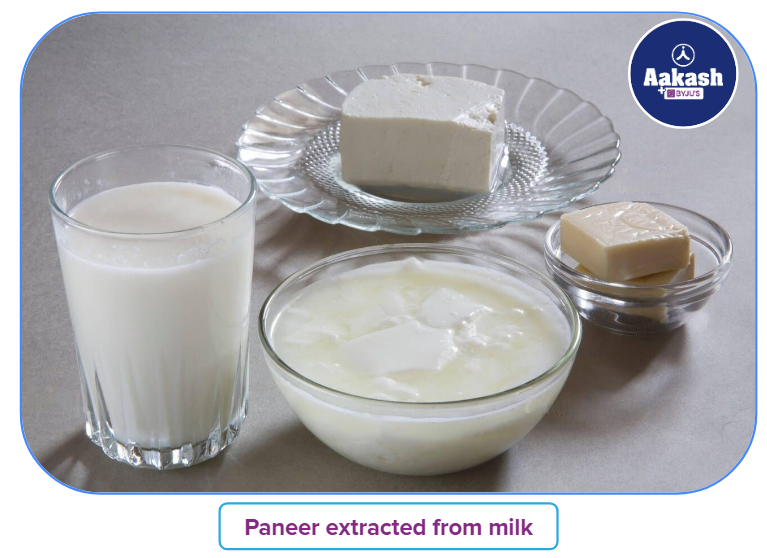
The way we extract paneer from milk, similar concepts are also used in the metallurgy process. There are a lot of methods available to extract metals from raw ore. All methods are important but have different substituents for working.
On this concept page, we will be learning about one of the important methods of extracting metals from their respective ores!
TABLE OF CONTENT
- Introduction
- Process of smelting
- Base metals
- Environmental impacts of smelting
- Practice problems
- Frequently asked questions-FAQs
Introduction:
Heat is applied to ore during the smelting process in order to extract a base metal. This kind of metallurgy is extractive. Silver, iron, copper, and other base metals are among the many metals that can be extracted from their ores using this method. Heat and a chemical reduction agent are used in smelting to break down the ore, removing other elements as gasses or slag while leaving the metal base behind.
The reducing agent is frequently a carbon-containing fossil fuel, such as coke—or, in older times, charcoal. Due to the reduced potential energy of the bonds in carbon dioxide, the oxygen in the ore binds to the carbon at high temperatures (CO2). The smelting process is most commonly used in a blast furnace to create pig iron, which is then transformed into steel. The refined metal element is produced as a byproduct of the chemical reaction in which the carbon source reacts to remove oxygen from the ore. The carbon supply undergoes two stages of oxidation. The air's oxygen (O2) and carbon (C) first burn together to create carbon monoxide (CO). Second, the ore (such as Fe2O3) combines with the carbon monoxide and loses one of its oxygen atoms, producing carbon dioxide (CO2). All of the oxygen in the ore will be eliminated after repeated interactions with carbon monoxide, leaving the element of raw metal (e.g. Fe).
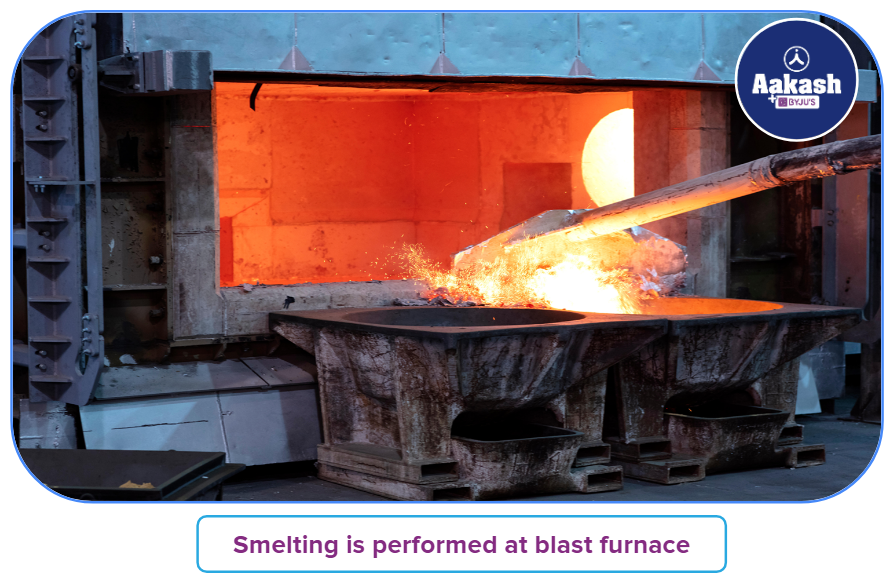
Process of smelting:
Smelting is a process that goes beyond simply extracting the metal from its ore. The majority of ores are made up of a chemical combination of metal and additional elements, such as oxygen (in the form of oxide), sulfur (in the form of a sulfide), or carbon and oxygen (as a carbonate).
Workers must cause a chemical reaction between these substances in order to extract the metal. Therefore, the process of smelting entails the use of suitable reducing agents that react with those oxidizing elements to liberate the metal.
(i) Carbon reduction process: Smelting involves the reduction of ore to molten metal at a high temperature. For extracting less electropositive metals such as Pb, Zn, Fe, Sn etc . Here are some powerful reducing agents such as C,H2,CO, water gas, Na, Al,K and Mg may be used. Some examples of reductions are given below:
Pyrometallurgy is the technique of extracting the metal by heating the metal oxide with a suitable reducing agent. The most often utilized reducing agents are aluminium, carbon, and carbon monoxide.
Carbon is utilised as a reducing agent in the smelting process to transform metal oxide into metallic forms. By intensely heating them with coal or coke, the oxides of less electropositive metals are decreased. The metal oxide's oxygen and carbon combine to generate carbon monoxide, which can also function as a reducing agent.
Similarly,
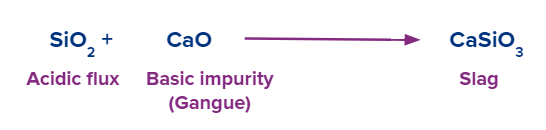
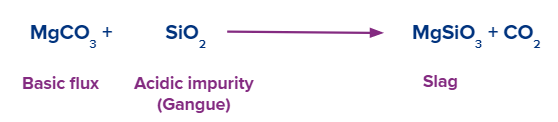
Even after concentration, the ores still contain some gangue to take out. The concentrated ore is combined with specific chemicals that combine with the gangue to create a fusible material that is not soluble in molten metal. The fluxes are the compounds utilized, while slag is the fusible material produced during the reduction process. Slag typically floats over the upper surface of the molten metal because it is lighter in weight.

Fluxes are divided into two categories: acidic flux and basic flux.
The chemical that eliminates the basic impurities is called an acidic flux and includes materials like silica, borax, etc.
Basic flux (e.g., limestone, ferric oxide, magnesite etc.,) is the chemical agent that neutralizes acidic impurities.
(ii) Reduction by aluminium (Goldschmidt aluminothermic process):
This method is used to remove metals from their oxides that have extremely high melting points. Their carbon reduction falls short of expectations. A steel crucible set in a bed of sand contains a mixture of concentrated oxide ore and aluminium powder known as thermite. Magnesium powder and barium peroxide are used as the ignition combination to start the process.
During reduction, a significant amount of heat energy is emitted which burns the metal and alumina together.
Base metals:
- Base metal smelting is a process that produces metals either directly from ores or from waste materials or recycled materials.
- This process typically affects metals including cobalt, copper, lead, nickel, zinc, and iron. Heat is utilized throughout the smelting process to separate metals from their ores.
- If the ore is an oxide, it is melted while containing carbon, which transforms the ore into a reduced metal.
Environmental impacts of smelting:
- Toxic metals like copper, silver, iron, cobalt, and selenium are released into the atmosphere during the smelting process, along with wastewater and slag.
- Smelting also produces gaseous sulfur dioxide, which contributes to acid rain, which causes soil and water to become acidic.
- One of the biggest sources of mercury in North America throughout the 20th century was the smelter in Flin Flon, Canada. Despite significant reductions in smelter discharges, landscape re-emission remained a significant mercury source in the area.
- For decades, mercury from the smelter will probably contaminate lakes due to re-emissions returning as rainwater and metal seeping from the soil.
- The base metal ore affects the number of pollutants produced by different types of smelters. For instance, in addition to producing aluminium, aluminium smelters also frequently produce fluoride, antimony, and nickel.
- In addition to copper, copper smelters frequently release cadmium, lead, zinc, arsenic, and nickel.
- Residents who work in the smelting sector have experienced respiratory conditions that prevent them from doing the physical chores necessary for their occupations.
Practice Problems:
Q1. The process of extracting the metal by heating is called ___________________.
A. chemical metallurgyB. pyrometallurgy.C. physical metallurgyD. extractive metallurgyAnswer: BSolution: Pyrometallurgy is the technique of extracting metal by heating the metal oxide with a suitable reducing agent. The most often utilized reducing agents are aluminium, carbon, and carbon monoxide.
Q2. Without the presence of air, heating ore with carbon is referred to as___________.
A. RoastingB. CalcinationC. SmeltingD. carbon-reductionAnswer: CSolution: Smelting, also known as chemical reduction, is an example of extractive metallurgy. Smelting is mostly used to create metals from their ore. Without the presence of air, heating ore with carbon is referred to as Smelting.
Q3. ___________ is known as acidic flux.
A. limestoneB. magnesiteC. ferric oxideD. silica oxideAnswer: DSolution: Molten metals are given an acidic flux to bond with basic impurities that are easily removed. For instance, silica oxide is utilized to purge the ore of calcium oxide from its impurities.
Q4. Which among the following statements is correct?
A. Flux combines with gangue to give slagB. Gangue combine with slag to give fluxC. Flux combine with slag to give gangueD. Gangue is the pure form of metal.Answer: ASolution: Flux is added during metallurgy, and it interacts with the gangue to create slag. Flux is a chemical applied to an ore during smelting to remove the gangue particles in it. Slag separates from the ore more readily than gangue. As a result, the fusible substance known as slag is created. Fluxes include things like lime, borax, etc.
Frequently Asked Questions-FAQs:
1. What are smelting's negative effects?
Answer: Cadmium is a known carcinogen, and the emissions from mining and smelting processes can impair the kidneys, skeletal system, and respiratory system. Children's learning issues have also been linked to cadmium exposure, even at modest levels.
2. Is pollution produced by smelting?
Answer: Air emissions from smelting processes are a significant cause of water and air pollution. Acid rain may come from the sulfuric acid mist that pervades the atmosphere and is created by these smelting facilities.
3. What gasses do smelting processes release?
Answer: When zinc, lead, copper, and nickel sulfide ore are smelted and converted to desired metal, sulfur dioxide (SO2), a major air pollutant, is released. By converting sulfur dioxide into sulfuric acid or recovering it as liquid sulfur dioxide or elemental sulfur, sulfur dioxide emissions can be reduced.
4. Where does smelting take place?
Answer: Smelting is the process of heating metal ores, such as copper glance (Cu2S), above the melting point of the metal in the presence of oxygen (for oxidation) or coke (for reduction). It takes place in a furnace with reverberation.

 Call Now
 Let's Chat
 Share
Share