-
Call Now
1800-102-2727


s-Block Elements - Definition, General Features, Physical and Chemical Properties, Uses, Practice Problems, FAQ

Who would not love to visit a candy shop! In fact, the very first glimpse of this flamboyant and candied atelier, would be sufficient to revive the satiated appetites of anyone. Every childlike soul, would crave to indulge in at least some of these delectable treats.
Besides this, have you noticed how nicely the similar groups of candies have been stocked up in separate blocks? As if the owner had an option for all your tastes! Be it a bonbon, a honeyed candy, or caramel candies, confetti, sweetmeats, eclairs, comfits, or marshmallows.. The choice is endless and they have been well sorted into blocks for the ease of identification and selection by customers.
Our periodic table is quite similar to this charming candy shop! Elements of different groups are marked and denoted by some blocks depending on the similarity of the shell where their outermost electron enters. So, just like the candies of a block, the groups of elements in a block also share similar properties. And the sole purpose of doing this is to ease the study and understanding of various groups of elements.
The first such block is s-Block Elements. Let’s take an intensive look into this special block and find out what is so special about it!
TABLE OF CONTENTS
- s-block Elements - Definition and Introduction
- Electronic configuration
- General Features
- Periodic Trends
- Physical Properties of Group 1 Elements (Alkali metals)
- Chemical Properties of Group 1 (Alkali Metals)
- Physical Properties of Group 2 (Alkaline Earth Metals)
- Chemical Properties of Group 2 (Alkaline Earth Metals)
- Uses
- Practice Problems
- Frequently Asked Questions - FAQ
s-block Elements - Definition and Introduction
The s-block elements of the periodic table are those elements in which the last electron enters the outermost s-orbital. As it can only accommodate a maximum of two electrons, only two groups (group 1 and 2) belong to the s-block of the periodic table. s-Block elements of the periodic table are highlighted in the illustration of the periodic table given below.
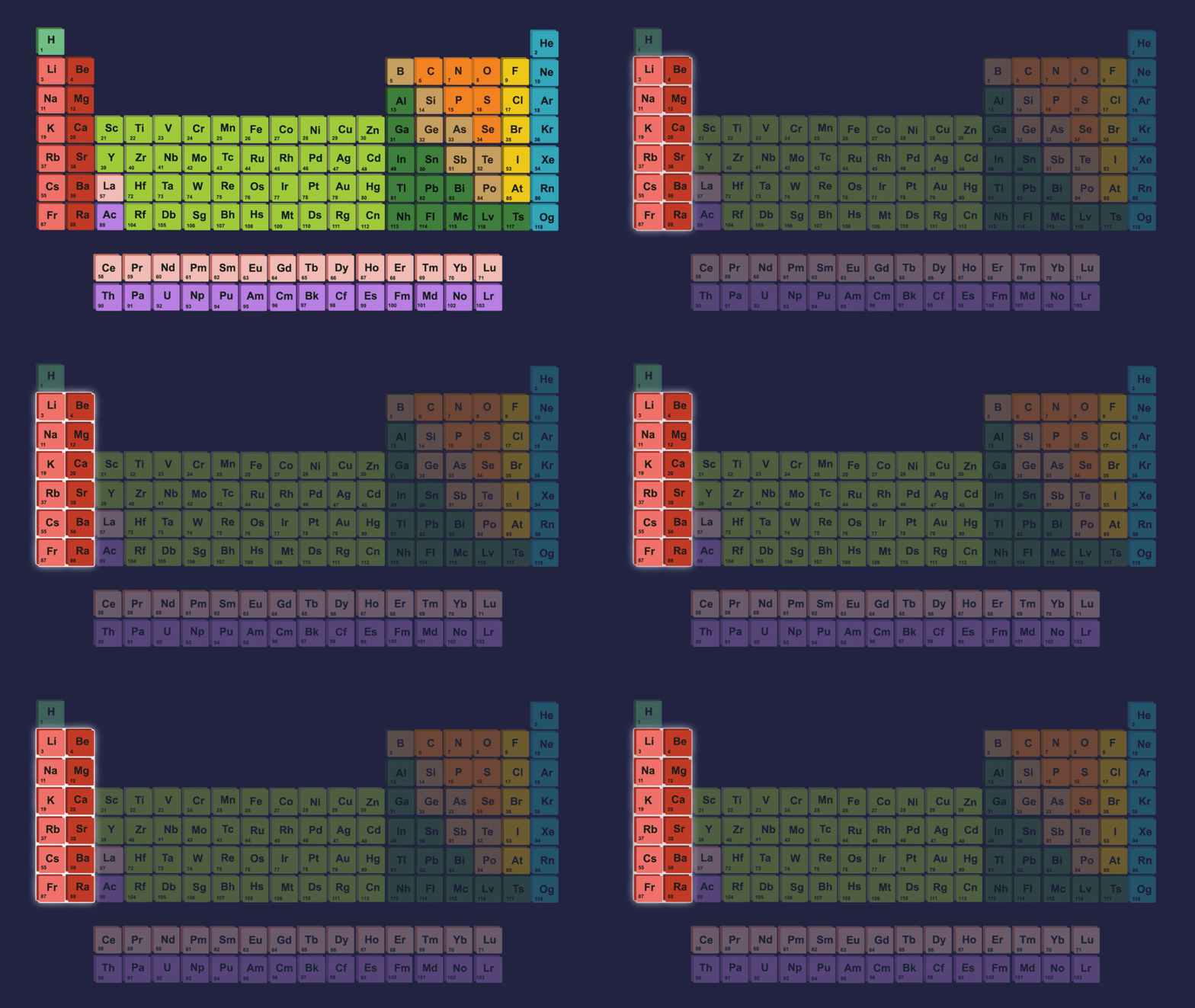
s-block comprises 12 elements namely lithium (Li), sodium (Na), potassium (K), rubidium (Rb), caesium (Cs), francium (Fr), beryllium (Be), magnesium (Mg), calcium (Ca), strontium (Sr), barium (Ba), and radium (Ra).
The s-block elements consist of Group 1 and Group 2 elements. Group 1 elements have only one electron in their outermost s- orbital and are called alkali metals. Group 2 elements have two electrons filling their outermost s- orbital and are called alkaline earth metals.
Electronic Configuration
The alkali metals in the s-block contain only one valence electron in their outermost shell. This outermost electron is loosely held, which makes these metals highly electropositive.
The alkaline earth metals have two electrons in their valence shell. The s- block elements of the periodic table are those elements in which the last electron enters the outermost s-subshell.
As the s- subshell can accommodate only two electrons, the first two groups belong to the s- block of the periodic table.
The exceptions to this rule are hydrogen and helium.
- Because of its resemblance to halogens, hydrogen is not considered an s-block element.
- Because helium is a noble gas, it is not considered an s- block element.
Group 1 - Alkali Metals
Group 1 elements include lithium (Li), sodium (Na), potassium (K), rubidium (Rb), cesium (Cs) and francium (Fr).
- They are collectively known as the alkali metals because they form strongly alkaline hydroxides in reaction with water.
- Examples: LiOH, NaOH, KOH, RbOH, CsOH, and FrOH.
- The general electronic configuration of the first group elements is [noble gas] ns1 and the valence shell electronic configuration is ns1.
The electronic configurations of elements included in group 1 of s-block elements are shown below:
|
Element |
Symbol |
Electronic configuration |
|
Lithium |
Li |
1s2 2s1 |
|
Sodium |
Na |
1s2 2s2 2p6 3s1 |
|
Potassium |
K |
1s2 2s2 2p6 3s1 3p6 4s1 |
|
Rubidium |
Rb |
1s2 2s2 2p6 3s2 3p6 3d10 4s2 4p6 5s1 |
|
Caesium |
Cs |
[Xe] 6s1 |
|
Francium |
Fr |
[Rn] 7s1 |
Group 2 - Alkaline Earth Metals
Alkaline earth metals consist of Beryllium (Be), Magnesium (Mg), Calcium (Ca), Strontium (Sr), Barium (Ba) and Radium (Ra).
- The general electronic configuration of the alkaline earth metals is [noble gas] ns2.
- These elements with the exception of beryllium are commonly known as alkaline earth metals.
- Because their oxides and hydroxides are alkaline in nature and these metal oxides are found in the earth’s crust.
The electronic configurations of elements included in group 2 of s-block elements are shown as below:
|
Elements |
Symbols |
Electronic configuration |
|
Beryllium |
Be |
[He] 2s2 |
|
Magnesium |
Mg |
[Ne] 3s2 |
|
Calcium |
Ca |
[Ar] 4s2 |
|
Strontium |
Sr |
[Kr] 5s2 |
|
Barium |
Ba |
[Xe] 6s2 |
|
Radium |
Ra |
[Rn] 7s2 |
General Features
- Elements of group 1 and 2 are metallic in nature.
- They are malleable, ductile, and rather soft metals.
- They are good conductors of heat and electricity.
- They have low melting and boiling points.
- Due to the greater atomic radii of s- block elements in comparison to all other elements of the periodic table, they have low ionisation enthalpy and behave as highly electropositive elements.
- The elements of alkali metals as well as alkaline earth metals are highly reactive and are hardly available in the free state.
- They are prepared by the electrolysis of their fused salts.
- They are very reactive as their last shell contains 1 or 2 electrons which can be given off easily (low ionisation potential).
- They exhibit a fixed valency of +1 and +2 respectively for alkali metals and alkaline earth metals.
- They form colourless compounds except for chromates and dichromates, which are generally coloured owing to the presence of transition metal chromium in it.
- The cations of s-block elements are diamagnetic.
- The compounds of alkali metals and alkaline earth metals are ionic. (except Li and Be).
- Their solutions in liquid ammonia are good conductors of electricity and are good reductants.
- The oxides of alkali metals as well as alkaline earth metals are basic in nature and are soluble in nature, hence alkaline.
- These elements are strong reducing agents due to their high negative electrode potential value.
- All elements, with the exception of magnesium and beryllium, have a distinct flame colour and rapidly react with water to generate alkalis and release hydrogen.
Periodic Trends
The periodic trends in the modern periodic table can be used to predict the properties of the s- block elements. These periodic trends are patterns in elemental properties. The following are the explanations for these periodic trends:
- Atomic radii: Alkali metals have a larger atomic radius than other elements in their respective period. The number of electrons increases as the atomic number increases. As a result, the atomic radius of elements increases as one moves down the group. This radius decreases over the period.
- Ionisation Enthalpy: As the metal's size increases down the group, the force of attraction between the nucleus and electrons decreases. As a result, the ionisation enthalpy decreases throughout the group. The ionisation enthalpy increases from left to right.
- Electron Affinity: Electron affinity decreases as the size of the elements increases down the group.
- Electronegativity: The electronegativity of s- block elements drops from top to bottom and increases from left to right.
- Electropositivity: This attribute increases as you progress through the group and decreases as you progress through the period.
- Metallic Nature: The metallic character of the elements in the s- block elements grows from top to bottom and diminishes from left to right.
- Non-metallic Nature: The non-metallic character of the elements decreases as you progress through the group and rises across a period from left to right.
Physical Properties of Group 1 Elements (Alkali metals)
- All the alkali metals are silvery-white, soft and light metals. Hence, they can be easily cut using a knife.
- The atomic and ionic radii of alkali metals increase on moving down the group, i.e., they increase in size while going from Li to Cs.
- The ionisation enthalpies of the alkali metals are considerably low and decrease down the group from Li to Cs. This is because the effect of increasing size outweighs the increasing nuclear charge, and the outermost electron is screened very well from the nuclear charge.
- Hence, on moving down the group, the hydration enthalpy of alkali metal ions decreases with the increase in ionic size. Thus, the correct order of the hydration energy of alkali metals is given as Li+ > Na+ > K+ > Rb+ > Cs+.
- As we move down the group, atomic mass and atomic radius increase. But the increase in atomic mass will overpower the increase in atomic radius (i.e., volume). Hence, density increases from Li to Cs. However, potassium is lighter than sodium.
- The abnormal value of density for potassium is because of the unusual increase in the atomic size of potassium due to the presence of 3d orbitals.
- The melting and boiling points of the alkali metals are low indicating weak metallic bonding due to the presence of only a single valence electron in them. As we move from Li to Cs, the size of the metal atom will increase which results in a decrease in metallic bond strength. Hence, the melting and the boiling points in alkali metals will decrease from Li to Cs.
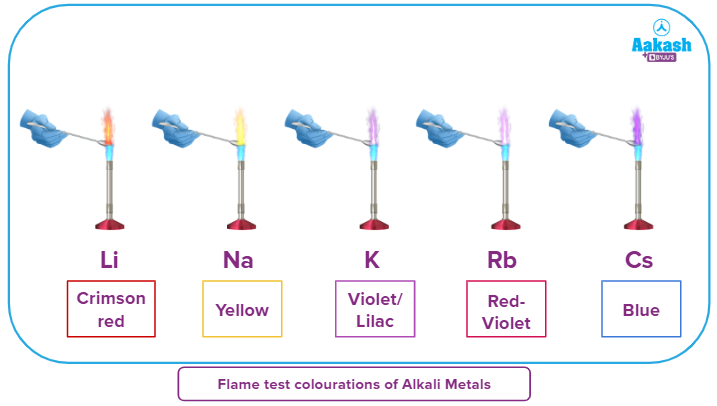
- The alkali metals and their salts impart a characteristic colour to an oxidising flame (blue colour flame). This is because the heat from the flame excites the outermost loosely held electron to a higher energy level.
Chemical Properties of Group 1 Elements (Alkali metals)
Because of the high reactivity of alkali metals towards air and water, they are normally kept in kerosene oil. (except lithium).
Atomic number increases down the group from Li to Cs. They are highly electropositive and form compounds that are ionic in nature.
The alkali metals are highly reactive due to their large size and low ionisation enthalpy. The reactivity of these metals increases down the group.
Reactions of Alkali Metals With Air (O2)
- The alkali metals tarnish in dry air due to the formation of their oxides. Lithium forms monoxide, sodium forms oxide as well as peroxide, and the other metals form oxide, peroxide as well as superoxides.
4Na (s)+ O2(g) ⟶ 2Na2O (s) [Oxide]
2Na (s)+ O2(g) ⟶ 2Na2O2 (s) [Peroxide]
M(s) + O2(g) ⟶ MO2(s) [Superoxide]
[Where, M = K, Rb, Cs]
- They are normally kept in kerosene oil because of their high reactivity to air and water.
- Lithium shows exceptional behaviour in reacting directly with the nitrogen of air to form lithium nitride.
6Li (s) +N2(g) 2Li3N (s)
Hydroxides of Alkali Metals
The oxides of the alkali metals react with moisture to form hydroxides and hydrogen gas. Alkali metal peroxides react with water to form metal hydroxides and hydrogen peroxide.
Example:
Li2O (s) + 2H2O (l)⟶ 2LiOH (aq)+ H2(g) [Oxide + Water]
Na2O2 (s)+ 2H2O (l) ⟶ 2NaOH (aq)+ H2O2 (aq) [Peroxide + Water]
2KO2 (s)+ 2H2O (l) ⟶ 2KOH (aq)+ H2O2 (aq)+O2(g) [Superoxide + Water]
Reactions of Alkali Metals with Water
The alkali metals react with water to form metal hydroxides and release hydrogen gas.
2M(s) + 2H2O(l) ⟶ 2MOH(aq) + H2(g)
The reaction of the alkali metals with water is exothermic, and the enthalpy of the reaction increases from lithium to caesium. Alkali metals float in the water during the reaction.
Example: 2Na(s) + 2H2O(l)2NaOH(aq) +H2(g)
Reactions of Alkali Metals With Dihydrogen
The alkali metals react with dihydrogen to form metal hydrides.
- All the alkali metal hydrides are ionic solids with high melting points.
2M (s) +H2(g) --> 2MH (s)
- As we move down the group, the stability of the hydride decreases.
- The metal hydrides react with water to give metal hydroxides (MOH) and release H2 gas.
LiH (s) +H2O (l) --> LiOH (aq) + H2(g)
Reactions of Alkali Metals With Halogens
The alkali metals react vigorously with halogens to form ionic halides. The alkali metal loses one electron and a halogen accepts that electron, which results in the formation of an ionic salt (M+X-).
2M (s) + X2(g) --> 2MX (s)
- Halides of potassium, rubidium, and caesium have the property of combining with extra halogen atoms forming polyhalides.
KI (s) + I2(g) --> KI3 (∵ I- + I2 --> I-3)
Carbonates and Bicarbonates
Alkali metal hydroxides on reacting with carbon dioxide forms metal carbonates. Also, carbonic acid reacts with metal hydroxides to form bicarbonates.
2NaOH (s) + CO2(g) --> Na2CO3(s) + H2O(l)
NaOH (s) + H2CO3(aq) --> NaHCO3(s) + H2O(l)
- Alkali metal carbonates except Li2CO3 are ionic, water-soluble and thermally stable in nature.
- Bicarbonates, except for LiHCO3 (liquid state), are solid, water-soluble and on heating liberate carbon dioxide.
Alkali Metal Sulphates and Nitrates
- Except for Li2SO4, all alkali metal sulphates are soluble.
- Alkali metal Sulphates can be reduced from carbon to sulphide.
Na2SO4(aq) + 2C(s) --> Na2S(aq) + 2CO2(g)
- Also, alkali metals form double salts with trivalent metal sulphates.
Example: Alum, KAl(SO4)2.12H2O .
- Nitrates of alkali metals are soluble in water and on heating except lithium nitrate decomposes to nitrites.

Reactions of Alkali Metals with Liquid Ammonia
- Alkali metals dissolve in liquid ammonia, The solubility of alkali metals in liquid ammonia is due to the formation of ammoniated cation and ammoniated electrons.
Example:
Na + (x + y)NH3 --> [Na(NH3)x]+ + [e(NH3)y]-
Ammoniated Cation Ammoniated electron
- On increasing the concentration of sodium metal, the concentrated metal-ammonia solution gets a metallic bronze colour and becomes diamagnetic due to the pairing of e-.
2e- + 2(NH3)y --> [e-(NH3)y]2
On keeping this solution standing for a long time, the colour fades due to formation of amide after liberating hydrogen.
- Hot alkali metals react with dry ammonia gas to form amide and liberate hydrogen. Amide on hydrolysis produces sodium hydroxide.
2Na (s)+2NH3(g) --> 2NaNH2(s) + H2(g)
NaNH2(s) + H2O(l) --> NaOH(aq) + NH3(g)
- The melting and boiling points of a particular alkali metal halide will follow the order:
MF > MCl > MBr > MI
Because the lattice enthalpy of alkali metal halides decreases as the size of halogen atoms increases, the melting and boiling point of the compound decreases.
- All the alkali metal halides, except LiF and CsI, are soluble in water.
Physical Properties of Group 2 (Alkaline Earth Metals)
- Alkaline earth metals are silvery-white, lustrous, and relatively soft, but harder than alkali metals.
- The colours of Be and Mg appear to be grey.
- They are strongly electropositive in nature due to their low ionisation energy.
- They have high electrical and thermal conductivities.
- They have higher melting and boiling points than the corresponding alkali metals due to their smaller sizes.
- However, they have lower melting and boiling points as compared to the d-block metals.
- The melting point depends upon the atomic mass, the strength of the metallic bond, and atomic packing. There is no regular trend in the melting point of alkaline earth metals.
- The alkaline earth metals (except Be and Mg) and their salts impart characteristic colours to an oxidising flame.
- This is because the heat from the flame excites the outermost loosely held electrons (ns2) to a higher energy level. When the excited electron comes back to the ground state, there is an emission of radiation in the visible region.
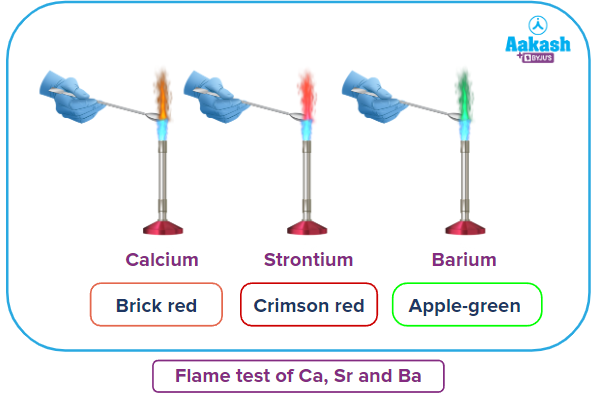
- The group 2 elements, mainly Ca, Sr, and Ba, impart characteristic brick red, crimson red, and apple green colours, respectively, to the flame during the flame test. The electrons in Be and Mg are too strongly bound to get excited by flame. Hence, these elements do not impart any colour to the flame.
Chemical Properties of Group 2 (Alkaline Earth Metals)
Alkaline earth metals are less reactive than alkali metals. The reactivity of these elements increases down the group. This is because, as we move down the group, size increases. So, ionisation energy decreases and it becomes easier to remove the electron. Hence, their reactivity increases.
Alkaline earth metals form compounds that are predominantly ionic, but less ionic than the corresponding compounds of alkali metals. This is due to the increased nuclear charge and smaller size (Fajan’s rule).
According to Fajan’s rule, the smaller the size of the cation and the greater the size of the anion, the higher the covalent nature of the ionic bond.
Reaction with air
- Be and Mg are kinetically inert to oxygen due to the formation of an oxide film on their surface. Calcium, strontium, and barium are even more electropositive and react with air readily to form their respective oxides and nitrides.
- Magnesium is more electropositive than beryllium, and it burns with dazzling brilliance in the air to give a mixture of MgO and Mg3N2. Magnesium burns so brightly because the reaction releases a lot of heat. As a result of this exothermic reaction, magnesium gives two electrons to oxygen, forming powdery magnesium oxide (MgO).

Reaction with water
Be and Mg are kinetically inert to water due to the formation of an oxide film on their surface. Mg shows an insignificant reaction with water but burns vigorously with steam or water vapour to produce white magnesium oxide and hydrogen gas. Magnesium decomposes hot water.
Mg(s) + 2H2O(g) ⟶ Mg(OH)2(s) + H2(g)
Reactivity towards halogens
Group 2 elements combine with halogens at elevated temperatures to form their corresponding halides.
M + X2 ⟶ MX2 (X = F, CI, Br, I)
- BeF2 is best formed by the thermal decomposition of (NH4)2BeF4 .
- BeCl2 is conveniently made from its oxide at a temperature of 600-800 K

Reactivity towards hydrogen
All group 2 elements except Be combines with H2 upon heating to form their corresponding hydrides (MH2).

BeH2 can be prepared by the reaction of BeCl2 with LiAlH4.
2BeCl2 + LiAlH4 ⟶ 2BeH2 + LiCl + AlCl3
- Alkaline earth metals are strong reducing agents which are indicated by their large negative values of reduction potentials. The reducing power of alkaline earth metals is less than that of their corresponding alkali metals.
- Be has a lower negative value when compared to the other alkaline earth metals. Its reducing nature is due to the large hydration energy associated with the small size of Be2+ ion and relatively large value of the atomisation enthalpy of the metal.
- Alkaline earth metals readily react with acids, liberating dihydrogen.

- The group 2 elements dissolve in liquid ammonia to give a deep blue-black solution, forming ammoniated ions.
M + (x + y)NH3 --> [Na(NH3)x]2+ + 2[e(NH3)y]-
Ammoniated Cation Ammoniated electron
The solution slowly decomposes to give amide with the liberation of H2.
M(NH3)6 ⟶ M(NH2)2 + 4NH3 + H2
Uses
- Lithium is used in manufacturing heat resistant ceramics, glasses, in cell phones as rechargeable batteries, and in alloy form in aircraft.
- Compounds of sodium and sodium salts are used in the food industry, soap-making, and pharmaceutical industries.
- Potassium chloride, potash, is used as fertiliser and insecticide, for water retention, enhancing crop yield, and many more.
- Rubidium is used in laser cooling, engines of space crafts, optical glasses, atomic clocks etc.
- Caesium-134 is used in the nuclear industry and also in cancer treatment.
- Beryllium is used in the manufacture of alloys.
- Cu-Be alloys are used in the preparation of high strength springs.
- Metallic beryllium is used for making windows of X-ray tubes.
- Magnesium forms alloys with aluminium, zinc, manganese, and tin.
- Mg-Al alloys, being light in mass are used in aircraft construction.
- Mg is used in flash powders and bulbs, incendiary bombs and signals.
- Milk of magnesia (A Suspension of Mg(OH)2 in water) is used as an antacid in medicine.
- MgCO3 and Mg(OH)2 are ingredients of toothpaste.
- Calcium is used in the extraction of metals from oxides.
- Calcium is used to remove traces of air from vacuum tubes.
- Radium salts are used in radiotherapy.
Practice Problems
Q1. When compared to alkaline earth metals, which of the following properties do the alkali metals exhibit?
1. Smaller ionic radii
2. Higher boiling points
3. Greater hardness
4. Low ionisation enthalpy
Answer: When compared to alkaline earth metals, the alkali metals exhibit lower ionisation energies because the alkali metals have the largest atomic size in their respective period. So, the force of attraction between the nucleus and the outermost electron is weak and hence, they have low ionisation enthalpies.
So, option D) is the correct answer.
Q2. Which of the following metals is used to make antacids?
1. Caesium
2. Lithium
3. Magnesium
4. Calcium
Answer: Milk of magnesia (A Suspension of Mg(OH)2 in water) is used as an antacid in medicine. Thus, the metal used to make antacids is magnesium.
So, option C) is the correct answer.
Q3. Carbonates of lithium are not as stable as that of sodium. This is due to
1. High electronegativity
2. Covalent nature
3. High ionisation potential
4. Uncertain
Answer: Due to its covalent nature, lithium carbonate is not stable. Lithium ions are extremely small, while carbonate ions are extremely large. As a result, the small lithium ion polarises the large carbonate ions, resulting in more stable lithium oxide.
So, option B) is the correct answer.
Q4. Why do beryllium and magnesium not impart colour to flame?
Answer: The electrons in Be and Mg are too strongly bound owing to greater effective nuclear charge and small ionic radii. Hence, they do not get excited by flame and do not impart any characteristic colour to the flame.
Frequently Asked Questions - FAQ
Question 1. Why is beryllium hydroxide amphoteric?
Answer: Beryllium has a very small size and a + 2 charge in its oxides. As a result, it has an extremely high charge density. According to Fajan's rule (the smaller the cation and the larger the anion, the higher the covalent nature of the ionic bond), the positive charge on the cation (Be2+) polarises the electron cloud of the anion (OH-), and hence the hydroxide has some covalent character. As a result, Be(OH)2 does not readily dissociate into Be2+ and OH- in water. So, Be(OH) is an amphoteric compound.
Question 2. Why is the solubility of LiF and CsI low as compared to other metal halides?
Answer: As the sizes of Li+ and F- are very small, the lattice energy of LiF is very high. Thus, due to the high lattice energy, the solubility of LiF decreases. As the sizes of Cs+ and I- are very big, the hydration energy of CsI is very low. Thus, due to this, the solubility of CsI decreases.
Question 3. Give evidence to show a diagonal relationship between beryllium and aluminium.
Answer:
- Like Al, Be metal also has an oxide film on the surface. Hence, both are not attacked by acids.
- Be(OH)2 dissolves in excess of alkali to give beryllate ion [Be(OH)4]2- just as Al(OH)3 gives aluminate ion [Al(OH)4]-.
- The chlorides of both Be and Al have bridged chloride structure in the vapour phase.
- Both these chlorides are soluble in organic solvents and are strong Lewis acids.
- They are used as Friedel-Craft catalysts.
- Be and Al ions have a similar charge/size ratio, so they have strong tendencies to form complexes, BeF42-, AlF63-.
Question 4. s-block elements are prepared by electrolysis and not by the reduction of their compounds by other group elements or their compounds, why? Which is the strongest reducing agent?
Answer: s-block elements are strong electropositive elements with a low reduction potential, indicating that they have a higher reducing ability than other elements. As a result, substances with a lower reducing ability will be unable to reduce them. The ease with which electrons can be released for reduction affects an atom's ability to reduce. Caesium appears to be a stronger reducing agent than lithium as ionisation energy decreases down the group.
However, the combined energy difference of three processes determines reducing ability (oxidation potential):
- Sublimation of the atom,
- ionization to the metal ion and
- Hydration of the ion with water.
Because lithium is the smallest ion, it has a much higher hydration enthalpy than caesium, which compensates for its higher ionisation enthalpy. Lithium has the highest reducing ability (highest oxidation potential or lowest reduction potential) when compared to caesium.
Related Topics
|
Flame Test |
Alkali metals |
|
Sodium Hydroxide |
Sodium Carbonate |
|
Diagonal Relationship |
Calcium Carbonate |

NEET Related Links
JEE MAIN Related Links
JEE Advanced Related Links
JEE Advanced Eligibility Criteria
JEE Advanced Chemistry Syllabus
JEE Advanced Registration Dates
CUET Related Links
Important Topics
Anemometer : Measurement of Wind Speed
Angular Acceleration Atomic Theory Audible and Inaudible Sound Average Speed and Average Velocity Average Velocity Avogadros Number Avogadros Hypothesis Azimuthal Quantum Number Balanced Force Bar Magnet Biconvex Lens Boyles Law Buoyancy Calorimeter Carnot Engine Celestial Bodies Centripetal And Centrifugal Force Concave and Convex Lenses Concave Convex Mirrors Contact and Non Contact Force Controlled Thermonuclear Fusion Convection Currents Convex Lens Convex Mirror Destructive Interference Difference Between Conduction Convection and Radiation Difference Between Electric Field and Magnetic Field Difference Between Heat And Temperature Difference Between Series And Parallel Circuits Differences Between Acceleration And Velocity Distance and Displacement Distance Time Graph Electrical Force : Electric Forces and Their Types Electromagnetic Waves : Definition, Equation and Properties of Electromagnetic Waves Electromagnetism Electron Spin Fluid Flow : Bernoullis Equation Derivation and Fluid Mechanics Fluid Friction : Types and Factors of Fluid Friction Frames of Reference : Inertial and Non- Inertial Frame of Reference Frequency and Wavelength Frictional Force Importance of Hydrosphere Instantaneous Speed and Velocity Introduction to Motion Kinetic and Potential Energy Difference Law Of Conservation of Energy Layers of the Earth Light Energy Light Sources List of physics scientists and Their inventionsLoudness of Sound
Magnetic Dipole Moment Magnetic Field Non - Contact Force Non - Renewable Energy Ohms Law Optics P Wave Physics Symbols Plane Mirrors Poissons Ratio Projectile Motion Properties of Water : Anomalous Expansion of Water Radius of Gyration Reflection of Light Reflection of Waves Relative Density Resonance Reverberation Rolling Friction Rotation and Revolution Screw Gauge Semiconductors and Insulators Sliding Friction Speed Time Graphs Static Friction Stefan Boltzmann Law Stress Tension Tension Force Thermometer: Clinical Laboratory Thermometer Types of Rocks Types of Waves Uniform Motion and Non Uniform Motion Unit of Voltage Uses of Convex Lens Uses Of Convex Mirror Uses of Electromagnet Uses of Optical Fibre Wave Wavelength of Light What is Scattering of Light Working of Electric Bell Conventional and Non-conventional Sources of Energy Buoyant Force Bulk Modulus of Elasticity Bernoulli’s Principle Angular Momentum Difference Between Speed And Velocity ForceUnit of Heat
Difference between Distance and Displacement Simple Microscope Derivation Of Equation Of Motion Thermometer: Clinical & Laboratory Thermometer Difference between Concave and Convex LensDerivation Of Lens Maker Formula
Unit Of Pressure Velocity Uses of Plane Mirror
Wave Theory of Light
Unit of Density Unit of Light Unit of Force Unit of Magnetic Field Unit of wavelength Unit of Viscosity Uses of Electroplating Young's Modulus
What is the Scattering of Light
Lenz Law Space Wave Propagation Schrodinger Wave Equation Relation between Fahrenheit and Celsius Refractive Index Potentiometer Working Pascal Law Oscillatory Motion Optical Instruments Newton's Laws of Motion - First Law Modulation and Demodulation Magnetic Flux Lens Formula and Magnification Kaleidoscope Faradays Law Epsilon Naught Value Energy Bands Electrostatics Electroscope AC Generator Unit of Current Lithosphere Bending Equation Derivation Difference Between Pound and Kilogram Semiconductor Devices OTEC - Ocean Thermal Energy Conversion Hall Effect Rectilinear Propagation of Light Difference Between Ammeter and Voltmeter Coefficient of Linear Expansion Ampere’s Law Cyclone and Thunderstorm Save The Environment From Pollution Particle Nature of Light Types of DC Motor Uses Of Transistor Derivation of Phase Rule Unit of Humidity

 Call Now
 Let's Chat
 Share
Share