-
Call Now
1800-102-2727


Roasting: Introduction, Process of Roasting, Difference Between Calcination and Roasting, Practice Problems & Frequently Asked Questions(FAQs)

Everybody would be familiar with grilled chicken.
Do you know the method used to make it?
It is the roasting process.
When preparing chicken, the phrase "roasting" is appropriate. Considering that it entails cooking by radiated heat, on a spit, over a ferociously burning fire, slow grilling would be a more realistic description. The continual spinning of the spit prevents the chicken from drying up and allows it to bast itself with the hot fat that oozes from the surface.
Food trucks, peasants, and cottage enterprises all employ the sand roasting method extensively in India to create a variety of value-added food products from diverse cereals, millets, and legumes. The traditionally manufactured sand-roasted goods are frequently used to make other snacks or as ready-to-eat snacks.
Table of Contents:
- Introduction of Roasting
- Process of Roasting
- Difference between Calcination and Roasting
- Practice Problems
- Frequently Asked Questions(FAQs)
Introduction of Roasting:
When we talk about roasting, we primarily mean a metallurgical procedure in which the ore is heated below its melting point in excessive air to create its oxide. While roasting is a technique that can be used to convert sulphide ores, calcination is the process that is typically used to oxidise carbonates.
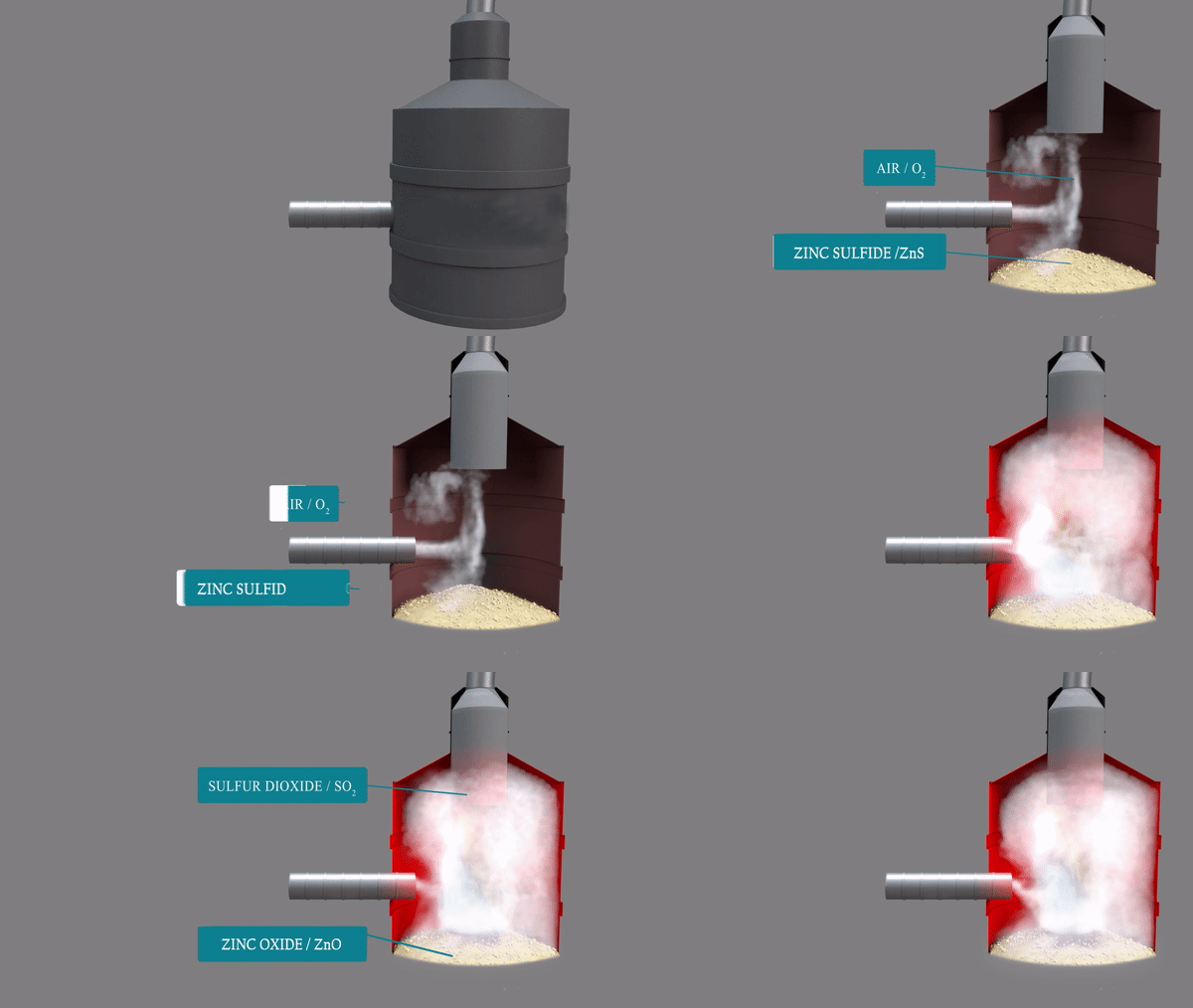
However, during roasting, non-metallic and moisture contaminants are liberated as a volatile gas. Reduction, oxidation, chlorination, sulfation, and pyro hydrolysis are all components of the solid-gas thermal reaction that occurs during roasting.
The main disadvantage of this technique is that it releases a significant amount of metallic, poisonous, and acidic substances that are harmful to the environment. The roasting of sulphides ores is a significant source of air pollution.
Process of Roasting:
Roasting is the technique of heating a substance below its melting point while it is exposed to an abundance of air or oxygen. In metallurgical processes, when ores are transformed into oxides, which then are used for the recovery of metal, roasting is applied. Sulphide ores are typically converted using it. Volatile chemicals, moisture, and contaminants are all eliminated throughout this process.
Roasting at moderate temperature:
1. It transforms metal sulphides into oxides.
2. Arsenic, antimony, sulphur, and phosphorus volatile contaminants are eliminated by producing their oxides.
Roasting at high temperature:
When sulphide ore containing Cu, Pb, Hg and Sb is heated to a high temperature in an environment with open access to air and reduced to metal, self-reduction occurs.
(Copper galena)
(Galena)
(Cinnabar)
Difference between Calcination and Roasting:
Below is a list of some key distinctions between roasting and calcination.
|
Roasting |
Calcination |
|
Roasting is the process of heating the ore below its melting point while it is exposed to excess oxygen or air. |
In the process of calcination, the ore is heated with a limited or little amount of oxygen or air or in the absence of air or oxygen. |
|
Specifically for sulphide ores, roasting is done. |
The thermal breakdown of carbonate ores occurs during calcination. |
|
Dehydrating ore is not a part of roasting. |
As a result of calcination, moisture is removed from the ore. |
|
Hazardous, acidic, and metallic components are emitted in significant quantities during roasting. |
The calcination process releases carbon dioxide. |
|
Roasting is an exothermic process |
Calcination is an endothermic process |
Practice Problems:
Q1. Iron pyrites (FeS2) are converted to the ferric oxide (Fe2O3) by the process
(A) Calcination
(B) Roasting
(C) Smelting
(D) None of the above
Answer: (B)
Solution: In the presence of an excessive amount of oxygen, roasting transforms sulphide ores into the equivalent metal oxides. Here Iron pyrites is a sulphide ore having the formula FeS2 which is converted to the ferric oxide (Fe2O3) by the process of Roasting. The reaction is given as
Q2. Which of the following techniques is most commonly used to concentrate the ores of sulphide?
(A) Froth Flotation process
(B) Leaching
(C) Hand picking
(D) All of the above
Answer: (A)
Solution: The theory behind the froth floatation process is the distinction between the ore and gangue particles' wetting characteristics with regard to water and oil. This technique is used for those metals whose ore is best moistened by water and gangue by oil. The gangue settled to the tank's bottom with the water while the sulphide ores were preferred moistened by the oil.
Therefore, the concentration of sulphide ore can be accomplished using this method. This technique is used to concentrate ores such as zinc-blend and galena.
Q3. Despite the absence of sulphide, roasting is used in the extraction of iron because
(A) Fe2O3(Hematite) is to be decomposed
(B) All Hematite (Fe2O3) is converted to ferrous oxide (FeO)
(C) All ferrous oxide (FeO) is converted to Hematite (Fe2O3)
(D) Formation is slag is encouraged
Answer: (A)
Solution: Roasting is a process that involves heating concentrated ore with a burst of air, oxidising the ore to produce the oxide, and removing contaminants like sulphur and arsenic by oxidising them to their oxides. Specialised furnaces like Bessemer or reverberatory furnaces are needed, as well as very high heat. In the case of Fe, roasting is necessary to change FeO into Fe2O3, which prevents the development of slag because only FeO not Fe2O3, produces slag. Thus, hematite is decomposed by roasting iron ore.
Q4. The process of roasting is
(A) Exothermic
(B) Endothermic
(C) Both exothermic and endothermic
(D) Neither exothermic nor endothermic
Answer: (A)
Solution: Sulphide ore is heated less than its melting point in a reverberatory furnace with air present to transform it into its oxides during roasting. Arsenic, antimony and sulphur as As2O3, Sb2O3 and SO2 are among the easily oxidizable volatile contaminants that are removed by roasting. Because roasting is an exothermic process, it does not require more heating once it has begun.
Frequently Asked Questions(FAQs):
Q1. Explain why carbonate and sulphide ores are typically transformed into oxides during the extraction procedure.
Answer: Heating in the proximity of excess air causes sulphide ores to change into oxides. This procedure is referred to as roasting. Carbonates are heated vigorously in a small amount of air, converting them to oxides. The method is called calcination. Because it is simpler to extract metal from oxides than from carbonates or sulphides, carbonate and sulphide ores are typically transformed into oxides during the extraction procedure. We simply need to employ a metal that is more reactive than the impure metal that needs to be eliminated, just like with oxides.
Q2. High temperatures prevent the use of carbon and hydrogen as reducing agents. justify the reason for this.
Answer: At high temperatures, carbon and hydrogen react with metals to generate carbides and hydrides, respectively, hence they cannot be employed as reducing agents for metals.
Q3. How does calcination actually happen without oxygen?
Answer: The carbonate ores undergo calcination. The calcination process involves intensely heating the ores without oxygen (air). This transforms the metal carbonates into metal oxides and carbon dioxide. These ores won't react when heated in the presence of oxygen or air, making the entire procedure useless.
Q4. Why do sulphide ores provide roasting while carbonate ores are calcined?
Answer: Both processes ultimately yield oxide. Sulphide ore needs air or oxygen for conversion to oxide. Hence the roasting process in an excess oxygen atmosphere is ideal for the sulphide ores. But the carbonate can decompose to form the oxide, releasing the carbon dioxide gas It does need air or oxygen, which in fact may reduce the decomposition and oxide formation. So, the calcination process of heating in the absence of air is suitable for carbonates.
Therefore, roasting is effective for sulphide ores and calcination for carbonate ores.

 Call Now
 Let's Chat
 Share
Share