-
Call Now
1800-102-2727


Reversible and Irreversible Reactions- Definitions, Examples, Practice Problems and FAQs

Every day, we observe various objects changing around us, such as ice melting, cooking food, and so on. In some circumstances, you can reverse the change to get back the starting material, while in some cases it may not be possible.
If you can run between both the forward and backward changes repeatedly, then it means the changes are reversible. And if not it is one-sided and called irreversible change.
You can now classify ice melting and cooking food as reversible or irreversible changes. Is in it?
If not, let us make a cake and see.
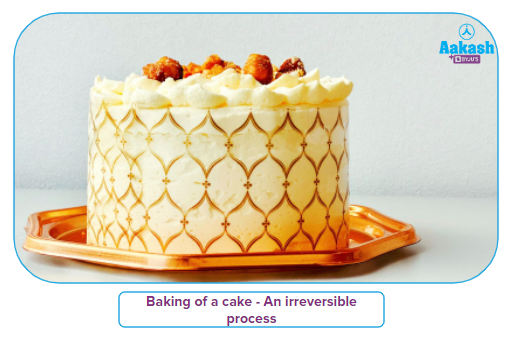
Let's take ingredients in a cake, such as eggs and flour. They're combined and cooked to make the cake, which is the end result (see Figure below). To go back to the raw eggs, wheat, and other ingredients, the cake must be "unbaked" and "unmixed, which is not possible." Making a cake is therefore irreversible.
By taking heat from the surrounding, the ice present in the beaker starts melting and changes into a liquid. But if you put this liquid contained in the beaker in the refrigerator, the liquid present in the beaker starts freezing and hence changes into ice again. Hence melting ice into liquid and freezing that liquid again into ice is reversible.
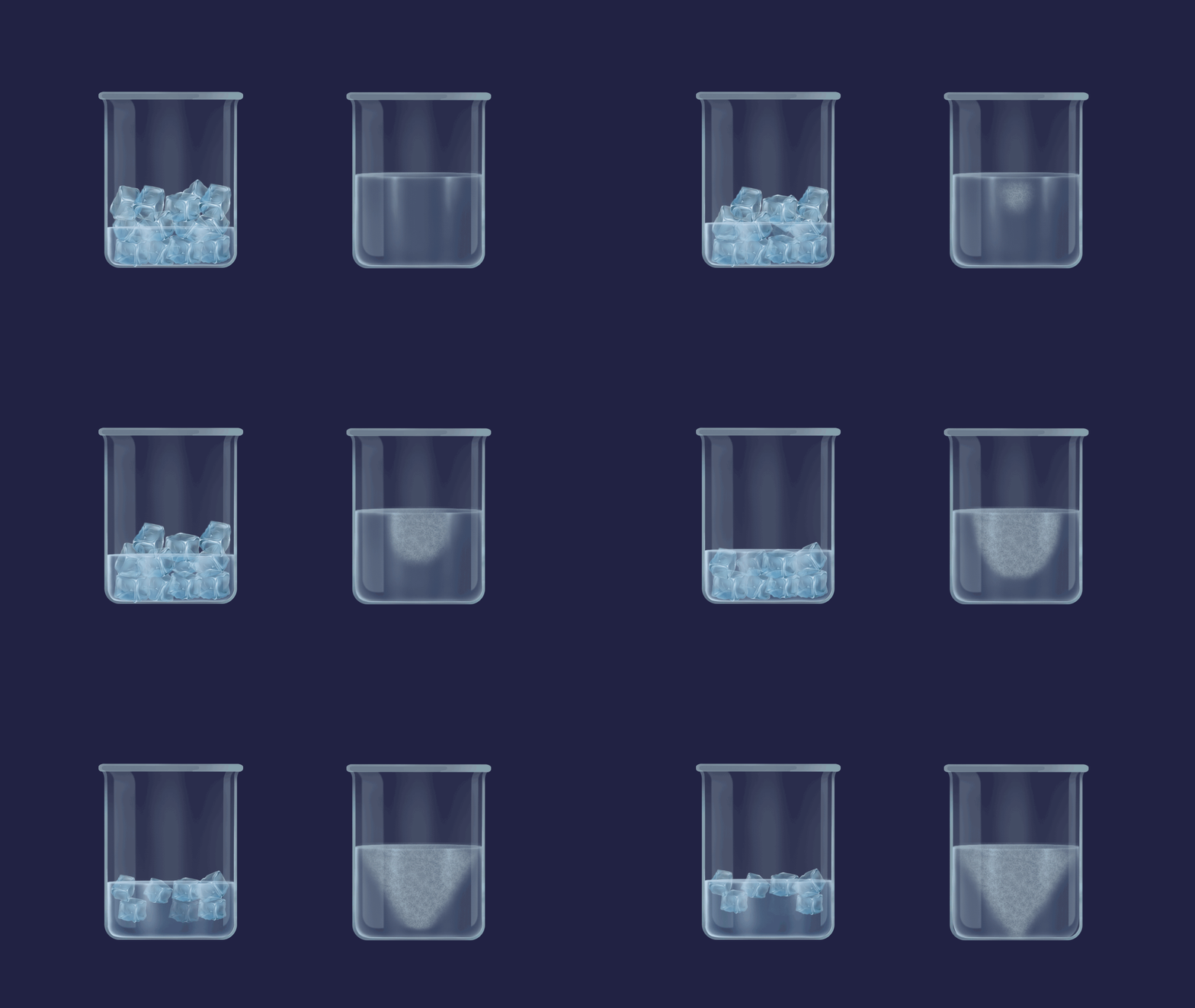
Melting and freezing
Table of content
- Irreversible reaction
- Reversible reaction
- Practice Problems
- Frequently Asked Questions
Irreversible reaction
Chemical reactions occur where reactants react with each other to generate products.
Irreversible reactions are unidirectional processes in which the reactants transform into products completely.
It involves a single reaction.
Key points
- Reactants combine to generate a completely new compound that cannot be changed again to the reactant.
- An irreversible reaction is a one-step reaction represented by (-->) a single arrow.
- It is not possible to establish equilibrium in irreversible reactions.
- Irreversible reactions go to completion.
- A few operations that create irreversible alterations are heating, burning, combining, and powdering. Cooking uncooked eggs that cannot be changed back to their original form is a commonly observed case. Another example is ash produced by the combustion of paper or other materials.
Some examples of Irreversible reactions
- Precipitation reaction: NaCl(aq) + AgNO3(aq) --> AgCl(s) + NaNO3(aq)
- Combustion reaction: C3H8(l) + 5O2(g) --> 3CO2(g) + 4H2O(g)
Reversible reaction
Reversible reactions are those which proceed in both forward and backward directions.
Reversible reactions are a set of two opposing reactions taking at the same or different rates(speed).
Key points
- Reactants combine to generate a completely new compound that can be changed again to a reactant.
- A reversible reaction is a two-step reaction represented by (⇌) a double arrow.
- Rate of the reversible reactions becomes same after some time resulting in the constancy of the concentrations of reactants and products. Reversible reactions are said to have attained equilibrium.
- Even at equilibrium, both forward and backward reaction continue to happen and so the equilibrium is said to be at dynamic equilibrium.
- Reversible reactions never go to completion.
- If the forward reaction is exothermic then the backward reaction is endothermic and vice-versa.
- Melting, boiling, evaporation, freezing, condensation, and disintegration are examples of reversible transformations. Melting wax, freezing ice, and boiling water that evaporates as steam and condenses back to water are a few examples.
Some examples of Reversible reactions
- H2(g) + I2(g) ⇌ 2HI(g)
- N2(g) + 3H2(g) ⇌ 2NH3(g)
Practice Problems
Q1. A mixture of two gases is gathered when ethanol is ignited. What conclusion could this observation lead to?
- The reaction is irreversible.
- It's an exothermic reaction.
- It's an endothermic reaction.
- The reaction can be reversed.
Answer. When a substance is ignited, it burns in the air. To put it another way, we assume it's performing a combustion reaction with oxygen in the air. After the ethanol is ignited, two separate gases are gathered, according to our sources. We can determine that a reaction occurred since the two gases differ from each other and from the two initial ingredients (ethanol and oxygen). We can also conclude that all of the reactants were transformed into products and that the products did not recombine to generate the ethanol because the original component, the ethanol, was not collected at the end of the reaction. We can deduce that the response is permanent. We are not able to depict whether the reaction is exothermic or endothermic because they are experimental observations.
As a result, the correct answer is A, indicating that the reaction is irreversible.
Q2. How can you relate the reversible reactions to our human body?
Answer: The haemoglobin protein has four binding sites. Carbon dioxide or oxygen can attach to haemoglobin molecules. Haemoglobin molecules gather up oxygen-rich molecules and bond to them as blood passes through the lungs. Haemoglobin drops oxygen at the capillaries as it passes through the remainder of the body. It absorbs carbon dioxide after exhaling oxygen.
As a result, haemoglobin molecules, oxygen, and carbon dioxide are reactants, whereas haemoglobin molecules bonded to oxygen or carbon dioxide are products. Some reactants become products while others become reactants in this closed system, making it analogous to a reversible reaction.
Q3. At constant temperature, When a reversible reaction reaches dynamic equilibrium. Which of the following statements is correct?
- The reaction comes to an end.
- There are equal amounts of reactants and products.
- The product concentration to reactant concentration ratio is constant.
- The forward reaction's products stop reacting.
Answer. The reactions have not stopped; they are still occurring at the same rate. Hence, the reaction does not come to an end. (A) is incorrect.
It is not necessary that the amount of reactant and product should be equal. The amount will become constant. (B) is incorrect.
As the amount of reactant and product become constant then their ratio will also become constant. (C) is correct.
When equilibrium is achieved, whether forward or backward reaction will not stop. Hence, reactant and product both react. (D) is incorrect.
Hence, Statement (C) is correct.
Q4. In the given reaction, CuSO4.5H2O(l) ⇌ CuSO4(s) + 5H2O(l), , the forward reaction is endothermic. Can you justify the behaviour of backward reaction?
Answer: The forward reaction is said to be endothermic. This signifies that the reaction requires heat energy from the environment to take place. During this dehydration process (forward reaction), the amount of heat energy transmitted from the surroundings to the reactant is the same as the amount of energy transferred from the product to the surroundings during the hydration reaction of the anhydrous product. As a result, this backward process is exothermic.
Frequently Asked Questions
Question 1. Does every reversible reaction exist in an equilibrium state at every step?
Answer. No, In a closed system, a reversible reaction is not an equilibrium at the beginning but when the concentrations of reactants and products do not change with time, reversible reactions eventually approach equilibrium. However, the forward and reverse reactions have not halted; they are still occurring at the same time.
Question 2. Is rolling an aeroplane from paper a reversible process?
Answer. Yes, rolling an aeroplane from paper is a reversible process. Because if we consider paper as a reactant and an aeroplane as a product, then the aeroplane can be converted back to paper. Hence it is a two-way process.
Question 3. Is burning a candle a reversible process?
Answer. No, burning a candle is an irreversible process. See, melting wax is a reversible process but when wax comes close to a flame, it burns and turns into carbon dioxide. This carbon dioxide cannot be turned back into wax.
Question 4. Why is the precipitation reaction known as an irreversible reaction?
Answer. A precipitation reaction is an irreversible process because once precipitate forms, there are insoluble solids present in the solution. Once precipitates leave the solution, you can not retrieve the reactant by heating the solution. These are permanent changes.
Related Topics
|
Le Chatelier's Principle |
Law of mass action and Equilibrium constant |
|
Chemical Equilibrium-Types of Equilibrium |
Physical equilibrium-Solid Liquid Equilibrium, Liquid-Vapour Equilibrium, Solid-Vapour Equilibrium |
|
Van't Hoff's Equation |

 Call Now
 Let's Chat
 Share
Share