-
Call Now
1800-102-2727


Racemic Mixtures: Definition, Nomenclature of Racemate Compounds, Resolution, Resolution of Racemic Acids, Bases, Alcohols, Methods of Resolution, Practice Problems & FAQs

Imagine you got two bags containing the same number of chocolates, but one containing only red coloured and another containing only blue coloured chocolates.
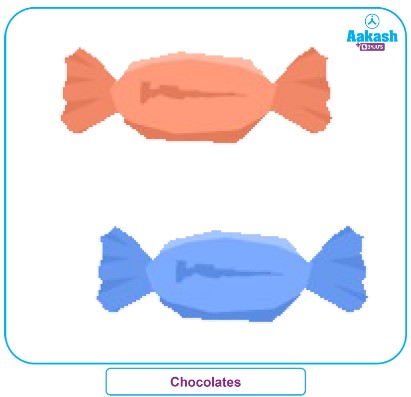
You could say you had a mixture of chocolates that contained both red and blue ones if you were to take both bags, dump them into a big bowl, and then mix them together.
You could say that you have a 50:50 mixture of chocolates if you combine the same number of red and blue ones.
This same scenario exists in a special type of organic compound mixture that contains two similarly structured compounds in equal proportions which are known as racemic mixture. In this article we will discuss racemic mixture in detail.
Table of Contents:
- Definition of Racemic Mixture
- Nomenclature of Racemate Compounds
- Resolution
- Resolution of Racemic Acids
- Resolution of Racemic Bases
- Resolution of Racemic Alcohols
- Methods of Resolution
- Practice Problems
- Frequently asked questions
Definition of Racemic Mixture:
Enantiomers are two organic isomeric compounds with the same molecular formula, structural formula, but are nonsuperimposable mirror images of each other. A mixture containing equal amount of each of the enantiomers( 50:50) is referred to as a racemic mixture. Though the individual isomer is optically active the mixture is optically inactive since the individual isomers act opposite to cancel one another activity on plane polarised light rotation. The mixture is said to be resolved when the enantiomers are separated. The resolution of a racemic mixture is a critical and essential technic widely practised because of the characteristic importance of one enantiomer over the other..
Nomenclature of Racemate Compounds:
When a racemic mixture exhibits no effect or change on polarised light passing through it, it is said to be racemate and that the amounts of both compounds are equal.
There is a specific change that can be seen after these compounds have been separated and exposed to polarised light. Assuming that the ability of two racemic compounds to rotate polarised light is the only difference between them, this ability is used as the nomenclature to distinguish between the two compounds.
The enantiomers rotate a bit, the plane polarising light to either right or left, in other words clockwise or anticlockwise respectively. Dextrorotation is the term used for the clockwise rotation of plane-polarised light. Levorotation is the term used to describe the opposite direction of rotation.
In nomenclature of the racemates, the chemical name of the compound is given a specific prefix indicating the direction of rotation.
A "+," "d," or "D" prefix is attached to a dextrorotatory compound in accordance with the racemic nomenclature and meaning. The meanings are all identical. Similar to this, a levorotatory compound has the prefix "-," "l," or "L." examples are,. D- fructose, (+) fructose, or d- fructose are all possible symbols for the dextro rotatory fructose compound, dextrose-fructose. Similar to this, L-fructose, (-)fructose, or l-fructose can be assigned to represent the enantiomer that has levo rotates the plane polarised light..
Resolution:
Achiral compounds on SN1 reaction naturally end with a racemic mixture containing a 50:50 composition of both enantiomers. Resolution refers to the process of separating racemates into their individual enantiomers. The physical characteristics of the two enantiomers are almost same making the separation or resolution of them using solubility or crystallisation and other physical properties is almost impossible and very challenging. Diastereomers, unlike enantiomers differ in their physical characteristics and can be easily separated into pure components.
A racemate containing equal proportions of the enantiomers on reacting with an another pure chiral compound forms two diastereomers. These diastereomers can be separated in pure form and hydrolysed to pure enantiomer and the reagent enabling the resolution of the enantiomers in pure form.
For example a racemate of acids can be reacted with a chiral alcohol to produce a diastereomeric ester or with a base to give a diastereomeric salt.
The same reactions can be used to separate an alcohol racemate or a racemate base also. For example a racemic mixture of alcohol reacts with a chiral carboxylic acid to form a diastereomeric esters. If, the acid used is pure (D) enantiomer, the products are a mixture of (D-D) and (D-L) diastereomeric esters. They can be easily separated and hydrolyzed to yield or "resolved" to their enantiomerically pure D and L alcohols.
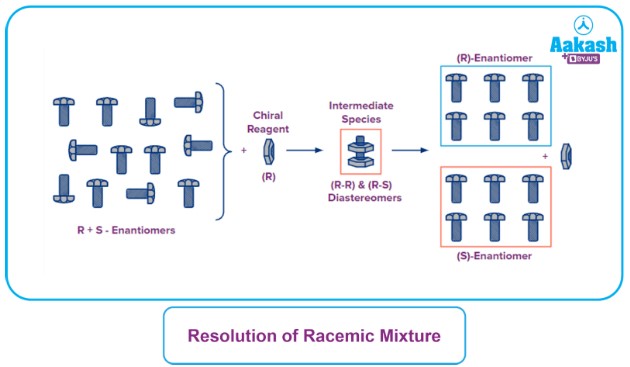
Chemical and physical reactions can form diastereomers, with different properties needed for easy separation. This general concept is illustrated in the above Figure. Say we are having an equal number of right (R) and left (L) handed bolts of same size mixed together. For separating them, take a a left or right handed nut. A left handed bolt can be screwed to both left and right handed nuts but their direction of winding and unwinding in opposite directions and thus differentiating the product. The products will be of R-R and R-L combination that can be easily identified. R-R andR-L combinations can be easily separated. Unwinding of the nut from the separated combinations will give the R or L form of bolts
Enantiomers also can be similarly made to react with a pure optically active substance to give d-d or d- l stereoisomers that can be easily separated. And ultimately isolated in pure forms of d or l.
Because enantiomers have identical physical properties, they are rarely separated by simple physical methods such as fractional distillation or crystallisation. Enantiomers only behave differently under the influence of another chiral substance, and almost all methods of enantiomer resolution are based on this fact.
Separation of Acid Racemate:
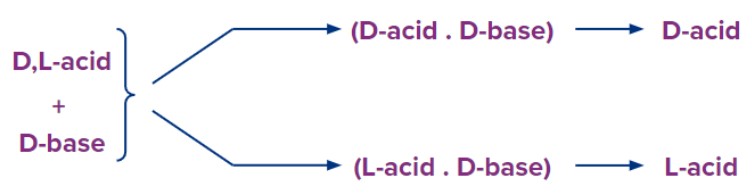
Pure optically active enantiomeric acids can be separated from their racemic mixture by treating with an optically active base substance. The reaction is a simple acid- base reaction forming salt and water. But the salt here will be of two types and diastereomeric with distinguishing physical properties. The two salts can be separated utilising the difference in physical properties first and hydrolysed to get back the pure enantiomeric substances.
For example, if you want to resolve a racemic D-L mixture of acids, choose a chiral base of either d or l form and allow them to react from diastereomeric salts. For example, a chiral D-base forms two salts with D acid-D base and L acid- D base. The salts being diastereomeric will have different physical properties enabling resolution, from which the pure form enantiomers can be liberated.
The process has to be sometimes repeated till the maximum optical rotation indicating the pure compound is achieved.
The optically active bases or acids can be natural or synthetic. Many naturally occurring chiral bases like brucine, strychnine, and quinine are available for this kind of resolution of racemates. Example of synthetic optically active bases that are available are Amphetamine, 1-phenylethanamine, and 2-amino-1-butanol.
Separation of Base Racemates:
In the light of the discussion above, a mixture of enantiomers of a base can be separated by reacting the mixture with an optically pure acids, forming diastereomeric salts, separating , hydrolysing and obtaining pure optically active baes enantiomers. Naturally occurring chiral acids of (-)- malic acid, (+)- tartaric acid, and (-)-mandelic acid are widely used in the separation of base racemic mixture.
Resolution of Alcohol Racemate:
A chiral acid, on reacting with the racemate alcohol, shall form diastereomeric esters. But the products mostly are liquid in nature and techniques like crystallisation cannot be applied. Other techniques like chromatography, solvent extraction are tried for the separation of pure alcohols from the racemate mixture.
Resolution Methods:
Considering the importance and necessity of specific enantiomers, other methods to selectively isolate a particular enantiomer at the expense of the clothes are being developed.
Chemicals that selectively react with one of the enantiomers can be used kinetically to destroy the unwanted enantiomer leaving behind the required enantiomers for further isolation.
Chemicals with higher physical interaction may hold back one of the enantiomers and allow the movement of the other enantiomer , say in chromatographic methods enabling the separation of them.
But all these ideas are developed on an individual case of separation rather than as a common technique.
Practice Problems:
Q.1. Which of the following has the ability to exist as a pair of enantiomers?
(A) 3-methyl hexane
(B) 3- methyl pentane
(C) 2-methyl propane
(D) None of the above
Answer: (A)
Because of molecular asymmetry and chiral carbon, 3-methylhexane
( is optically active. It can therefore exist as a pair of enantiomers.
Here (*) represents chiral carbon means which is having four different groups.
Q.2. Racemic mixture is
(A) Optically active
(B) Optically inactive
(C) Both A and B
(D) None of the above
Answer: (B)
An equimolecular mixture of enantiomeric pairs is referred to as a racemic mixture. The rotation caused by one enantiomer's molecules cancels out the rotation caused by the other enantiomer's molecules. Because of this, racemic mixture becomes optically inactive.
Q.3. Among the following, which statement about any (S)-enantiomerism is true?
(A) It rotates plane-polarised light to the left
(B) It rotates plane-polarised light to the right
(C) It is a racemic form
(D) It is the mirror image of the related (R)-enantiomer.
Answer: (D)
Carbons with four different substituents on them are referred to as stereocenters (also known as chiral centres) and are classified as having either R stereochemistry or S stereochemistry. If a molecule has one stereocenter with a R configuration, its mirror image would have a S configuration stereocenter, and vice versa. The R,S is related to the configuration of the penultimate hydroxyl group and has nothing to do with plane polarised light rotation or D and L nomenclature.
Q.4. Select the correct option among the following that best describes enantiomerism?
(A) A stereoisomer pair that is not mirror images of one another
(B) Any pair of stereoisomers
(C) A stereoisomer pair that are non-superimposable mirror images of one another
(D) None of the above
Answer: (C)
Enantiomers are non-superimposable mirror images of one another. Stereoisomers are enantiomers that are mirror images of one another. Diastereomers are also non-superimposable but not mirror images of each other. Diastereomers are not mirror images of each other, which are known as stereoisomers.
Frequently asked questions:
Q 1. What characteristics does the racemic mixture have?
Answer: A racemate is optically inert because there is no net rotation of plane-polarised light within it. Since the two enantiomers are present in equal amounts, their opposing rotational effects on plane-polarised light cancel out.
A racemate may possess qualities that set it apart from either of the two pure enantiomers, in contrast to the two pure enantiomers, which are physically identical aside from the plane-polarised light rotation. The most frequent variations are in melting points, but solubilities and boiling points can also vary.
Q 2. What distinguishes optically active from optically inactive compounds?
Answer: A substance that does not rotate the plane of plane polarised light is referred to as optically inactive, whereas a substance that rotates the plane of plane polarised light either in clockwise or anticlockwise direction is referred to as optically active.
Q 3. How do you separate a racemic mixture using an enzyme reaction?
Answer: Enzymes are chiral protein molecules that are stereospecific and function as catalysts. They only interact with one enantiomer in a racemic mixture because of their chirality. An enzyme-bound enantiomer goes through a reaction. The non-bonding enantiomer does not change. The unreacted enantiomer can then be separated from the reaction mixture using standard separation techniques like distillation or recrystallization. However, you will lose the other half of the original mixture.
Q 4. What is racemisation?
Answer: In organic chemistry, racemization happens when a compound undergoes a reaction that results in an equal mixture of both possible enantiomers, also known as a racemic mixture. When two substances are categorised as being enantiomers of one another, it means that their mirror images cannot be superimposed.
Related topic
| R and S Configuration | Stereoselectivity and regioselectivity | enantiomeric excess |
| Optical isomerism | Elements of Symmetry | Configurational and conformational |
| Structural Isomerism | Number of stereoisomers | Conformation |

 Call Now
 Let's Chat
 Share
Share