-
Call Now
1800-102-2727


Pulverisation – Size Reduction Techniques, Types, Components, and Mechanism of Pulverisation, Practice Problems and FAQ

Metals have long been a part of daily life for humans. Many of the metals we use don't exist in nature in their native forms. They exist as minerals in which useful metals are mixed with non-metallic impurities like sand, clay, limestones, etc. Therefore, it is crucial to remove these metals from the minerals so that they may be put to better use. Ores are minerals that can be utilised to obtain metals in a profitable manner. The extraction of metals from their ores is called metallurgy. Grinding and pulverisation are the first and most important processes in the process of obtaining a metal from its ore.
The ores that were mined from the crust of the earth typically come in large lumps. Jaw crushers or grinders are used to reduce these lumps to small fragments. This action is referred to as grinding. With the use of a ball mill or stamp mill, the minute bits produced by grinding are reduced to fine powder. Pulverisation is the term for this action.
In this article, we will get to know more about the types, components, and mechanisms of pulverisation in detail.
TABLE OF CONTENTS
- Size Reduction Techniques
- Pulverisation
- Pulverisation – Motives
- Pulverisation – Types
- Pulverisation – Components and Mechanism
- Pulverisation – Applications
- Practice Problems
- Frequently Asked Questions – FAQ
Size Reduction Techniques
Size reduction is crucial because it facilitates the separation of entrapped components, increases the surface area per unit volume, and facilitates better handling in mineral processing procedures. Small particles can be produced either by breaking bigger particles or by agglomerating smaller particles. The following techniques are commonly adopted in the size reduction of bigger particles.
- Pulverisation
- Cryogenic grinding
- Atomisation
- Electrolysis
Pulverization by new methods like electrohydraulic effect, high-frequency currents, and air-pressure mills are being tried for special powder preparations.
Pulverisation
The mechanical process of pulverisation reduces the size of any solid material to less than 10 mm by applying an external force in one or more steps. Pulverisation using a stone mortar and pestle is being carried out since 8000 B.C. Large-scale pulverisation has seen improvements from milling stones to crushers to the modern mill of present times. Pulverisation has become an essential process in the manufacture of materials like glass, ceramics, paints, and medicines.
Pulverisation – Motives
To create a powder with certain qualities for use in a particular application, pulverisation is done. The following are the reasons why things are ground up.
- To ensure that the ore has homogeneous particle size
- To increase the surface area
- To facilitate the separation of important constituents
- To boost the reactivity
- To aid in alloying with metals of a comparable size
- To make composites
- To increase homogenisation
- To help logistics
Pulverisation – Types
Pulverisation methods can be classified based on the pulverisation material or on the mechanism of pulverisation. Based on the raw material of pulverisation, pulverisers are classified into coal pulverisers, concrete pulverizers, plastic pulverizers, food pulverizers, plastic pulverizers and so on. Based on the mechanism of pulverisation, the technique is of three main categories
- Crushing
- Impact
- Grinding
Crushing: Crushers, as the name suggests, are the breaking of big and dense objects, like rocks, stones, and concrete held between two opposite forces slowly. Crushing is a compression cum pulverisation process. Crushers are used to make small uneven pieces for easy handling. MPS mills and Bowl mills are a type of crusher used for crushing coal. These are medium-speed pulverizers.
Impact: Impactors or impact crushers, use a sudden force on the bigger pieces by a movable piece like that of a hammer or a big ball. This is a collision pulverisation used to get particles of around 10 cm.
Grinding: Grinding mills use the friction created between small hard moving materials on the larger pieces to break down materials. Grinding mills are of two types namely, ball mills and hammer mills. A ball mill has an inclined or horizontally rotation cylinder containing spherical hard materials made from steel, ceramics, etc. The material gets smashed and pulverised by the rotating balls. Hammermills, on the other hand, has fixed hammer attachment which smashes the larger pieces during rotation. These are slow-speed pulverizers. Mineral, cement and chemical industries use grinding mills for pulverising their materials.
Pulverisation – Components and Mechanism
All pulverizers contain a feeder, rotating cylinder, grinding spheres for crushing, and an existing mechanism for drawing pulverised material. Additionally, they may also contain a temperature controller, flow controller, accident protection shields, automatic shut-off, etc. The material of construction and operation of the components of the pulveriser depends on
- Coarseness or density of the raw material
- Loading
- Separation of the pulverised material and the number of recycling
Each loading will result in a certain degree of pulverisation only. So, separation and recycling improve pulverisation. Solids have default imperfections in them. Application of strain induces shear along the imperfections leading to breaking into small pieces.
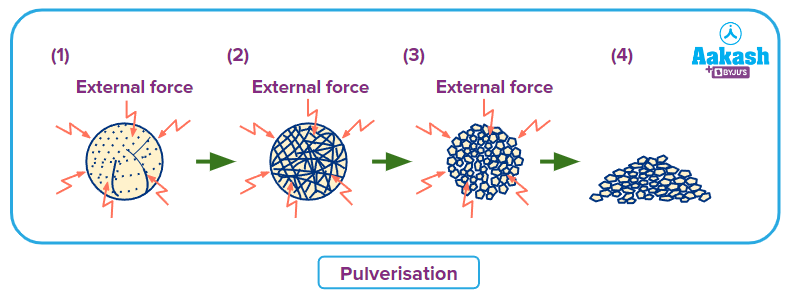
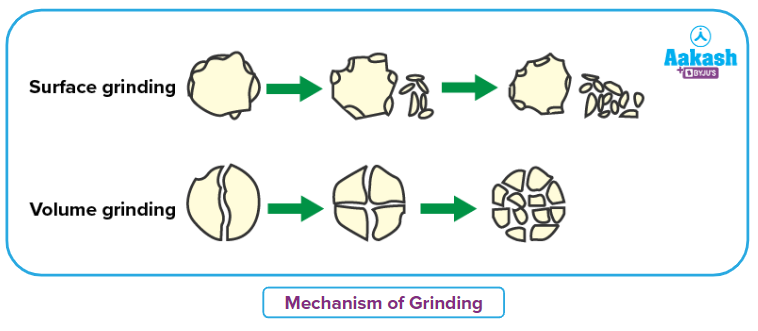
Depending on the method of application of strain (external force), pulverisation can be classified as volume grinding and surface grinding. In the crushing and impact pulverisation techniques, the breaking occurs inside the body, and hence, these are volume grinding. In the grinding technique, small pieces separate due to the collisions between the spherical balls on the big particles, till they form very small particles. So this will be a surface grinding.
The defects decrease with pulverisation because of this, the smaller particles exhibit higher strength and try to aggregate. So, some surface active agents are mixed while pulverisation.
Pulverisation – Applications
Material in its powder form is necessary for many industries of mining, power generation, pharmaceuticals, food processing, building construction, paints, waste disposal, personal products etc.
Practice Problems
1. Pulverisation in a ball mill is based on
a. Impact pulverisation
b. Compression pulverisation
c. Surface attrition
d. None of these
Answer: C
Solution: In Impact and compression pulverisation, breaking occurs through defects in the solid under force. In the ball mill, the object colloids repeatedly with the balls resulting in the removal of surface particles only without affecting the bulk of the material. Therefore, pulverisation in a ball mill is based on surface attrition or surface grinding.
So, option C is the correct answer.
2. Choose the correct statement.
a. In the crushing pulverisation technique, a single sudden force is applied.
b. In the impact pulveriser technique, two opposite forces are used.
c. In the crushing pulverisation technique, two opposing forces are applied.
d. In the grinding pulverisation technique, no force is used.
Answer: C
Solution: In the crushing technique of pulverisation, two opposing forces crush slowly the big particles into smaller ones. In impact pulverisation, an object with strong force is made to hit suddenly and repeatedly to break the given material. In grinding pulverisation, a force of friction is used for size reduction.
So, option C is the correct answer.
3. Cement industries use __________ technology to pulverise their raw material.
a. Crusher
b. Impact
c. Grinding
d. Mortal and pestle
Answer: C
Solution: Cement industries use a long cylindrical rotating vessel for grinding the rocky raw material. Grinding mills use the friction created between small hard moving materials on the larger pieces to break down materials. Grinding mills are of two types namely, ball mills and hammer mills. A ball mill has an inclined or horizontally rotation cylinder containing spherical hard materials made from steel, ceramics, etc. The material gets smashed and pulverised by the rotating balls. Hammermills, on the other hand, has fixed hammer attachment which smashes the larger pieces during rotation. These are slow-speed pulverizers. Mineral, cement and chemical industries use grinding mills for pulverising their materials.
So, option C is the correct answer.
4. The disadvantage(s) of the ball mill is/are
a. Fast
b. Large wear and tear
c. High-cost
d. Large floor area
Answer: B
Solution: Grinding mills are of two types namely, ball mills and hammer mills. A ball mill has an inclined or horizontally rotation cylinder containing spherical hard materials made from steel, ceramics, etc. The material gets smashed and pulverised by the rotating balls. The ball mills are slow in pulverisation and have higher wear and tear than other pulverisation techniques. This is a disadvantage of ball mills.
So, option B is the correct answer.
Frequently Asked Questions – FAQ
1. How is pulverisation useful in waste disposal?
Answer: The collected solid waste is ground into powder by grinding devices in the pulverisation technique of waste disposal, changing its volume and physical properties. Landfilling is used to further dispose of this solid waste that has been ground up. This method is expensive.
2. In grinding, what is ‘grade’?
Answer: The tenacity or hardness with which the bond holds the cutting tips or abrasive grains in place is referred to as the "grade" of a grinding wheel. It doesn't refer to how tough the grain of the abrasive is.
3. Can rubbers be pulverised?
Answer: Yes, rubbers can be pulverised in cryogenic grinding. In cryogenic grinding, rubber materials are cooled with liquid nitrogen to temperatures below the rubber polymer's glass transition and then milled at high strain rates to create a fine powder.
4. At what speed do the pulverisers rotate?
Answer: These pulverisers' grinding sections typically rotate at 75 to 225 rpm. They run on the concepts of attrition and crushing. One surface rolls on top of the other to create pulverisation between the two surfaces.
Pulverised coal is most useful in power generation. Why?
The complete combustion of the coal ensured by pulverised coal fire results in better steam generator efficiency. The majority of large coal-fired utility boilers use it. The efficiency of coal combustion increases with finer coal grinding.

 Call Now
 Let's Chat
 Share
Share