-
Call Now
1800-102-2727


Ortho Hydrogen – Forms of Hydrogen, Ortho, Para Hydrogens, and Their Differences, Practice Problems and FAQ

Have you looked up at the stars from the edges of cities or from the countryside?The milky way arch will be easy to spot if it is completely dark where you are looking from. There are 200 billion stars in it. You will be able to see some of the planets in our solar system, some stars from other galaxies, and occasionally the individual galaxies themselves in addition to the stars in our galaxy. Other celestial objects that are not visible to the naked eye include black holes, neutron stars, brown dwarfs, rogue planets, and exoplanets.

All these celestial objects make up the universe's normal matter, which makes up only 5% of the total universe. Only 5% of our universe is made up of ordinary matter, with the remaining 68% being dark energy and 27% being dark matter.
About 75% of the observable universe consists of hydrogen. Thus, hydrogen is the element that is most plentiful in the universe. In order to survive as a species, it is crucial for humans to comprehend the qualities, traits, types, and forms of hydrogen.
The various forms of hydrogen will be covered on this concept page, with an emphasis on the nuclear spin isomers of hydrogen i.e. ortho– and para–hydrogens.
TABLE OF CONTENTS
- Various Forms of Hydrogen
- Nascent Hydrogen
- Atomic Hydrogen
- Occluded Hydrogen
- Ortho– and Para–Hydrogen
- Difference Between Ortho– and Para–Hydrogens
- Conversion of Para–Hydrogen into Ortho–Hydrogen
- Practice Problems
- Frequently Asked Questions – FAQ
Various Forms of Hydrogen
The atomic structure of hydrogen is the most basic of all the elements found in nature. It only has one proton, one electron, and no neutrons when it is in its atomic state. Hydrogen has a 1s1 electronic configuration. It is known as dihydrogen when it is present as a diatomic (H2) molecule.
There are various special hydrogen forms. They are
- Nascent Hydrogen
- Atomic Hydrogen
- Occluded Hydrogen
- Ortho– and Para–Hydrogen
Nascent Hydrogen
Nascent hydrogen is the term used to describe hydrogen that is freshly produced in a reaction. It has greater activity than regular hydrogen.
When hydrogen gas is bubbled through acidified potassium permanganate, the solution is not decolourised, but when some small pieces of zinc metal are added to this solution, hydrogen gas evolves and the solution is decolourised. The hydrogen that is produced in this case is more active than molecular hydrogen and is known as nascent hydrogen. Nascent means ‘newly born’.
It is speculated that hydrogen molecules pick up some of the energy generated in the hydrogen-producing process, making them hyperactive.
Atomic Hydrogen
- Hydrogen is split into atoms when it passes through an electric arc created between two tungsten filaments. Atomic hydrogen is the name given to this type of hydrogen. This is an endothermic reaction and requires 105.4 kJ/mol.
H2 H+H
Molecular Hydrogen Atomic Hydrogen
- Atomic hydrogen has a lifetime of 0.3 seconds. It easily takes on its regular form again. The exothermic nature of this conversion makes it ideal for welding.
- Compared to regular hydrogen, this type of hydrogen is more active.
- Nascent hydrogen can form even at normal temperatures, but atomic hydrogen can only be created at extremely high temperatures. Atomic hydrogen has greater reducing power than nascent hydrogen.
Occluded Hydrogen
In 1867, Graham observed that one volume of red hot palladium absorbed 975 volumes of hydrogen on cooling, and the gas that was adsorbed by the metal got released when the metal was heated under reduced pressure. This phenomenon is called occlusion or adsorption, and the hydrogen gas that got occluded or adsorbed is called occluded or adsorbed hydrogen. Metals like platinum, iron, gold and nickel exhibit this property.
Occluded hydrogen is a stronger reducing agent and is more reactive than ordinary hydrogen. It is speculated that hydrogen gas occupies the holes in the crystal lattice of the metal in the interstitial compound.
Ortho– and Para–Hydrogen
When the nucleus of an atom contains an odd number of nucleons (neutrons and protons), the nucleus has a resultant spin. When two such atoms combine to form a molecule, the nuclear spins of these atoms can be parallel or anti-parallel to each other. This phenomenon is called nuclear spin isomerism and the molecules are called nuclear spin isomers. The molecule in which the spins of the two nuclei are parallel are called ortho isomers and the molecule in which the spins of the two nuclei are anti-parallel are called para isomers. Both these forms exist in a temperature-dependent equilibrium.
- Since the hydrogen molecule contains two hydrogen atoms, it exists in diatomic form.
- Each atom has one proton in its nucleus, surrounded by an electron.
- When two hydrogen atoms combine to form a molecule, the two electrons always have opposite spins. If not, the molecule will be highly unstable according to Pauli’s exclusion principle.
- Like the electron, the proton has a spin. The ortho and para forms of a hydrogen molecule are created when the spins of the neutrons of the two hydrogen atoms are in the same or opposite directions, respectively.
- The forms of hydrogen are known as ortho hydrogen and para hydrogen, respectively, depending on whether the nuclear spins of the atoms are parallel or anti-parallel.
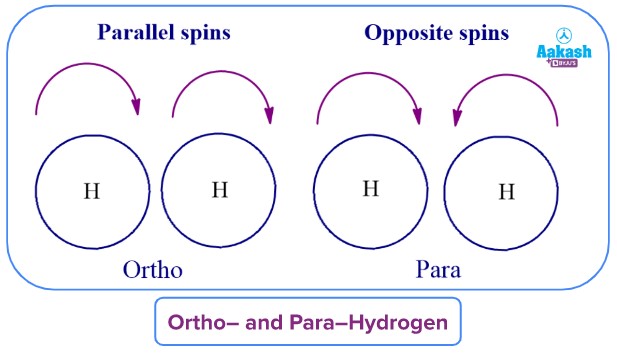
The net nuclear spin of the isomers is as follows.
Ortho-hydrogen:
Para-hydrogen:
- Thermal excitation leads hydrogen to have roughly 75% orthohydrogen and 25% parahydrogen at ambient temperature and thermal equilibrium.
- In the lab, ortho- and parahydrogen can be mixed 50:50 by either holding hydrogen at 77 K for a short period of time with activated charcoal or by passing it over an iron(III) oxide catalyst at that temperature.
Difference Between Ortho– and Para–Hydrogens
Due to variations in their internal energy, the ortho and para forms' physical characteristics, such as boiling temperatures, specific heats, and thermal conductivities, change significantly. The band spectra of the ortho and para versions of H2 differ as well.
Here are a few major differences based on the physical properties.
Internal Energy
The para-form has a lower energy than the ortho-form as the spins of two protons are in the same direction in ortho-form. This increases the molecular energy of the ortho-form. Therefore, the net spin of ortho-hydrogen is +1. In the para-form, the nuclear spins of both the protons are in the opposite sides, and therefore cancel out each other. Thus, the net nuclear spin of the para-form is 0. This neutralisation of spins leads to a lesser molecular energy in para-form.
Stability
At room temperature, the stability of ortho-form is more than that of the para-form. Hence, para-form tend to change into ortho-form.
Effect of Temperature on the Ratio of Ortho– and Para–Hydrogens
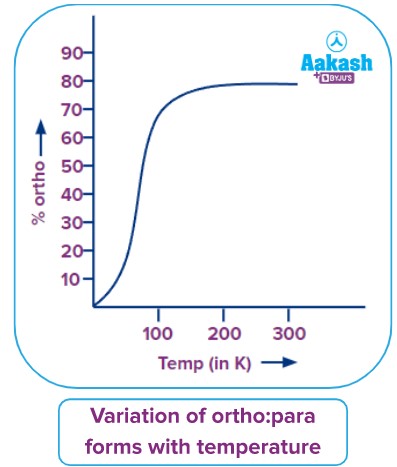
The ratio of ortho: para–hydrogen depends on temperature. At absolute zero, only para-form exists i.e. the ratio of para:ortho = 1:0, as para has low internal energy.
As the temperature is increased, the proportion of ortho form increases and that of para-form decreases. At the temperature of liquefaction, the ratio of para:ortho is 1:1, while at room temperature and any elevated temperatures, the ratio is 1:3.
Physical Properties
The nuclear spin isomerism has no effect on chemical properties and a less significant effect on the physical properties of the isomers. However, two of the most notable differences are
- The thermal conductivity of para-form is 50% greater than that of the ortho-form.
- The melting point of the para-form is 0.15 K below that of hydrogen containing 75% ortho-hydrogen.
Conversion of Para–Hydrogen into Ortho–Hydrogen
At room temperature, compared to para-hydrogen, ortho hydrogen is more stable. The following techniques are used to convert the para form into ortho form.
- Via the use of catalysts such as platinum or iron.
- Through the discharge of an electric current.
- By heating Para form at least 8000C.
- By mixing with molecules that are paramagnetic, such as O2, NO, and NO2.
- By combining with atomic hydrogen or newly formed hydrogen.
Practice Problems
1. What is the ortho-para hydrogen ratio at room temperature?
a. 2:1
b. 1:3
c. 3:1
d. 1:2
Answer: C
Solution: The spins of two protons in a hydrogen molecule might be in the same or opposite directions, giving birth to the ortho and the para-forms. When the proton spins are in the same direction, the form is called ortho hydrogen, and when they spin in different directions, the form is called para hydrogen.Under normal air circumstances, ordinary hydrogen is 75% ortho and 25% para. The ratio of ortho to para-hydrogen comes out to be 3:1.
So, option C is the correct answer.
2. _________ or ____________ are the major catalysts which are used in the conversion of the ortho into para form of hydrogen.
a. Platinum or Iron
b. Copper or Gold
c. Silver or Iron
d. Platinum or Zinc
Answer: A
Solution: Platinum or Iron are the major catalysts which are used in the conversion of the ortho into para form of hydrogen. Compared to para-hydrogen, ortho hydrogen is more stable at room temperature, therefore, para-forms get converted into ortho form.
So, option A is the correct answer.
3. Adsorption of gases on metals occurs in the process known as _____________.
a. Absorption
b. Occlusion
c. Sorption
d. Desorption
Answer: B
Solution: Adsorption of gases on metals occurs in the process known as occlusion. In 1867, Graham observed that one volume of red hot palladium absorbed 975 volumes of hydrogen on cooling, and the gas that was adsorbed by the metal got released when the metal was heated under reduced pressure. This phenomenon is called occlusion or adsorption, and the hydrogen gas that got occluded or adsorbed is called occluded or adsorbed hydrogen.
So, option B is the correct answer.
4. Which among the following statements is incorrect regarding ortho and para forms of hydrogen?
a. Ortho form has larger molecular energy than the para form.
b. Under normal conditions, ordinary hydrogen is 75% ortho.
c. Ortho form is found to be more stable than the para form of hydrogen.
d. Both ortho and para forms show the same band spectra.
Answer: D
Solution: Due to variations in their internal energy, the ortho and para forms' physical characteristics, such as boiling temperatures, specific heat, and thermal conductivities, change significantly. Ortho form has larger internal energy and is more stable as compared to para form at room temperature and above. Both ortho and para forms show different band spectra due to differences in their internal energy.
So, option D is the correct answer.
Frequently Asked Questions – FAQ
1. What do you understand by spin quantum number?
Answer: The fourth quantum number, represented by the letters s or ms, is the spin quantum number. The intrinsic angular momentum of an electron in an atom is indicated by the spin quantum number. It details an electron's quantum state, including its energy, orbital structure, and orbital orientation.
2. How many states of spin can hydrogen possess?
Answer: One proton and an electron in orbit make up each hydrogen atom. Its spin quantum number is 12 since its atomic number is 1. As a result, the hydrogen proton can exist in either its "up" state or its "down" state.
3. Why can not we get pure ortho hydrogen?
Answer: Because ortho hydrogen does not reflect the system's absolute ground state, you cannot produce it in pure form. The degeneracy of the Boltzmann factor, which results in three times more ortho molecules with a spin of 1 than para molecules with zero spin, accounts for 75% of the total.
4. What three industrial purposes does hydrogen have?
Answer: The industry utilises almost all of the hydrogen that is consumed in the country to refine petroleum, treat metals, create fertiliser, and process food.

NEET Related Links
JEE MAIN Related Links
JEE Advanced Related Links
JEE Advanced Eligibility Criteria
JEE Advanced Chemistry Syllabus
JEE Advanced Registration Dates
CUET Related Links
Important Topics
Anemometer : Measurement of Wind Speed
Angular Acceleration Atomic Theory Audible and Inaudible Sound Average Speed and Average Velocity Average Velocity Avogadros Number Avogadros Hypothesis Azimuthal Quantum Number Balanced Force Bar Magnet Biconvex Lens Boyles Law Buoyancy Calorimeter Carnot Engine Celestial Bodies Centripetal And Centrifugal Force Concave and Convex Lenses Concave Convex Mirrors Contact and Non Contact Force Controlled Thermonuclear Fusion Convection Currents Convex Lens Convex Mirror Destructive Interference Difference Between Conduction Convection and Radiation Difference Between Electric Field and Magnetic Field Difference Between Heat And Temperature Difference Between Series And Parallel Circuits Differences Between Acceleration And Velocity Distance and Displacement Distance Time Graph Electrical Force : Electric Forces and Their Types Electromagnetic Waves : Definition, Equation and Properties of Electromagnetic Waves Electromagnetism Electron Spin Fluid Flow : Bernoullis Equation Derivation and Fluid Mechanics Fluid Friction : Types and Factors of Fluid Friction Frames of Reference : Inertial and Non- Inertial Frame of Reference Frequency and Wavelength Frictional Force Importance of Hydrosphere Instantaneous Speed and Velocity Introduction to Motion Kinetic and Potential Energy Difference Law Of Conservation of Energy Layers of the Earth Light Energy Light Sources List of physics scientists and Their inventionsLoudness of Sound
Magnetic Dipole Moment Magnetic Field Non - Contact Force Non - Renewable Energy Ohms Law Optics P Wave Physics Symbols Plane Mirrors Poissons Ratio Projectile Motion Properties of Water : Anomalous Expansion of Water Radius of Gyration Reflection of Light Reflection of Waves Relative Density Resonance Reverberation Rolling Friction Rotation and Revolution Screw Gauge Semiconductors and Insulators Sliding Friction Speed Time Graphs Static Friction Stefan Boltzmann Law Stress Tension Tension Force Thermometer: Clinical Laboratory Thermometer Types of Rocks Types of Waves Uniform Motion and Non Uniform Motion Unit of Voltage Uses of Convex Lens Uses Of Convex Mirror Uses of Electromagnet Uses of Optical Fibre Wave Wavelength of Light What is Scattering of Light Working of Electric Bell Conventional and Non-conventional Sources of Energy Buoyant Force Bulk Modulus of Elasticity Bernoulli’s Principle Angular Momentum Difference Between Speed And Velocity ForceUnit of Heat
Difference between Distance and Displacement Simple Microscope Derivation Of Equation Of Motion Thermometer: Clinical & Laboratory Thermometer Difference between Concave and Convex LensDerivation Of Lens Maker Formula
Unit Of Pressure Velocity Uses of Plane Mirror
Wave Theory of Light
Unit of Density Unit of Light Unit of Force Unit of Magnetic Field Unit of wavelength Unit of Viscosity Uses of Electroplating Young's Modulus
What is the Scattering of Light
Lenz Law Space Wave Propagation Schrodinger Wave Equation Relation between Fahrenheit and Celsius Refractive Index Potentiometer Working Pascal Law Oscillatory Motion Optical Instruments Newton's Laws of Motion - First Law Modulation and Demodulation Magnetic Flux Lens Formula and Magnification Kaleidoscope Faradays Law Epsilon Naught Value Energy Bands Electrostatics Electroscope AC Generator Unit of Current Lithosphere Bending Equation Derivation Difference Between Pound and Kilogram Semiconductor Devices OTEC - Ocean Thermal Energy Conversion Hall Effect Rectilinear Propagation of Light Difference Between Ammeter and Voltmeter Coefficient of Linear Expansion Ampere’s Law Cyclone and Thunderstorm Save The Environment From Pollution Particle Nature of Light Types of DC Motor Uses Of Transistor Derivation of Phase Rule Unit of Humidity

 Call Now
 Let's Chat
 Share
Share