-
Call Now
1800-102-2727


Introduction to Organic Compounds, History, Hybridisation Effects, Homologous Series, Classification of Organic Compounds, Practice Problems, FAQs

Organic compounds are compounds of carbon, hydrogen, and their derivatives. The study of such compounds is done in a separate branch of chemistry called organic chemistry. Organic compounds are compounds of carbon and hydrogen and the following elements may also be present: (Halogens, Nitrogen, Sulfur, Phosphorous, and Oxygen). There are many organic compounds available in nature, and many organic compounds are synthesized every year. Such a possibility arises due to the self-linking property of carbon.
|
Element |
Bond Energy |
|
C |
C-C (Strongest bond) |
|
Si |
Si-Si |
|
Ge |
Ge-Ge |
|
Sn |
Sn-Sn |
|
Pb |
Pb-Pb (Weakest Bond) |
Table of Contents
- History of Organic Compounds
- Catenation
- Hybridisation and its effects
- Important Terms
- Homologous Series
- Classification of Organic Compounds
- Alicyclic Compounds
- Cyclic Compounds
- Practice Problems
- Frequently asked questions
History of Organic Compounds
Different theories were proposed to explain the existence of organic compounds.
1. Berzilius vital force theory
- According to this theory, organic compounds are those which came from living organisms, and can never be synthesized in the laboratory.
- Inorganic compounds are those that came from non-living sources and can be synthesized in the laboratory.
- So, Berzilius proposed that the synthesis of these compounds within the living organisms required some mysterious force, and this force is called the vital force, and the theory was referred to as the vital force theory.
2. Wöhler theory
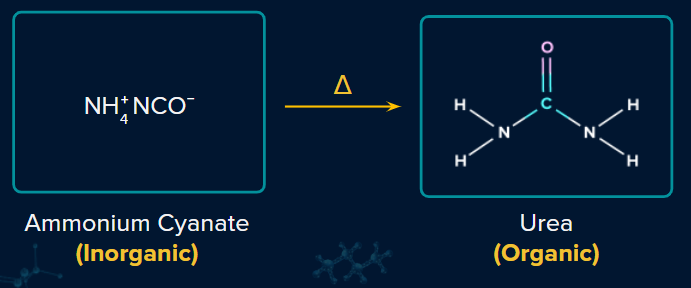
The vital force theory suffered the first death blow in 1828 when Wöhler synthesized the first organic compound, urea (NH2CONH2), in the laboratory by heating ammonium cyanate (NH4CNO), an inorganic compound.
Catenation
Catenation can be defined as the property of self-linkage of atoms of an element to form chains and rings.

The element carbon has the strongest tendency to show catenation or self-linkage because
- Carbon shows tetravalency so that it can form bonds with carbon itself and with other elements.
- It can form multiple bonds (C = C, C ≡ C). Due to its small size, there are efficient axial overlapping b/w two p-orbitals.
- High bond energy of C-C bond so that it can form strong bonds in long chains and cyclic compounds.
Hybridization and its effects
Hybridization in carbon is of three types namely sp, sp2 and sp3. These hybridized states in any given structure can be known by counting 𝞂 bonds around the carbon atom.
If a particular atom of carbon is forming four 𝞂 bonds then the hybridization will be sp3, if three 𝞂 bonds then the hybridization will be sp2 and if two 𝞂 bonds are there around the carbon atom then the hybridization will be sp.
|
Hybridization |
sp3 |
sp2 |
sp |
|
Angle |
109.28 |
120 |
180 |
|
Geometry |
Tetrahedral |
Trigonal Planar |
Linear |
|
Electronegativity |
2.48 |
2.75 |
3.25 |
|
C-C Bond Length (Ao) |
1.54 |
1.34 |
1.20 |
|
C-H Bond Length (Ao) |
1.10 |
1.07 |
1.06 |
|
C-C Bond Energy (Kcal/mol) |
80-85 |
142 |
200 |
|
C-H Bond Energy (Kcal/mol) |
98.6 |
106 |
121 |
- Since the extent of sideways overlap is always low, a carbon-carbon π-bond is always weaker than a head-on overlap leading to a carbon-carbon σ-bond.
- A carbon-carbon double bond is still stronger than a carbon-carbon single bond since it consists of a strong σ-bond along with a weak π-bond.
- In a similar way a carbon-carbon triple bond is stronger than a carbon-carbon double bond.
Important Terms
- Saturated Compounds: When all the valencies of an element are satisfied by σ-covalent bonds.
- Unsaturated Compounds: When a compound contains one or more π-bonds.
- Molecular Formula: The molecular formula of a compound indicates the actual number of atoms of each element present in one molecule.
- Structural Formula: It indicates the linkage due to the covalent bond between different atoms in a molecule.
(i) Expanded Structural Formula (E.S.F.)
(ii) Condensed Structural Formula (C.S.F.)
(iii) Bondline Structural Formula (B.S.F.)
Examples:
|
Condensed Structural Formula |
C3H8 |
C4H10 |
|
Expanded Structural Formula |
|
|
|
Bondline Structural Formula |
|
|


- Degree of carbon: It is defined as the number of carbon atoms attached to a carbon atom.

Homologous series
It is defined as a series of similarly constituted compounds in which the members possess the same functional group, have similar chemical characteristics, and have a regular gradation in their physical properties.
A group or a series of organic compounds each containing a characteristic functional group forms a homologous series.
Successive homologues differ from each other in the molecular formula by -CH2 only.
Examples:
CH3-CH3 (Ethane), CH3-CH2-CH3 (Propane), and CH3-CH2-CH2-CH3 (Butane).
CH3-CH3 + (-CH2) → CH3-CH2-CH3 + (-CH2) → CH3-CH2-CH2-CH3


Classification of Organic Compounds
There are over 27 million chemical compounds known. As a result, studying them separately is nearly impossible. Thus there is a need for the classification of organic compounds. Organic substances can be categorized in two ways structurally and chemically i.e.,
- Based on structure
- Based on functional group
A general classification of the organic compound on the basis of structure is given below:

Acyclic compounds
These are the compounds formed by joining carbon atoms to form an open chain. Aliphatic compounds are another name for these compounds.
Their structure might be either straight or branched chains.
Example of straight-chain Acyclic compound:
n-Butane: CH3 - CH2 - CH2 - CH3
Ethane: CH3 - CH3
Example of branched-chain Acyclic compound:
Isobutane:

Isopentane:

Neopentane:

Cyclic compounds
These are the compounds in which the carbon atoms are linked to each other or to the atoms of other elements in such a manner that the molecule has a closed-chain or cyclic or ring structure.
Examples:
|
Structure |
Name |
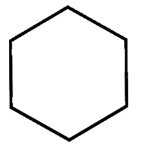 |
Cyclohexane |
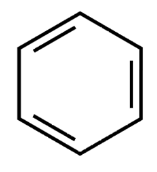 |
Benzene |
|
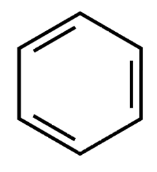 |
Pyridine |
1. Alicyclic (or aliphatic cyclic compounds): An alicyclic compound contains one or more all-carbon rings which may be either saturated or unsaturated, but do not have aromatic character.
Example: Cyclopropane

Alicyclic compounds are further classified into homocyclic and heterocyclic compounds:
2. Homocyclic Compounds: In homocyclic compounds, all the atoms that form the ring are only carbon atoms.
Example: Cyclohexane

3. Aliphatic heterocyclic Compounds: In aliphatic heterocyclic compounds, the cyclic molecule involves carbon as well as heteroatoms like N, O, S, etc.
Example: Tetrahydrothiophene

4. Aromatic Compounds: Aromatic compounds are chemical compounds that consist of conjugated planar ring systems accompanied by delocalized pi-electron clouds in place of individual alternating double and single bonds. They are also called aromatics or arenes. The best examples are toluene and benzene. Aromatics require satisfying Huckel’s rule (4n + 2)π electrons.
Example: Benzene

Aromatic compounds are further classified into benzenoid, non-benzenoid, and heterocyclic aro7. matic compounds.
5. Benzenoid Compounds: It involves only benzene rings.
Example: Naphthalene, toluene, etc.

6. Non-benzenoid Compounds: A compound that exhibits an aromatic behavior but does not contain any benzene ring. The non-benzenoid aromatic compounds have one or more rings fused together but none of the rings is a benzene ring.
Example: Azulene

7. Aromatic Heterocyclic Compounds: In aromatic heterocyclic compounds, the ring contains atoms of carbon as well as any other heteroatoms like N, S, O, etc., but these are still aromatic. These are not just heterocyclic molecules, these are aromatic heterocyclic molecules.
Example: Pyrrole

Practice Problems
Q1. For the given molecule,
A. How many σ and π bonds are present?
B. What is the hybridization of the marked carbon atoms?

Solution:

A. 7σ and 3π bonds
B. sp2and sp
Q2. Calculate the degree of all the carbon atoms in the molecule.

Solution:
Primary Carbons - 5
Secondary Carbons - 1
Tertiary Carbon - 1
Quaternary Carbon - 1

Q3. Find the number of secondary carbon atoms present in the given molecule.

A). 2
B). 3
C). 1
D). 4
Solution:

In the given molecule there are 3 primary carbon atoms, 3 secondary carbons, and 1 tertiary carbon atom.
So, the correct option is B.
Q4. What is the molecular formula of an alkane having a molecular weight of 72 amu ?
- C3H8
- C5H12
- C4H10
- C6H14
Solution:
A. Molecular Weight of C3H8 is 44 amu.
B. Molecular Weight of C5H12 is 72 amu.
C. Molecular Weight of C4H10 is 58 amu.
D. Molecular Weight of C6H14 is 86 amu.
So, the correct option is B.
Q5. What is the hybridization of the marked carbon?

A) sp3
B) sp2
C) sp
D) sp3d
Solution:
The marked carbon in the given molecules forms 2 sigma bonds and 2 pi bonds, so the hybridization of the marked carbon is sp.
So, the correct option is C.
Q6. What is the hybridization of the marked carbon?

A) sp3
B) sp2
C) sp
D) sp3d
Solution:
The marked carbon in the given molecules forms 4 single covalent bonds, so the hybridization of the marked carbon is sp3.
So, the correct option is A.
Q7. Find the number of primary carbons in the following structure.

A). 2
B). 3
C). 1
D). 4

In the given molecule there is 1 primary carbon atom, 5 secondary carbons, and 1 tertiary carbon atom.
So, the correct option is C.
Q8. Cyclopentane is an example of which type of organic molecule?
A) Homocyclic
B) Non-benzenoid
C) Aromatic Heterocyclic
D) Acyclic
Answer : (A)
Solution: An alicyclic compound is an organic compound that is both aliphatic and cyclic.
Cyclopentane is a five-membered ring constituting only carbon atoms and its aliphatic.

Q9. Pyridine is an example of which type of organic molecule?
A) Homocyclic
B) Non-benzenoid
C) Aromatic Heterocyclic
D) Acyclic
Solution: Pyridine is an example of a six-membered aromatic heterocycle and has an electronic structure similar to benzene.

So, the correct option is C
Frequently asked questions
Question 1. Write some applications of organic compounds.
Answer: Organic compounds are used in many daily life things such as fuels, medicines, food, etc.
Question 2. What is the major source of organic compounds?
Answer: The main source of organic compounds is fossil fuels. (petroleum, coal, plants, animals)
Question 3. Which is the first organic compound discovered?
Answer: The first organic compound discovered is urea (NH2CONH2), in the laboratory by heating ammonium cyanate (NH4CNO), an inorganic compound.
Question 4. What is Berzilius's vital force theory?
Answer: According to this theory, organic compounds are those which came from living organisms,
and can never be synthesized in the laboratory.
Question 5. Give some examples of organic compounds used in medicine.
Answer: Organic compounds, frequently split into big groups of tiny organic molecules (e.g., atorvastatin, fluticasone, clopidogrel) and "biologics" (infliximab, erythropoietin, insulin glargine), the latter more generally employed as protein pharmaceutical goods, are most commonly utilized as medicinal products.
Question 6. Explain some properties of Organic compounds.
Answer: Physical properties of organic compounds of interest usually provide quantitative and qualitative information. The melting point, boiling point, and refraction index are all examples of quantitative data. Odor, durability, solubility, and colour are examples of qualitative qualities.
Related Topics
|
Nomenclature of functional groups |
IUPAC nomenclature of unsaturated hydrocarbons |
|
Nomenclature of polyfunctional groups |
IUPAC nomenclature of saturated hydrocarbons |

 Call Now
 Let's Chat
 Share
Share