-
Call Now
1800-102-2727


Nucleic Acid - What are Nucleic Acids? Structure of Nucleic Acids, Structure of DNA, - FAQs

Functions of DNA, Structure of RNA, Functions of RNA, Practice problems, Frequently asked questions

Here, Sharukh khan and his son have been portrayed, in which the resemblance of both can be seen in their physical structure. Are you curious why this occurs?? Let’s find out.
This can be seen in the context of Nucleic acid, which is responsible for inherent character. Nucleic acids are the main information-carrying molecules of the cell, and by directing the process of protein synthesis, they determine the inherited characteristics of every living thing
If you’re now thinking that what are nucleic acids? How are they formed? How do they help in inheritance characters? What are their functions? Don’t worry. We have got you covered. Let's take a closer look at everything.
Table of content:
- What are Nucleic Acids?
- Structure of Nucleic Acids
- Structure of DNA
- Functions of DNA
- Structure of RNA
- Functions of RNA
- Practice problems
- Frequently asked questions - FAQs
What are Nucleic Acids?
Nucleic acids are large structural polymers of nucleotides found in the nucleus of a cell.’ The name nucleic acid was given to this macromolecule because it was first discovered in the nucleus of a cell and had acid-like properties. It is a polymer, meaning it is made up of smaller subunits (nucleotides) that are interlinked together. There are two main nucleic acids, DNA and RNA, and they are responsible for containing the genetic information of a cell. The two nucleic acids have slight differences in their structures but perform extremely different functions in the biological system.
Video link: https://youtu.be/hFq6jD9PKJ4
Structure of Nucleic Acids:
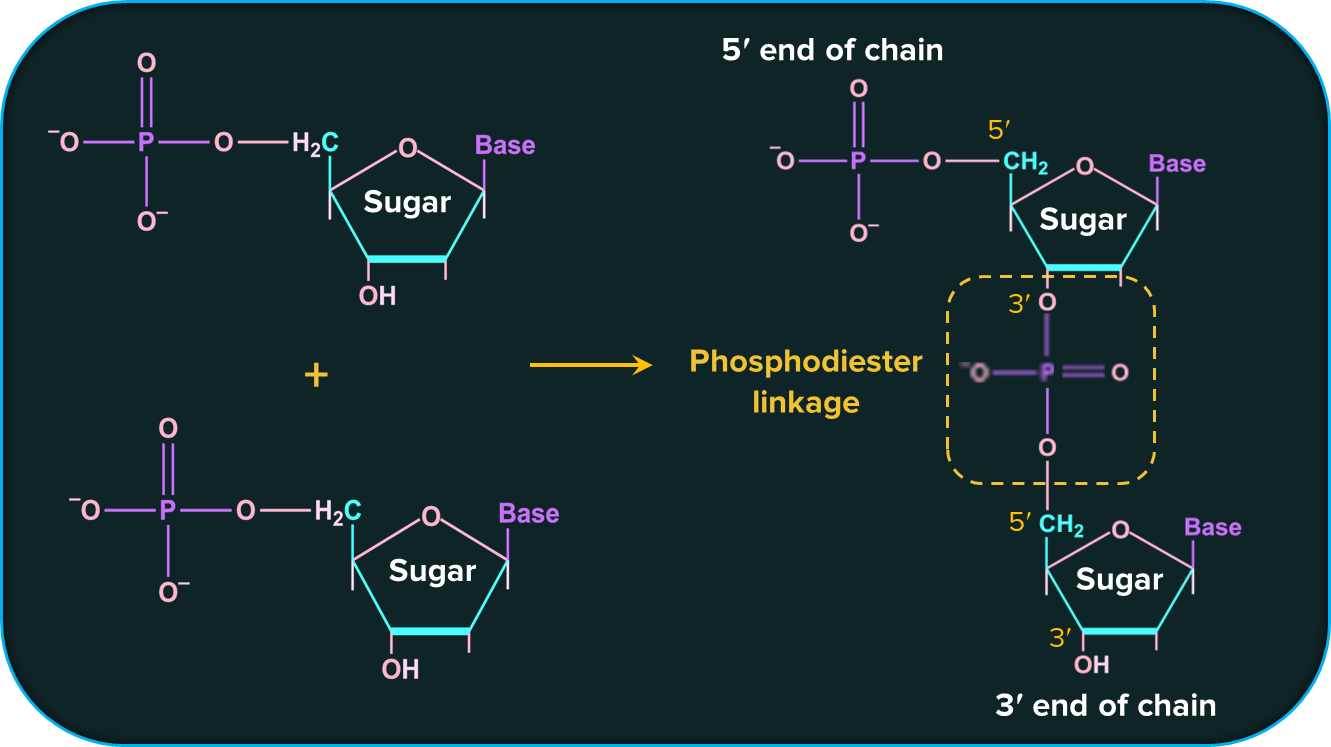
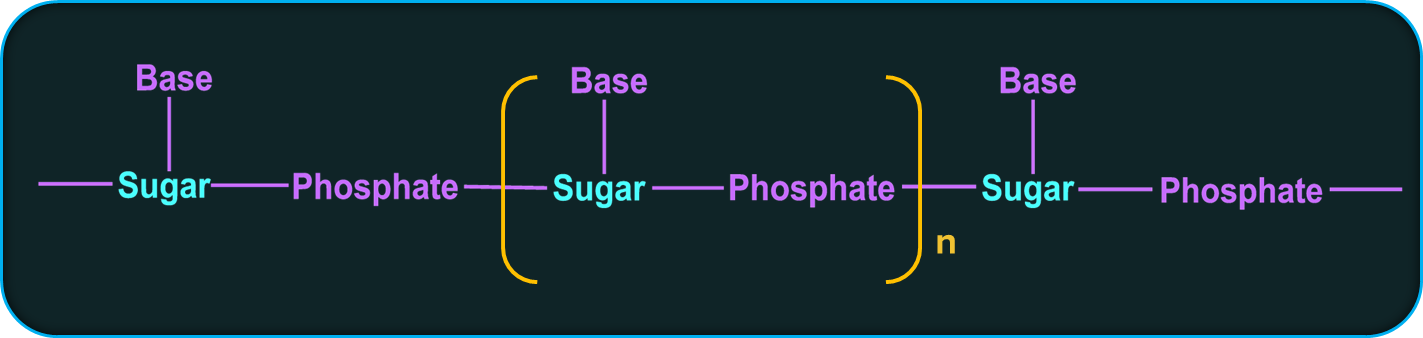
Nucleic Acids are composed of smaller units called nucleotides which are held together by phosphodiester linkages.
Nucleotides:
- The basic unit of nucleic acid is further composed of three subunits: a pentose sugar, a phosphate group and a nitrogenous base.
- These nucleotides are the differentiating factor between the two nucleic acids.
Phosphodiester Bond:
- The adjacent molecules of nucleotides are held together by a phosphodiester bond; this bond is formed between a 3’ OH group of the pentose sugar of one nucleotide and the 5’ phosphate group of another nucleotide.
Nitrogenous Bases:
- There are two types of nitrogenous bases that form complementary pairing with each other.
- Based on the number of rings present in the structure, they are further classified as purines and pyrimidines.
- Purines have double rings in their structure and include adenine and guanine.
- Pyrimidines have a single ring and include thymine, cytosine, and uracil.
A simplified version of the nucleic acid chain is given below:
Structure of DNA
- Deoxyribonucleic acid (DNA) is one of the two nucleic acids found in the nucleus of the cell.
- The structure of nucleotides present in the DNA has pentose sugars that lack oxygen at the 2’ position, hence the name deoxyribonucleic acid.
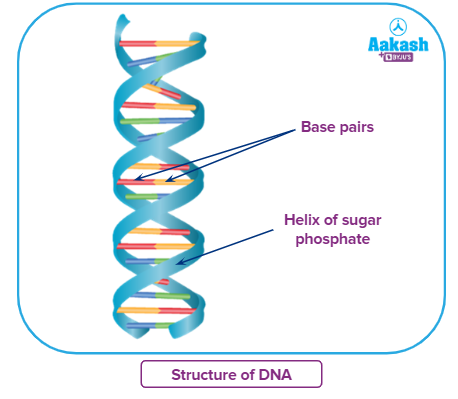
- DNA is a double helical structure with a 3’OH to 5’ phosphodiester bond.
- The nitrogenous bases found in DNA include adenine, guanine, cytosine and thymine.
Functions of DNA
- The nucleus of our cells contains chromosomes which are the tightly packed structures of DNA.
- These chromosomes are responsible for the transfer of genetic information from parent to daughter cell. This process of genetic transfer is called vertical transfer.
- DNA undergoes a process of replication to duplicate the amount of genetic material present in the cell. This replicated DNA later undergoes a process of transcription and forms complementary RNA strands. And the RNA further undergoes translation to form proteins. This implies that DNA forms the basic genetic code for the formation of proteins.
- DNA does not have a structural role in the cell; however, it can undergo breakdown with the help of nucleases to replenish the source of nucleotides and their components in the cell.
- The structure of DNA is also used to study evolution and correlation amongst species of animals. The minute traces of blood or hair found at the crime scene contains an ample amount of DNA that can be sequenced and used to trace the culprit.
Structure of RNA
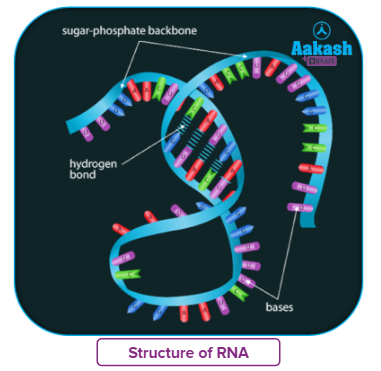
- Ribonucleic acid (RNA) is a single-stranded helix with nucleotides containing a complete pentose sugar, nitrogenous bases like uracil, cytosine, adenine and guanine, and a phosphate group.
- RNA has uracil as a nitrogen base instead of thymine. There are different types of RNA present in the cell-like mRNA, tRNA, and rRNA performing various functions of the cell.
- Apart from this, there are other non-coding RNAs present in the cell as well.
Functions of RNA
Different types of RNA in the cell perform different functions. The functions performed by ribonucleic acids are:
- Messenger RNA (mRNA) contains sets of triplet nucleotides (codons) that code for a specific amino acid in the protein. These mRNAs form the basis of protein synthesis.
- Ribosomal RNA (rRNA) combines with proteins to form ribosomes. These ribosomes bind to mRNA and bring about the translation of the codon into amino acids.
- Transfer RNA (tRNA) is 70-90 nucleotides long and helps in the transfer of amino acids to the ribosomal subunit at the site of protein synthesis.
- Ribozyme, a ribosome containing catalytic enzyme, brings about certain biochemical reactions in the cell, like gene-splicing.
- RNA can also be used as a diagnostic parameter in the detection of an underlying viral infection.
Conclusion: Nucleic Acid is extremely important in transferring hereditary genetic information across generations. Any defect in the structure of nucleic acid leads to abnormalities and fatality. Both DNA and RNA form the core of genetic transfer and are essential for the survival and existence of humankind.
Practice problems:
Question: The nucleic acid monomeric unit is known as_____
A. Nucleotides
B. Nucleosides
C. Pyrimidines
D. Purines
Answer: As nucleotides are monomeric nucleic acids, they are classified as polynucleotides. It consists of three parts: a nitrogenous base, sugar, and a phosphoric acid ion.
So, option A is the correct answer.
Question: What is the name of the pyrimidine base found in RNA but not DNA?
A. Thymine
B. Adenine
C. Uracil
D. Guanine
Answer: Uracil is similar to thymine, except it does not have a methyl group at the C5 position. Uracil is an RNA component that is not found in DNA.
So, option B is the correct answer.
Question: Nucleic acids are formed up of monomers called nucleotides, which are made up of ________ components.
A. 1
B. 2
C. 3
D. 4
Answer: They are made up of nucleotides, which are three-component monomers consisting of a 5-carbon sugar, a phosphate group, and a nitrogenous base.
So, option C is the correct answer
Question: What does a nucleoside consist of?
A. a sugar + a phosphate
B. a base + a sugar
C. a base + a phosphate
D. a base + a sugar + phosphate
Answer: A nucleoside is made up of sugar and a base.
So, option B is the correct answer:
Frequently asked questions - FAQs
Question: What role does nucleic acid play in the transmission of genetic information?
Answer: Nucleic Acid plays a critical role in the transmission of hereditary genetic information across generations. Any defect in the nucleic acid structure causes abnormalities and death. DNA and RNA are the building blocks of genetic transmission and are required for human survival and existence.
Question: What role does nucleic acid play in DNA fingerprinting?
Answer: The transmission of intrinsic characteristics from parent to offspring is mediated by nucleic acids. They are in charge of protein synthesis in our bodies, and forensic professionals employ DNA fingerprinting to determine paternity. Criminals are also identified using this method.
Question: What are the two nucleotide base pairs?
Answer: Four nucleotides constitute two base pairs in the upper right corner: thymine and adenine (linked by double hydrogen bonds) and guanine and cytosine (connected by triple hydrogen bonds). Individual nucleotide monomers are chain-joined at their sugar and phosphate molecules, resulting in two nucleic acids 'backbones' (a double helix), as seen in the upper left.
Questions: Who discovered nucleic acid first?
Answer: Friedrich Miescher named nuclein after discovering nucleic acid in pus cells from discarded bandages. Nucleic acid was eventually shown to be a combination of basic protein and phosphorus-containing acid.

NEET Related Links
JEE MAIN Related Links
JEE Advanced Related Links
JEE Advanced Eligibility Criteria
JEE Advanced Chemistry Syllabus
JEE Advanced Registration Dates
CUET Related Links
Important Topics
Anemometer : Measurement of Wind Speed
Angular Acceleration Atomic Theory Audible and Inaudible Sound Average Speed and Average Velocity Average Velocity Avogadros Number Avogadros Hypothesis Azimuthal Quantum Number Balanced Force Bar Magnet Biconvex Lens Boyles Law Buoyancy Calorimeter Carnot Engine Celestial Bodies Centripetal And Centrifugal Force Concave and Convex Lenses Concave Convex Mirrors Contact and Non Contact Force Controlled Thermonuclear Fusion Convection Currents Convex Lens Convex Mirror Destructive Interference Difference Between Conduction Convection and Radiation Difference Between Electric Field and Magnetic Field Difference Between Heat And Temperature Difference Between Series And Parallel Circuits Differences Between Acceleration And Velocity Distance and Displacement Distance Time Graph Electrical Force : Electric Forces and Their Types Electromagnetic Waves : Definition, Equation and Properties of Electromagnetic Waves Electromagnetism Electron Spin Fluid Flow : Bernoullis Equation Derivation and Fluid Mechanics Fluid Friction : Types and Factors of Fluid Friction Frames of Reference : Inertial and Non- Inertial Frame of Reference Frequency and Wavelength Frictional Force Importance of Hydrosphere Instantaneous Speed and Velocity Introduction to Motion Kinetic and Potential Energy Difference Law Of Conservation of Energy Layers of the Earth Light Energy Light Sources List of physics scientists and Their inventionsLoudness of Sound
Magnetic Dipole Moment Magnetic Field Non - Contact Force Non - Renewable Energy Ohms Law Optics P Wave Physics Symbols Plane Mirrors Poissons Ratio Projectile Motion Properties of Water : Anomalous Expansion of Water Radius of Gyration Reflection of Light Reflection of Waves Relative Density Resonance Reverberation Rolling Friction Rotation and Revolution Screw Gauge Semiconductors and Insulators Sliding Friction Speed Time Graphs Static Friction Stefan Boltzmann Law Stress Tension Tension Force Thermometer: Clinical Laboratory Thermometer Types of Rocks Types of Waves Uniform Motion and Non Uniform Motion Unit of Voltage Uses of Convex Lens Uses Of Convex Mirror Uses of Electromagnet Uses of Optical Fibre Wave Wavelength of Light What is Scattering of Light Working of Electric Bell Conventional and Non-conventional Sources of Energy Buoyant Force Bulk Modulus of Elasticity Bernoulli’s Principle Angular Momentum Difference Between Speed And Velocity ForceUnit of Heat
Difference between Distance and Displacement Simple Microscope Derivation Of Equation Of Motion Thermometer: Clinical & Laboratory Thermometer Difference between Concave and Convex LensDerivation Of Lens Maker Formula
Unit Of Pressure Velocity Uses of Plane Mirror
Wave Theory of Light
Unit of Density Unit of Light Unit of Force Unit of Magnetic Field Unit of wavelength Unit of Viscosity Uses of Electroplating Young's Modulus
What is the Scattering of Light
Lenz Law Space Wave Propagation Schrodinger Wave Equation Relation between Fahrenheit and Celsius Refractive Index Potentiometer Working Pascal Law Oscillatory Motion Optical Instruments Newton's Laws of Motion - First Law Modulation and Demodulation Magnetic Flux Lens Formula and Magnification Kaleidoscope Faradays Law Epsilon Naught Value Energy Bands Electrostatics Electroscope AC Generator Unit of Current Lithosphere Bending Equation Derivation Difference Between Pound and Kilogram Semiconductor Devices OTEC - Ocean Thermal Energy Conversion Hall Effect Rectilinear Propagation of Light Difference Between Ammeter and Voltmeter Coefficient of Linear Expansion Ampere’s Law Cyclone and Thunderstorm Save The Environment From Pollution Particle Nature of Light Types of DC Motor Uses Of Transistor Derivation of Phase Rule Unit of Humidity

 Call Now
 Let's Chat
 Share
Share