-
Call Now
1800-102-2727


Nuclear Reactor- Introduction, Components of a Nuclear Reactor, Types of a Nuclear Reactor, Breeder Reactors, Practice Problems & FAQs

All of you must have experienced a power cut in your house maojorly during summers but what may be the reason for the power cut?
One of the main reasons is more demand but less supply. So, how this demand of electricity be fulfilled during summer season?
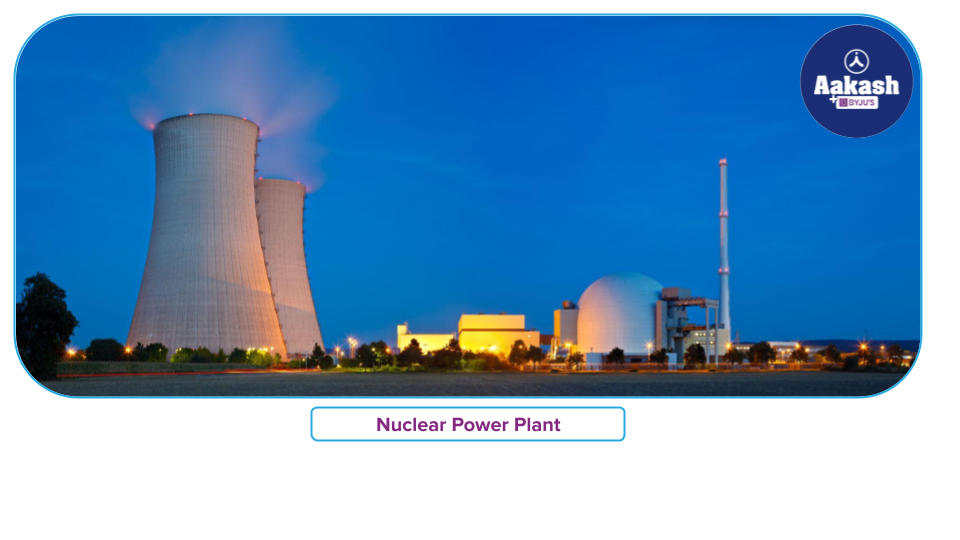
Nuclear power plants may help to solve this problem in future! These all our appliances run on electricity and with increasing demand nuclear power plant is on way to solve this crisis. In India, mostly electricity is generated from the thermal power plants which cause global warming and climate change. There is an urgent need for an alternate source of energy which will have comparatively less pollution and is more reliable to fulfil the demand of future generations. Nuclear energy will play a vital role to fulfil all the needs. It is also becoming the most important technique to strengthen the defence to protect the sovereignty of the state by acquiring different types of nuclear bombs and weapons.
Let’s learn more about nuclear reactors, will see how electricity is produced in nuclear power plants!
Table of Contents
- Introduction to Nuclear Reactor
- Components of Nuclear Reactor
- Types of Nuclear Reactor
- Breeder Reactor
- Practice Problem
- Frequently Asked Questions-FAQs
Introduction to Nuclear Reactor
The reactor is the furnace where fissionable materials are burned for a useful purpose. It is an instrument designed to allow a nuclear chain reaction to occur under control by not allowing all the neutrons produced to carry the chain reaction. Controlled fission is carried out in a plant known as nuclear power plant.
It is necessary to control the fission chain reaction of uranium-235 isotope (fuel of nuclear reactor) so that less energy is emitted and at a usable rate.
Components of Nuclear Reactor
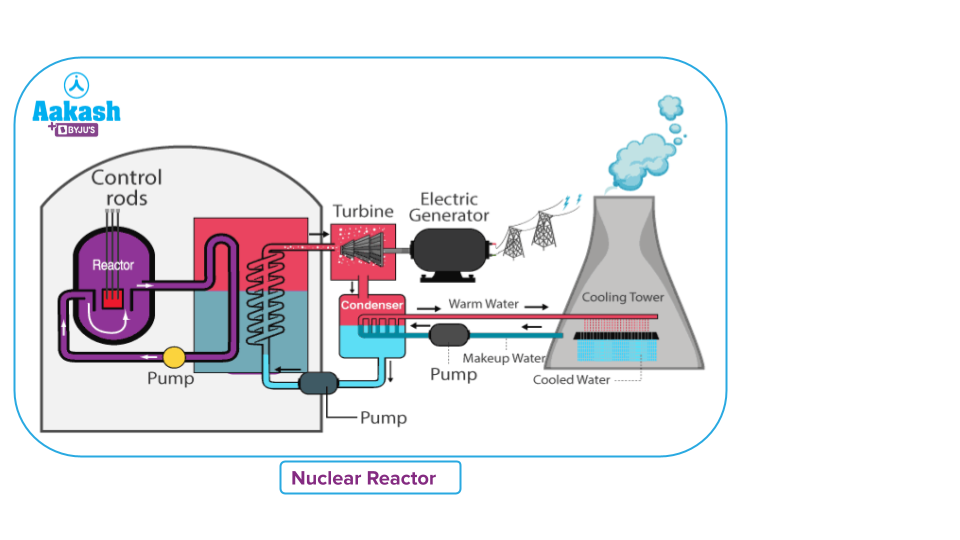
In a nuclear reactor there are five main components namely:
Fuel: Either enriched uranium or natural uranium is used as a fuel. The fission of Uranium-235 produces heat and emits neutrons which start the chain reaction. Fuel is employed either in the form of rods, plates or hollow cylinders.
Controlled rods: Boron or cadmium steel rods are used which absorb the neutron produced in the fission of uranium-235 and thereby control the rate of the fission reaction.

Moderator: We use a moderator to slow down the fast-moving neutron emitted during the fission reaction. A moderator should be used which has comparable mass and is slowed by colliding it with the neutron without absorbing them. Generally, water and graphite is used as a moderator but the more efficient moderator is helium and heavy water but it is used only in the laboratory.
Shielding: It protects the operating personnel and environment from destruction in case of any leakage of radiation. Generally, the reactor is enclosed in a steel containment vessel which is housed in thick-walled concrete buildings.
Cooling system: Liquid alloy of sodium and potassium is used as a coolant. It cools the fuel core by removing the heat produced by the fission. Water and heavy water (D2O) can also be used as a coolant.
Types of Nuclear Reactors
Nuclear reactors are classified on the basis of different parameters.
There are two types of nuclear reactors based on the usage:
- Nuclear power reactors: These are the nuclear reactors which are used for the purpose of producing energy and electricity.
- Nuclear research reactors: These are the reactors which are used for research and testing purposes.
Based on the type of fuel used, nuclear reactors are generally classified into two types:
- Uranium fuelled: Two types of isotopes of uranium are used as fuel uranium-235 and uranium-238 in which uranium-238 is a fertile material ( i.e., it is not itself fissile in nature but can be made fissile by reacting it with neutrons)
- Plutonium fuelled: Plutonium-239 can also be used as a fuel in the nuclear reaction.
Based on the design, nuclear reactors are generally classified into two types:
- Pressurized water reactor
- Boiling water reactor
Breeder Reactor
Generally uranium-235 is used as a fuel for the nuclear reaction but due to less abundance in nature its isotopic form i.e., Uranium-238 can also be used to produce the energy though it is nonfissable substance but it can be made fissile by reacting it with neutrons which converts it to fissionable plutonium-239.

The above reaction produces 3 neutrons and utilises only two neutrons. The extra neutron present is utilised to convert more uranium-238 to plutonium-238. Thus, the reactor breeds its own fuel and is named as a breeder reactor.
Practice Problems
Q1. The waste produced in a nuclear power plant should be handled properly because __________.
- It is radioactive in nature.
- It is inflammable substances.
- It causes pollution.
- It has a poisonous smell.
Answer: (A)
Solution: The waste produced in a nuclear power plant contains radioactive substances and needs to be handled properly. Therefore, it is necessary to dispose of the nuclear waste in a thick lead container and put it in an underground repository. So, option A is the correct answer.
Q2. Which of the following is not a naturally occurring nuclear fuel?
- Uranium-235
- Plutonium-239
- Uranium-238
- Both B and C
Answer: (B)
Solution: Plutonium-239 is radioactive in nature but does not occur naturally. Whereas Uranium-235 and Uranium-238 exist in nature. So, option B is the correct answer.
Q3. Which of the following substances can be used as a moderator in a nuclear reactor?
- Heavy water
- Uranium
- Thorium
- Plutonium
Answer: (A)
Solution: Generally water and graphite is used as a moderator but the more efficiency helium and heavy water can be used as moderators which are only used only in the laboratory. So, option A is the correct answer.
Q4. What is the role of using controlled rods in nuclear power plants?
- It is used as a coolant to remove extra heat produced during the fission reaction.
- It helps in removing waste produced during the nuclear reaction.
- It is used to control the rate of fission reactions by capturing neutrons.
- It acts as a fuel for the nuclear reactor.
Answer: (C)
Solution: Boron or cadmium steel rods are used as controlled rods in nuclear power plants which absorb the neutron produced in the fission of uranium-235 and thereby control the rate of the fission reaction.

So, option C is the correct answer.
Frequently Asked Questions-FAQs
Q1. What will happen when nuclear reactor explodes?
Answer: In nuclear reactors, uranium is used as a fuel to produce electricity with the help of steam. If a nuclear reactor explodes, it will cause pressure and heat to develop and will release steam and radioactive substances into the environment. These radioactive substances are quite harmful for all the living organisms.
Q2. How electricity is generated using a nuclear reactor?
Answer: In nuclear reactors, energy is released when radioactive substances are bombarded with neutrons and the energy produced in the reaction is used to heat the water and convert it into steam. Steam produced in the process rotates the turbine and produces electricity.
Q3. What is the nuclear fuel cycle?
Answer: There are a large number of industrial processes for the production of fuel for nuclear reactors and handling of the spent fuel once it is removed from the reactor. The process together is known as the nuclear fuel cycle.
Q4. What is a chain reaction?
Answer: Chain reaction is the type of reaction which continues for longer periods of time. For example, if the uranium or any radioactive sample undergoes a fission process in such a way that the neutron is emitted and the emitted neutron again strikes the radioactive material emitting more neutrons and so reaction continues.

 Call Now
 Let's Chat
 Share
Share