-
Call Now
1800-102-2727


MOT- Features, Types of MO, Linear Combination of Atomic Orbitals, Shapes of MO, Energy Level Diagrams of MO

Have you ever enjoyed when relatives give you some extra money when they come to your home? This is really exciting for every child. You may get in a better zone than earlier, now you are able to spend more on your desires and one more thing you have experienced is that when your siblings forced you to spend money on their expenses then you might get destablished. Doesn't this happen to you? Same happens in chemistry also. When two similar interactions occur then it is the case of stability and if it is opposite then some instability arises. Let’s study this interesting concept.
Why do we study molecular orbital theory?
To overcome the limitation of VBT, F. Hund and R.S. Mulliken proposed a new theory and named it Molecular orbital theory (MOT). MOT is used to determine the bond parameters and magnetic nature of molecules.
Table of content:
- What is molecular orbital theory
- Features of Molecular Orbital Theory
- Types of MO
- Linear Combination of Atomic Orbitals
- Symmetrical and Asymmetrical MO
- Energy Level Diagram of Molecular Orbitals
- Bond order calculation
- Practice problems
- FAQs
What is molecular orbital theory?
Molecular orbital theory is a theory in which electrons are treated as wave mechanical objects moving under the influence of the nuclei in the whole molecule.
Features of Molecular Orbital Theory
- Electrons are associated with the molecules as a whole and not with individual atoms.
- Atomic orbitals (AOs) of individual atoms combine to form molecular orbitals (MOs).
- Atomic orbitals are monocentric, whereas molecular orbitals are polycentric.
- Energies of the atomic orbitals of the combining atoms must be comparable.
- The number of molecular orbitals formed is equal to the number of atomic orbitals combined.
- Two atomic orbitals produce two molecular orbitals, one with lower energy and the other with higher energy than the energy of combining atomic orbitals.

Atomic orbital combine to form molecular orbital
Types of MO
Bonding molecular orbitals (BMO): Atom A and atom B are to be bonded. The electron cloud of atom A is attracted towards the nucleus of atom B and vice versa. This leads to the formation of orbitals having lower energy and maximum stability. These orbitals are known as bonding molecular orbitals (BMO).


Antibonding molecular orbitals (ABMO): Some electron clouds around the two nuclei tend to pull the nuclei of the two atoms away from each other, leading to an empty region between the nuclei of the involved atoms. These electron clouds tend to keep the two nuclei apart from each other. Therefore, these orbitals have higher energy and are unstable.
Types of Molecular Orbitals Based on Overlapping:


Sigma (σ) BMO: Electron density is directly shared between the bonding atoms along the bonding axis.
Sigma (σ*) ABMO: Normally, this orbital is empty i.e., out of BMO and ABMO, BMO is filled first and if ABMO is also filled then the wave nature of electron density (when present) will be out of phase and cancelling in nature. There is a node exactly in the middle of the bonding atoms (zero electron density).
Pi (π) BMO: The bonding electron density lies above and below, or in front and the back of the bonding axis with no electron density on the bonding axis.
Pi (π*) ABMO: The combination of two atomic orbitals of 2 px or 2py out of phase with each other results in the formation of π*2 px or π* 2py antibonding molecular orbital.
Linear Combination of Atomic Orbitals:


Electrons are associated with dual nature (particle and wave nature). Therefore, an electron is associated with a wave function Ψ, which is the solution to the Schrodinger wave equation and is said to occupy molecular orbitals.

Bonding molecular orbitals: Constructive interference
Consider two atomic orbitals A and B combining linearly. The wave function of BMO is the sum of the wave functions of atomic orbitals A and B.
ѰBMO = ѰA + ѰB

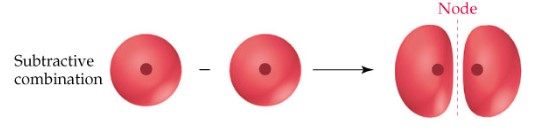
Antibonding molecular orbitals: Destructive interference
Consider two atomic orbitals A and B combined linearly. The wave function of ABMO is the difference between the wave functions of atomic orbitals A and B.
ѰABMO = ѰA − ѰB
Symmetrical and Asymmetrical MO
σ symmetry:
- A molecular orbital will have σ symmetry if the orbital is symmetric concerning the axis joining the two nuclear centres, i.e., the internuclear axis. This means that the rotation of the molecular orbital about the internuclear axis does not result in a phase change.

Symmetry of σ BMO
- A σ* molecular orbital (sigma antibonding orbital) also maintains the symmetry when rotated about the internuclear axis. The σ* molecular orbital has a nodal plane that is between the nuclei and perpendicular to the internuclear axis.

π symmetry:
- A molecular orbital with π symmetry results from the interaction of either two px- px atomic orbitals or two py- py atomic orbitals.
- A molecular orbital will have π symmetry if the orbital is asymmetric concerning rotation about the internuclear axis.
Asymmetry of π BMO
- A π* molecular orbital (pi antibonding orbital) will also produce a phase change when rotated
about the internuclear axis. The π* molecular orbital also has a second nodal plane between the nuclei.

Gerade and Ungerade:
- The orbital is designated g (for gerade, even or zero nodes) if the phase is the same. The orbital is designated u (for ungerade, uneven or odd nodes) if the phase changes sign.
In the figure, the direction of the arrow mark shows the operation of inversion, in which the sign of the lobes remains the same. Therefore, the orbital is gerade (g).

- In the figure, the direction of the arrow mark shows the operation of inversion, in which the sign of the lobes changes. Therefore, the orbital is ungerade (u).

Conclusion: Table showing the symmetry of molecular orbitals.
|
MO |
Symmetry of MO gerade (g), or ungerade(u) |
|
σ(BMO) |
g |
|
σ(ABMO) |
u |
|
(BMO) |
u |
|
(ABMO) |
g |
Energy Level Diagram of Molecular Orbitals
Molecular Orbital Diagram for 1–14 electron System:
The order of increasing energy of molecular orbitals as follows:
σ1s < σ*1s < σ2s < σ*2s < π2px= π2py < σ2pz < π*2px = π*2py < σ*2pz

Energies of molecular orbital for 15–20 electron system:
The order of increasing energy of molecular orbitals is as follows:
σ1s < σ*1s < σ2s < σ*2s < σ2pz < π2px = π2py < π*2px = π*2py < σ*2pz

Orbitals are filled as per the Aufbau principle, Hund’s rule, and Pauli’s exclusion principle.
Bond order calculation :
(B.O.) is defined as one half the difference between the number of electrons present in the bonding
and the antibonding orbitals.
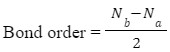
Where, Nb= number of bonding electrons, Na= number of antibonding electrons
Practice problems
Example 1: Draw the molecular orbital diagram for B2 molecule.
Answer: The electronic configuration of B is 1s2 2s2 2p1 . In the B2 molecule, a total of 10 electrons are present that occupy the molecular orbitals.The molecular electronic configuration of B2 is σ1s2 σ*1s2 σ2s2 σ*2s2 (π2px1 = π2py1).

Example 2: What is the bond order of a Ne molecule?
a. 1
b. 2
c. 0
d. 1.5
Answer: The molecular electronic configuration of Ne2 is as follows:

Example 3. Draw the molecular orbital diagram for He2+ molecule.
Solution: The electronic configuration of He is 1s2. The molecular electronic configuration of He2+ is σ1s2 σ*1s1

Example 4. In the molecular orbital diagram for molecular ion, N2+ the number of electrons in σ2p molecular orbital is
a. 0
b. 2
c. 3
d. 1
Answer: The molecular electronic configuration of N2+ is σ1s2 σ*1s2 σ2s2 σ*2s2 (π2px2 = π2py2) σ2pz1.
From electronic configuration, we can easily predict the number of electrons in σ2p which is equal to 1.
FAQs:
Q 1. What is bonding axis?
Answer: Shared electron density is directly between the bonding atoms along with one of the axis and by convention z-axis that is taken to be internuclear axis is considered as bonding axis.
Q 2. Helium molecule has zero bond order. What does this mean?
Answer: Helium molecule has zero bond order, this means that the number of electrons in bonding molecular orbital is equal to the number of electrons in anti- molecular orbital.
Q 3. What is a node?
Answer: Node is a point in the wave where the probability of finding electron density is zero.
Q 4. What is constructive interference and distructive interference?Answer: Constructive interference occurs when the maxima of the two waves add together (the two waves are in the same phase) so that the amplitude of the resulting wave is equal to the sum of the individual amplitudes. Destructive interference occurs when the maxima of two waves are out of phase. A positive displacement of one wave is cancelled by a negative displacement of the other. The amplitude of the resulting wave is zero or less than the amplitude of the combining waves.
Related topics:
|
Hybridisation |
VSEPR Theory |
|
Covalent bonding |
VBT |
|
Coordinate bonding |
Metallic bonding |

NEET Related Links
JEE MAIN Related Links
JEE Advanced Related Links
JEE Advanced Eligibility Criteria
JEE Advanced Chemistry Syllabus
JEE Advanced Registration Dates
CUET Related Links
Important Topics
Anemometer : Measurement of Wind Speed
Angular Acceleration Atomic Theory Audible and Inaudible Sound Average Speed and Average Velocity Average Velocity Avogadros Number Avogadros Hypothesis Azimuthal Quantum Number Balanced Force Bar Magnet Biconvex Lens Boyles Law Buoyancy Calorimeter Carnot Engine Celestial Bodies Centripetal And Centrifugal Force Concave and Convex Lenses Concave Convex Mirrors Contact and Non Contact Force Controlled Thermonuclear Fusion Convection Currents Convex Lens Convex Mirror Destructive Interference Difference Between Conduction Convection and Radiation Difference Between Electric Field and Magnetic Field Difference Between Heat And Temperature Difference Between Series And Parallel Circuits Differences Between Acceleration And Velocity Distance and Displacement Distance Time Graph Electrical Force : Electric Forces and Their Types Electromagnetic Waves : Definition, Equation and Properties of Electromagnetic Waves Electromagnetism Electron Spin Fluid Flow : Bernoullis Equation Derivation and Fluid Mechanics Fluid Friction : Types and Factors of Fluid Friction Frames of Reference : Inertial and Non- Inertial Frame of Reference Frequency and Wavelength Frictional Force Importance of Hydrosphere Instantaneous Speed and Velocity Introduction to Motion Kinetic and Potential Energy Difference Law Of Conservation of Energy Layers of the Earth Light Energy Light Sources List of physics scientists and Their inventionsLoudness of Sound
Magnetic Dipole Moment Magnetic Field Non - Contact Force Non - Renewable Energy Ohms Law Optics P Wave Physics Symbols Plane Mirrors Poissons Ratio Projectile Motion Properties of Water : Anomalous Expansion of Water Radius of Gyration Reflection of Light Reflection of Waves Relative Density Resonance Reverberation Rolling Friction Rotation and Revolution Screw Gauge Semiconductors and Insulators Sliding Friction Speed Time Graphs Static Friction Stefan Boltzmann Law Stress Tension Tension Force Thermometer: Clinical Laboratory Thermometer Types of Rocks Types of Waves Uniform Motion and Non Uniform Motion Unit of Voltage Uses of Convex Lens Uses Of Convex Mirror Uses of Electromagnet Uses of Optical Fibre Wave Wavelength of Light What is Scattering of Light Working of Electric Bell Conventional and Non-conventional Sources of Energy Buoyant Force Bulk Modulus of Elasticity Bernoulli’s Principle Angular Momentum Difference Between Speed And Velocity ForceUnit of Heat
Difference between Distance and Displacement Simple Microscope Derivation Of Equation Of Motion Thermometer: Clinical & Laboratory Thermometer Difference between Concave and Convex LensDerivation Of Lens Maker Formula
Unit Of Pressure Velocity Uses of Plane Mirror
Wave Theory of Light
Unit of Density Unit of Light Unit of Force Unit of Magnetic Field Unit of wavelength Unit of Viscosity Uses of Electroplating Young's Modulus
What is the Scattering of Light
Lenz Law Space Wave Propagation Schrodinger Wave Equation Relation between Fahrenheit and Celsius Refractive Index Potentiometer Working Pascal Law Oscillatory Motion Optical Instruments Newton's Laws of Motion - First Law Modulation and Demodulation Magnetic Flux Lens Formula and Magnification Kaleidoscope Faradays Law Epsilon Naught Value Energy Bands Electrostatics Electroscope AC Generator Unit of Current Lithosphere Bending Equation Derivation Difference Between Pound and Kilogram Semiconductor Devices OTEC - Ocean Thermal Energy Conversion Hall Effect Rectilinear Propagation of Light Difference Between Ammeter and Voltmeter Coefficient of Linear Expansion Ampere’s Law Cyclone and Thunderstorm Save The Environment From Pollution Particle Nature of Light Types of DC Motor Uses Of Transistor Derivation of Phase Rule Unit of Humidity

 Call Now
 Let's Chat
 Share
Share