-
Call Now
1800-102-2727


Molar Conductivity

Molar conductivity is a concept in electrochemistry that describes how an electrolyte conducts electricity when present in a solution. It combines the effects of both the ability of ions to move and the number of ions present in a given volume of solution. Molar conductivity focuses on the concept of ionic mobility, ionisation of electrolytes, and their behaviour at different concentrations.
Definition
Molar Conductivity (Λm) is defined as the conductance of a solution containing one mole of electrolyte, placed between two electrodes one centimetre apart and having a cross-sectional area to contain all the solution between them.
Formula
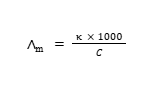
where,
Λm – Molar conductivity (S·cm²·mol⁻¹)
κ – Specific conductivity (S·cm⁻¹)
C – Molar concentration (mol·L⁻¹)
Variation with Concentration
The molar conductivity changes with dilution and the type of electrolyte.
For Strong Electrolytes
Strong electrolytes are almost completely dissociated in solution.
As dilution increases, Λm increases slightly because ions experience less interionic attraction (lower ion–ion interaction), increasing their mobility.
Examples: NaCl, HCl, KOH
The Debye–Hückel–Onsager equation explains the relationship:
Λm = Λmo − A√C
where, Λmo is the limiting molar conductivity (at infinite dilution) and A is a constant.
For Weak Electrolytes
Weak electrolytes are partially dissociated in solution.
As dilution increases, Λm increases sharply because the degree of ionisation rises significantly according to Ostwald’s dilution law. At infinite dilution, dissociation is complete, and Λm reaches its maximum value Λmo.
Examples: CH₃COOH, NH₄OH
Limiting Molar Conductivity (Λmo)
Λmo is the molar conductivity at infinite dilution when the dissociation of the electrolyte is complete and ions move independently. It is found experimentally by extrapolating a plot of Λm vs √C (for strong electrolytes) or Λm vs C (for weak electrolytes) to C → 0.
Graph Representation
The graph of molar conductivity (Λm) vs √C shows that for strong electrolytes, Λm decreases slightly with increasing concentration due to interionic attractions, and the plot is a straight line that can be extrapolated to get Λmo. For weak electrolytes, Λm increases sharply on dilution because ionisation rises significantly, giving a steep upward curve. Both curves meet Λmo at infinite dilution, where dissociation is complete.
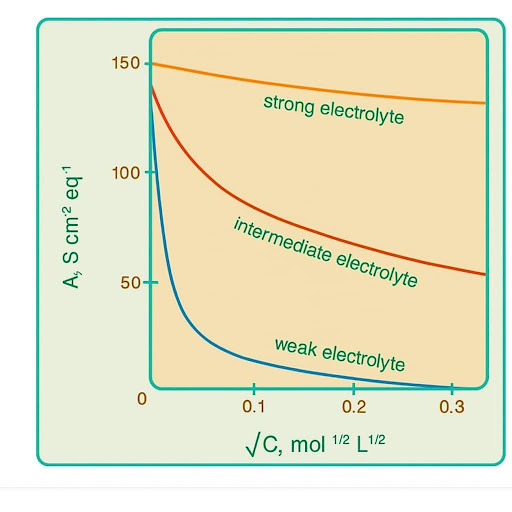
Λm vs. C
Kohlrausch’s Law
Kohlrausch’s Law of Independent Migration of Ions states that, at infinite dilution, the molar conductivity of an electrolyte is the sum of the contributions of its ions.
Mathematically:
Λmo = λo+ + λo−
where,
λo+ – Limiting molar conductivity of cation
λo− – Limiting molar conductivity of anion
The general equation for strong electrolytes can be expressed as:
Λm = Λmo − A√C
Factors Affecting Molar Conductivity
- Nature of electrolyte – Strong or weak electrolyte affects dissociation and thus molar conductivity.
- Concentration – Increasing dilution increases Λm, especially for weak electrolytes.
- Temperature – Higher temperature increases ion mobility and hence Λm.
- Solvent properties – Dielectric constant and viscosity influence dissociation and mobility.
Applications
- Determining the degree of dissociation (α) of weak electrolytes.
- Calculating the dissociation constant (Ka/Kb)of weak acids and bases using Ostwald’s dilution law.
- Studying ionisation of electrolytes and comparing strong vs weak electrolytes.
- Measuring water purity as pure water has a very low molar conductivity.
- Calculate conductometric titrations by tracking the endpoint in acid–base, precipitation, or redox titrations.
- Estimating limiting molar conductivity (Λmo) using Kohlrausch’s law for weak electrolytes.
- Identifying ions by their ionic conductivities.
Summing Up
Molar conductivity is the conductance of a solution containing one mole of electrolyte, influenced by ion mobility and concentration. It increases with dilution, sharply for weak electrolytes and slightly for strong ones. At infinite dilution (Λmo), dissociation is complete. It helps determine ionisation, dissociation constants, water purity, and is used in conductometric titrations, ion identification, and studying electrolyte behaviour.
Frequently Asked Questions
Q1. Why do weak electrolytes show a sharp increase in Λm with dilution?
Dilution increases their degree of ionisation significantly, producing more free ions.
Q2. Does temperature always increase molar conductivity?
In most cases, yes, because ion mobility increases, but in some cases, excessive temperature may cause decomposition of the electrolyte.
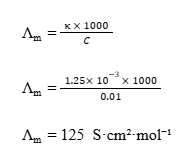
Q3. The specific conductivity (κ) of a 0.01 mol·L⁻¹ NaCl solution is 1.25 × 10⁻³ S·cm⁻¹. Calculate its molar conductivity (Λm).
Given: κ = 1.25 × 10⁻³ S·cm⁻¹, C = 0.01 mol·L⁻¹
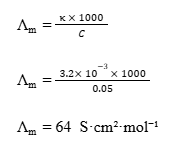
Q4. The specific conductivity (κ) of a 0.05 mol·L⁻¹ HCl solution is 3.2 × 10⁻³ S·cm⁻¹. Determine its molar conductivity (Λm).
Given: κ = 3.2 × 10⁻³ S·cm⁻¹, C = 0.05 mol·L⁻¹


 Call Now
 Let's Chat
 Share
Share