-
Call Now
1800-102-2727


Millikan’s Oil Drop Experiment – Introduction, Theory, Apparatus, Procedure, Calculations, Conclusions, Practice Problem and FAQ

The electron is the tiniest particle known to science! We, the inhabitants of Earth, gradually learned more about the electrons. We were aware that they were negatively charged, but what exactly was the magnitude of charge an electron bore intrigued Mr Robert Millikan's inquisitive mind. This compelled him to carry out the timeless oil drop experiment, known as "Millikan's Oil Drop Experiment."
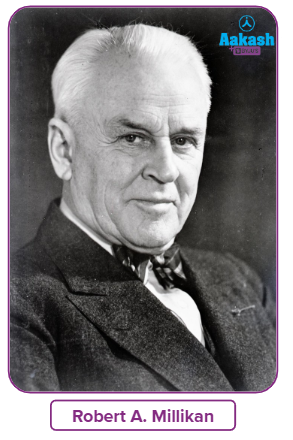
With immense perseverance, Robert Millikan and Harvey Fletcher performed an experiment in 1909 that made them find out the charge of an electron with high accuracy and the same value that we have been using to date.
TABLE OF CONTENTS
- Millikan’s Oil Drop Experiment - Introduction
- Millikan’s Oil Drop Experiment - Principle
- Millikan’s Oil Drop Experiment - Theory
- Millikan’s Oil Drop Experiment - Experiment
- Millikan’s Oil Drop Experiment - Procedure
- Milliken’s Oil Drop Experiment - Calculation
- Practice Problems
- Frequently Asked Questions - FAQ
Millikan’s Oil Drop Experiment - Introduction
In 1909, Robert A. Millikan and Harvey Fletcher conducted Millikan's Oil Drop Experiment to determine the charge of an electron. The Ryerson Physical Laboratory, which is located at the University of Chicago, was the place where this experiment took place. In addition, this experiment has proven to be incredible in determining the quantum nature of charge.
- Robert A. Millikan, an American physicist, invented a simple method of measuring the minute electric charge that exists on many of the droplets in an oil mist.
- The force on any electric charge in an electric field is equal to the product of the charge and the electric field.
- Millikan was able to determine the magnitude of the charge by measuring both the quantity of electric force and the magnitude of the electric field on the minuscule charge of an isolated oil droplet.
- Robert Millikan was honoured with the Nobel Prize in physics in 1923 for this stunning experiment.

Millikan’s Oil Drop Experiment - Principle
Millikan created an electric field by allowing charged small oil droplets to pass through a hole. The charge over an oil droplet was estimated by altering the strength of the electric field, which always came as an integral value of 'e'.
- While falling through a viscous medium like air, a spherical drop of oil will quickly reach a constant velocity.
- When it achieves this equilibrium condition, additional forces operating on the drop, such as gravity, buoyant forces from the air, electrical forces, and so on, balance the viscous force.
- An ionisation source is used to introduce an electrical force of varied size to change the motion of the falling drop in this experiment.
- The amount of charge on the drop can be measured by monitoring the velocity of the oil drop under various conditions.
- The quantisation of charge can be confirmed if the charge on the drop is an integer multiple of the fundamental unit of charge (the electron).
Millikan’s Oil Drop Experiment - Theory
In the absence of an electric field, the oil drops are allowed to fall between the plates at first. They accelerate at first because of gravity, but due to air resistance, they progressively slow down.
- In the absence of an electric field, the terminal velocity ‘v1' is calculated as:
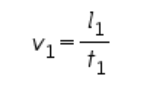
where ‘l1' corresponds to distance travelled by the oil drop and 't1' is the time taken. Stokes' law is used to compute the drag force acting on the drop, which is given as:
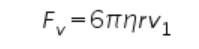
- For a perfectly spherical body, the apparent weight (Actual weight- Thrust) is given by:
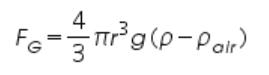
- Because the oil drop is not accelerating at terminal velocity, the total force exerted on it must be zero. Hence,
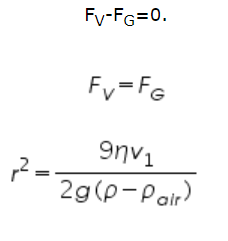
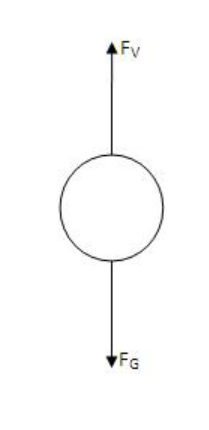
Where,
g - Acceleration due to gravity
ρ - Density of liquid
r - Oil droplet’s radius
ρair - Density of air
η - Air viscosity
v1 -Terminal velocity
- With the voltage supply, a field is now created in the bottom chamber. By changing the voltage, a likely-looking drop is picked and retained in the centre of the field of view. The drop suspends in the air if the electric forces Fe balance the gravity force FG.
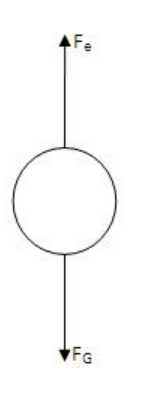
Then,
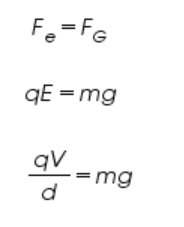
- The balancing potential is V, and the distance between the plates is d. Some of the drops (the charged ones) will begin to rise if the applied electric force Fe is larger than the downward force. The viscous forces and gravity now act downward, whereas the electric force will now act upwards. The terminal velocity v2 is computed as follows:
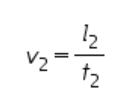
where l2 is the oil drop's distance travelled and t2 is the time taken. Fe-Fv'-FG=0 is now the entire force acting on the drop.
- So,
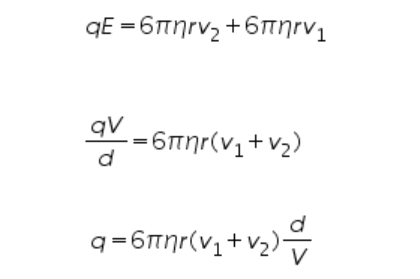

- Millikan repeated the experiment a number of times, changing the strength of the X-rays used to ionise the air each time. As a result, the number of electrons attracted to the oil drop fluctuated. Then he calculated different values for q, which turned out to be a multiple of .
Millikan’s Oil Drop Experiment - Experiment
Millikan and Fletcher designed and built the experiment's apparatus. It has two metal plates which are separated by an insulated rod. Also, there exists four holes in the plate, three of which let in light to flow through and the fourth one, allows viewing through the microscope.
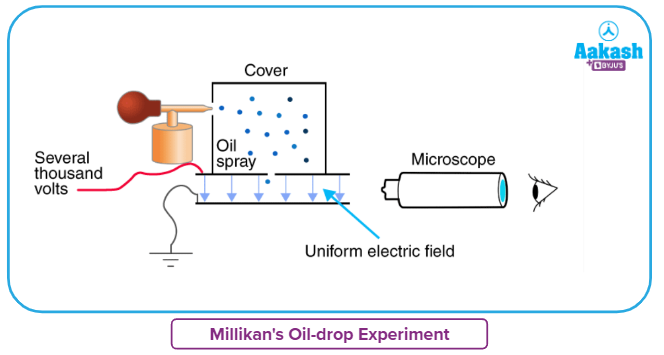
Ordinary oil was not used in the experiment because it would evaporate due to the heat of the light, perhaps resulting in Millikan's Oil Drop Experiment mistake. As a result, the oil was employed that is commonly used in vacuum apparatuses and has a low vapor pressure.
Millikan’s Oil Drop Experiment - Procedure
- Oil is atomized after it has passed through the atomizer in the form of small droplets. The droplets are passed via the holes in the apparatus's upper plate.
- The terminal velocity of oil droplets is measured when the downward motions of droplets are detected using a microscope.
- By passing an X-ray beam through the air inside the chamber, it is ionised. Collisions with gaseous ions created by air ionisation give these oil droplets their electrical charge.
- The electric field is created between the two plates, and the electric field can impact the motion of charged oil droplets.
- The oil is drawn downward by gravity, while the charge is drawn higher by the electric field. The strength of the electric field is controlled such that the oil droplet achieves a gravity-balanced position.
- At equilibrium, the charge over the droplet is computed, which is determined by the strength of the electric field and the mass of the droplet.
Millikan’s Oil Drop Experiment - Calculation
Where
E= Electric Field
q= charge on electron
Where
m= Mass of Oil droplet
g= Acceleration due to gravity
∴ qE= mg
Millikan's method for measuring electron charge may be seen hence. All of the drops contained charges that were multiples, according to Millikan.
Any oil droplet's charge is always an integral value of electron is . As a result, Millikan's Oil Drop Experiment concludes that charge is quantized, i.e. the charge on each particle will always be an integral multiple of e-.
Practice Problems
Q. 1. In Millikan's oil drop experiment an oil drop of mass kg is balanced by applying a voltage of 8.77 kV between two plates that are around 10.8 m apart. What is the number of elementary charges present on the drop? (Consider g = )
A. 3
B. 4
C. 1
D. 2
Answer: We know that, qE= mg
∵and q= ne
∴
So,
∴ n =3
So, option A) is the correct answer.
Q. 2. The apparatus for the Milikan’s oil drop experiment was constructed by:
A. Thomson and Millikan
B. Millikan and Fletcher
C. Millikan and Boiler
D. Millikan and Dalton
Answer: In 1909, Robert A. Millikan and Harvey Fletcher constructed the apparatus and conducted Millikan's oil drop experiment to determine the charge of an electron.
So, option B) is the correct answer.
Q. 3. Oil which is passed through the atomizer came out in the form of:
A. Splash
B. Mist
C. Water|
D. Sprinkler
Answer: In Millikan's oil drop experiment, the oil that is passed through the atomizer came out in the form of tiny droplets or mist.
So, option B) is the correct answer.
Q. 4. Millikan’s oil drop experiment is used to find out the charge on a:
A. Neutron
B. Proton
C. Electron
D. Neutrino
Answer: In 1909, Robert A. Millikan and Harvey Fletcher conducted the Millikan's Oil Drop Experiment to determine the charge of an electron.
So, option C) is the correct answer,
Frequently Asked Questions - FAQ
Q1. Why did Millikan use oil in his experiment?
Answer: The oil was chosen because of its exceptionally low vapour pressure, which is common in vacuum apparatus. Ordinary oils would evaporate as a result of the light source's heat, causing the mass of the oil drop to alter over time.
For Millikan's oil drop experiment, oil is one of the best liquids. It keeps its bulk for a long time and can withstand greater temperatures. We also use an atomizer to create ultra-fine droplets. Because water cannot stay unaltered at such high temperatures, oil is used which does not have such a tendency to vaporise at elevated temperatures.
Q2. What was Millikan’s conclusion after performing the oil drop experiment?
Answer: Millikan’s conclusion from his experiment was– The charge on every oil drop is an integral multiple of the charge on one electron. It's all about the electric force. The charge and mass of an atom must be condensed into a small amount.
Q3. What is the reason behind the quantization of charge?
Answer: Charges are quantized because the charge of each object is different (ion, atom, etc.). As a result of charge quantization, no random values can be extracted from the charge, only integral multiples of the fundamental charge (proton / electron charge).
Q4. What is the significance of Millikan’s oil drop experiment?
Answer: Millikan's experiment is significant since it defined the charge on an electron. Millikan regulated the behaviour of gravitational, electrical, and (air) drag forces with a very basic, very simple apparatus.

 Call Now
 Let's Chat
 Share
Share