-
Call Now
1800-102-2727


Magnetic Separation – Introduction, History, Types of Separators, Applications, Practice Problems, FAQ

Consider the following scenario. Every student is required to create some creative models or poster presentations in accordance with their class standards for an annual scientific exhibition that takes place at the school.
So, Jack thought about doing a poster presentation. He purchased 10 iron clips to hang the poster for presentation. The polythene bag containing the clips dropped accidentally from Jack's hand, causing all of the clips to land on the ground. While jack located nine clips, one is still missing.
Is there a way for Jack to find his missing clip?
Using a magnet to locate the clip is the best solution. Jack used a magnet to find the missing clip as he went searching in the places that he had been before. The underlying principle here is that magnet attracts magnetic things.

The same principle is employed in the industry to purify certain metals. This method of separation is called the magnetic separation method.
We will get to know more about magnetic separation and its applications on this concept page.
TABLE OF CONTENT
- Magnetic Separation – Introduction
- Magnetic Separation – History
- Magnetic Separation – Types of Separators
- Magnetic Separation – Applications
- Practice Problems
- Frequently Asked Questions – FAQ
Magnetic Separation – Introduction
- The method of magnetic separation involves attracting magnetic materials using a magnet in order to separate the components of mixtures. Non-magnetic compounds are separated from magnetic ones using the magnetic separation technique.
- The rare ferromagnetic (minerals containing iron, nickel, and cobalt) and paramagnetic minerals are helpful for this approach. The majority of metals, such as aluminium, silver, and gold, are not magnetic and are not separated by this technique.
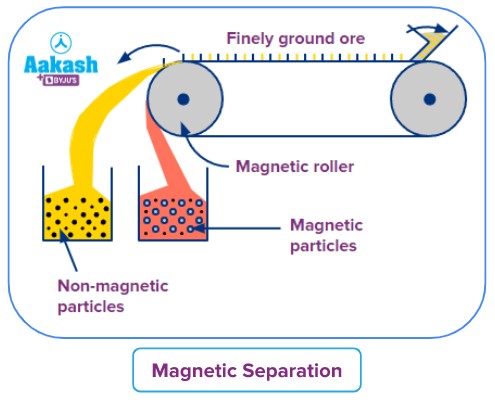
- Magnetic materials are separated mechanically using a wide range of techniques. Magnets are positioned inside two separator drums during magnetic separation. The rotation of the drums causes magnetic particles to wander as a result of the magnets. Thus, a magnetic concentration will emerge (e.g. an ore concentrate).
Magnetic Separation – History
- Michael Faraday learned that various materials may be differentiated based on their magnetic characteristics. The common ferromagnetic and paramagnetic minerals are the major ones.
- Magnetic separation began to be marketed in the 1860s. Iron and brass were separated using it.
- Ferromagnetic materials began to be magnetically separated after the 1880s. High-intensity magnetic separation was introduced in the 1900s and enabled the separation of useful materials.
- Electromagnet systems were the most widely used after World War II. In scrap yards, this method was applied. As new technologies were introduced in the late 1970s, magnetic separation was once again developed. Magnetic pulleys, overhead magnets, and magnetic drums were some of the innovative magnetic separation techniques.
Magnetic Separation – Types of Separators
Drum Separator
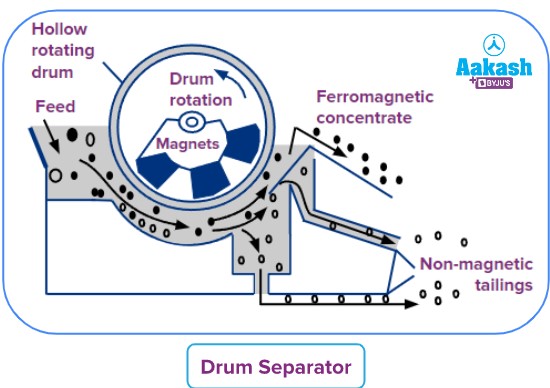
- A non-magnetic drum with three to six permanent magnets makes up a drum separator.
- In the inner perimeter, it is made of ceramic or rare earth magnetic alloys.
- A flowing stream of feed, ideally moist, passes over the rotating drum in a consistent manner.
- The revolving magnets take up the ferromagnetic and paramagnetic materials and pin them to the outside of the drum.
- The concentrate is compressed, dewatered, and discharged as the drum goes upward, leaving the gangue in the tailing chamber.
- The collection of concentrate is intended to accommodate either a clockwise or counterclockwise rotation of the drum. Magnetic concentration is produced using a drum separator and is very clean.
Cross–Belt Separator
- A magnet is mounted over the moving belt carrying the magnetic feed in a cross-belt separator.
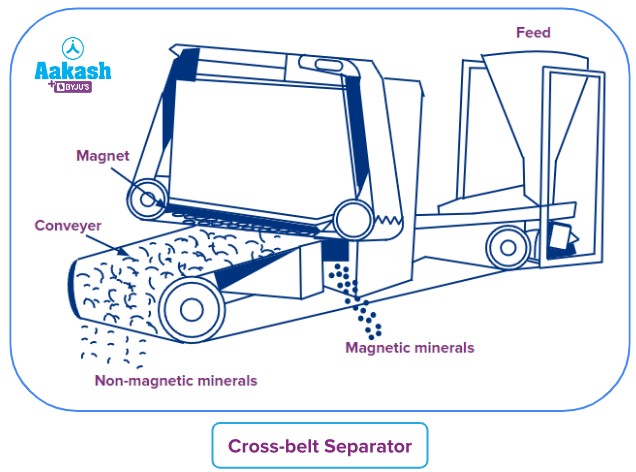
- The gangue is left to the tail after the magnet lifts the magnetic materials and sends them across the field.
- The technique is frequently employed in the beach sand mineral business to separate rutile and ilmenite. Rare earth roll magnetic separators and rare earth drum magnetic separators are the most used cross-belt separators nowadays.
Magnetic Separation – Applications
- Electromagnetic cranes that extract magnetic material from garbage and unsuitable materials can also employ magnetic separation. This explains why such cranes are used for waste management and shipping equipment.
- This method may be used to eliminate unwanted metals from materials. All materials are maintained purely using this technique.
- Recycling facilities frequently utilise magnetic separation to extract metals, purify ores, and separate components from recycling.
- The recycling business employs magnetic drums, magnetic pulleys, and overhead magnets.
- Due to iron's attraction to a magnet, magnetic separation is also helpful in the mining process.
- In order to reduce pollution, during chemical processing, and when benefiting from nonferrous low-grade ores, magnetic separation is also employed.
- Dairy, grain and milling, plastics, culinary, chemical, oils, textile, and more sectors employ magnetic separation.
Practice Problems
1. Which among the following ore is separated by the technique of magnetic separation?
a. Haematite
b. Siderite
c. Iron pyrites
d. All the above.
Answer: D
Solution: The method of magnetic separation may be used to separate iron ores such haematite (Fe2O3), magnetite (Fe3O4), siderite (FeCO3), and iron pyrites (FeS2).
So, option D is the correct answer.
2. Which among these is a magnetic material?
a. Plastic
b. Silicon
c. Nickel
d. Carbon
Answer: C
Solution: When a material is positioned close to a magnet, magnetic materials will either experience an attractive or repulsive force. Cobalt, iron, and nickel are a few examples of magnetic materials. Due to the parallel alignment of its two unpaired electrons, or "spins," in the presence of an external magnetic field, nickel (Ni) is ferromagnetic by nature. Nickel is permanently magnetised because it retains its magnetic properties even in the absence of a magnetic field. Other mentioned options are non-magnetic materials.
So, option C is the correct answer.
3. __________ method is used in the concentration of haematite ore.
a. Crystallisation
b. Magnetic separation
c. Distillation
d. Chromatography
Answer: B
Solution: Concentration is the process of removing the undesirable components from the ore, such as sand, clays, etc. This can be done using different processes. Haematite ore contains iron, which is separated from the impurities using the magnetic separation technique. In this technique, a magnet draws the ore particles to it, leaving behind undesirable non-magnetic impurities.
So, option B is the correct answer.
4. Which scientist first discovered the technique of magnetic separation?
a. Albert Einstein
b. Enrico Fermi
c. Michael Faraday
d. Nikola Tesla
Answer: C
Solution: When a substance is placed in a magnetic environment, Michael Faraday found that the substance changes the environment's intensity. He learned from this knowledge that different materials can be differentiated based on their magnetic characteristics.
So, option C is the correct answer.
Frequently Asked Questions – FAQ
1. Is magnetic separation a chemical or physical technique?
Answer: One of the most popular and significant physical separation techniques is magnetic separation, and there are many different types of magnetic separation equipment available. The fundamental idea behind the magnetic separation is the separation of magnetically susceptible particles from non-magnetic particles.
2. What happens when a magnet is split?
Answer: Imagine a magnet as a collection of microscopic magnets, referred to as magnetic domains, that are pressed close together. The magnetic fields of the others are strengthened by each. There is a little north and south pole on each one. If you split one in half, the freshly sliced faces will serve as the tiny pieces' new north and south poles.
3. Are all metals magnetic?
Answer: Metals are not all magnetic. In reality, it depends on your definition of the word "magnetic." A substance can be superconducting, diamagnetic, paramagnetic, or ferromagnetic, which are the four fundamental forms of magnetism. Permanent magnets strongly reject superconducting materials.
4. What parameters impact the effectiveness of magnetic separation?
Answer: The impact of the magnetic separation process is frequently influenced by the magnetic field intensity, gradient, and direction (i.e., whether the magnetic field is evenly distributed) in the separation space of the magnetic separation equipment.

NEET Related Links
JEE MAIN Related Links
JEE Advanced Related Links
JEE Advanced Eligibility Criteria
JEE Advanced Chemistry Syllabus
JEE Advanced Registration Dates
CUET Related Links
Important Topics
Anemometer : Measurement of Wind Speed
Angular Acceleration Atomic Theory Audible and Inaudible Sound Average Speed and Average Velocity Average Velocity Avogadros Number Avogadros Hypothesis Azimuthal Quantum Number Balanced Force Bar Magnet Biconvex Lens Boyles Law Buoyancy Calorimeter Carnot Engine Celestial Bodies Centripetal And Centrifugal Force Concave and Convex Lenses Concave Convex Mirrors Contact and Non Contact Force Controlled Thermonuclear Fusion Convection Currents Convex Lens Convex Mirror Destructive Interference Difference Between Conduction Convection and Radiation Difference Between Electric Field and Magnetic Field Difference Between Heat And Temperature Difference Between Series And Parallel Circuits Differences Between Acceleration And Velocity Distance and Displacement Distance Time Graph Electrical Force : Electric Forces and Their Types Electromagnetic Waves : Definition, Equation and Properties of Electromagnetic Waves Electromagnetism Electron Spin Fluid Flow : Bernoullis Equation Derivation and Fluid Mechanics Fluid Friction : Types and Factors of Fluid Friction Frames of Reference : Inertial and Non- Inertial Frame of Reference Frequency and Wavelength Frictional Force Importance of Hydrosphere Instantaneous Speed and Velocity Introduction to Motion Kinetic and Potential Energy Difference Law Of Conservation of Energy Layers of the Earth Light Energy Light Sources List of physics scientists and Their inventionsLoudness of Sound
Magnetic Dipole Moment Magnetic Field Non - Contact Force Non - Renewable Energy Ohms Law Optics P Wave Physics Symbols Plane Mirrors Poissons Ratio Projectile Motion Properties of Water : Anomalous Expansion of Water Radius of Gyration Reflection of Light Reflection of Waves Relative Density Resonance Reverberation Rolling Friction Rotation and Revolution Screw Gauge Semiconductors and Insulators Sliding Friction Speed Time Graphs Static Friction Stefan Boltzmann Law Stress Tension Tension Force Thermometer: Clinical Laboratory Thermometer Types of Rocks Types of Waves Uniform Motion and Non Uniform Motion Unit of Voltage Uses of Convex Lens Uses Of Convex Mirror Uses of Electromagnet Uses of Optical Fibre Wave Wavelength of Light What is Scattering of Light Working of Electric Bell Conventional and Non-conventional Sources of Energy Buoyant Force Bulk Modulus of Elasticity Bernoulli’s Principle Angular Momentum Difference Between Speed And Velocity ForceUnit of Heat
Difference between Distance and Displacement Simple Microscope Derivation Of Equation Of Motion Thermometer: Clinical & Laboratory Thermometer Difference between Concave and Convex LensDerivation Of Lens Maker Formula
Unit Of Pressure Velocity Uses of Plane Mirror
Wave Theory of Light
Unit of Density Unit of Light Unit of Force Unit of Magnetic Field Unit of wavelength Unit of Viscosity Uses of Electroplating Young's Modulus
What is the Scattering of Light
Lenz Law Space Wave Propagation Schrodinger Wave Equation Relation between Fahrenheit and Celsius Refractive Index Potentiometer Working Pascal Law Oscillatory Motion Optical Instruments Newton's Laws of Motion - First Law Modulation and Demodulation Magnetic Flux Lens Formula and Magnification Kaleidoscope Faradays Law Epsilon Naught Value Energy Bands Electrostatics Electroscope AC Generator Unit of Current Lithosphere Bending Equation Derivation Difference Between Pound and Kilogram Semiconductor Devices OTEC - Ocean Thermal Energy Conversion Hall Effect Rectilinear Propagation of Light Difference Between Ammeter and Voltmeter Coefficient of Linear Expansion Ampere’s Law Cyclone and Thunderstorm Save The Environment From Pollution Particle Nature of Light Types of DC Motor Uses Of Transistor Derivation of Phase Rule Unit of Humidity

 Call Now
 Let's Chat
 Share
Share