-
Call Now
1800-102-2727


Law Of Equilibrium And Equilibrium Constant

Chemical reactions can be both reversible and irreversible. During reversible reactions, which can proceed both forward and backwards, there reaches a point where the concentration of reactants and products becomes constant. This point is called equilibrium.
The Law of Equilibrium explains the behaviour of chemical systems at equilibrium. The mathematical representation of the law of chemical equilibrium is given by the Equilibrium Constant (K).
What is the Law of Equilibrium?
The Law of Equilibrium, also known as the Law of Mass Action, was proposed in the 19th century by Guldberg and Waage. It states:
“At equilibrium, the rate of the forward reaction equals the rate of the backwards reaction, and the ratio of the concentrations of products to reactants, raised to their stoichiometric coefficients, remains constant at a given temperature.”
Let us consider a general reversible reaction to understand this:
|
aA + bB cC + dD |
Where,
- A and B are reactants
- C and D are products
- a, b, c and d are stoichiometric coefficients (i.e., they represent the numerical value of molecules in a balanced equation)
According to the Law of Equilibrium, when this system reaches equilibrium, the following ratio is constant:
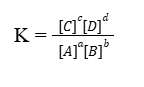
Here, the [] represents ‘concentration of’. This relationship shows that no matter how much reactant or product you start with, once equilibrium is established at a given temperature, this ratio stays the same.
What is the Equilibrium Constant?
The Equilibrium Constant (K) is the mathematical value that expresses the relationship. It tells about the position of equilibrium:
- If K is very large (>> 1): Products dominate at equilibrium, and thus the reaction strongly favours the forward direction
- If K is very small (<< 1): Reactants dominate and thus a very small amount of product is formed.
- If K ≈ 1: Both reactants and products are present in significant amounts
The important point to note here is that K depends only on temperature. While pressure or concentration has a temporary impact on equilibrium (as explained by Le Chatelier’s principle), the final K value remains constant.
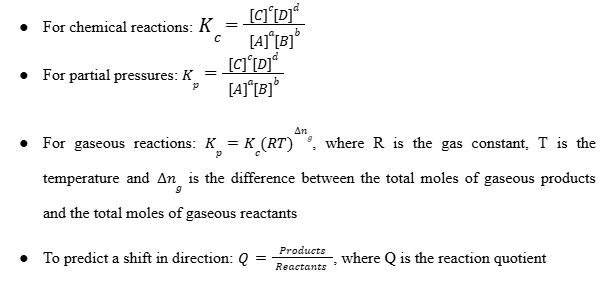
For gases, we often express equilibrium in terms of partial pressures rather than concentrations. In that case, we use Kp instead of Kc.
Important Formula for Law of Chemical Equilibrium
The essential formula related to the law of chemical equilibrium is as follows:
Factors Affecting Chemical Equilibrium
The different factors that change the chemical equilibrium are:
- Change in concentration: Adding more reactants pushes the reaction forward (to produce more products). Similarly, adding more products pushes the reaction backwards.
- Change in pressure (for gases): Increasing pressure favours the side with fewer moles of gas. Decreasing pressure favours the side with more moles of gas.
- Change in temperature: In the case of an exothermic reaction (that releases heat), raising the temperature shifts the equilibrium backwards. But if the reaction is endothermic (that absorbs heat), raising the temperature shifts the equilibrium forward.
- Catalysts: Catalysts lower the activation energy, thus easing the attainment of the activation energy. Note that catalysts do not change the equilibrium constant or position of equilibrium.
Summary
The law of equilibrium, or the law of mass action, explains that at equilibrium, the ratio of product to reactant concentration is constant at a given temperature. This ratio is called the equilibrium constant (K). Large K favours product formation, small K favours reactant formation and K equivalent to 1 keeps both products and reactants in comparable amounts.
The position of equilibrium is affected by changes in concentration, pressure, and temperature (Le Chatelier’s Principle), while catalysts simply speed up the approach to equilibrium.
FAQs
Q1. What is Le Chatelier’s principle?
If a system at equilibrium is disturbed by a change in concentration, pressure, or temperature, it shifts in a direction that opposes the change and restores equilibrium.
Q2. What are the practical applications of the law of equilibrium?
The practical applications of the law of equilibrium are witnessed in the Haber process, contact process, pharmaceuticals, biological systems and solubility control.
Q3. How to use the law of equilibrium in heterogeneous reactions?
In heterogeneous reactions, the law of equilibrium includes only concentrations of gases or aqueous species, while pure solids and liquids are omitted.


 Call Now
 Let's Chat
 Share
Share