-
Call Now
1800-102-2727


Lassaigne Test

The Lassaigne test, also referred to as the Sodium fusion test, is the classical method of detecting elements in organic chemistry. It allows detection of non-metals like nitrogen, sulphur and halogens bonded with unknown organic compounds. The test was developed by J. L. Lassaigne in the 19th century (1843) and still holds practical value.
Principle of the Lassaigne Test
The Lassaigne test is based on the simple principle: Many elements in organic compounds are covalently bonded and cannot be detected directly. Thus, fusing the compound with metallic sodium converts it into ionic form. These non-metal ionic forms can be easily identified through standard chemical tests.
The sodium used in the test acts as a strong reducing agent and a fusing agent at high temperature. It reacts with non-metals to form the following ionic salts:
- Nitrogen (N) to form sodium cyanide (NaCN)
- Sulphur (S) to form sodium sulphide (Na₂S)
- Halogen (Cl, Br, I) to form sodium halide (NaCl, NaBr, NaI)
Detecting Elements Through the Lassaigne Test
Here is how each of the mentioned elements is detected through the Lassaigne test:
Nitrogen
To detect nitrogen, the extract is first treated with ferrous sulphate (FeSO₄) and heated. Then ferric chloride (FeCl₃) and dilute sulphuric acid are added. If nitrogen is present, a Prussian blue colour appears due to the formation of ferric ferrocyanide. This blue colour is a clear indication of nitrogen in the organic compound.
The reaction pathway is:
- Na + [C and N (form organic compound)] → NaCN
- FeSO₄ + 2NaOH → Fe(OH)₂ + Na₂SO₄
- Fe(OH)₂ + 2NaCN → Fe(CN)₂ + 2NaOH
- Fe(CN)₂ + 4NaCN → Na₄[Fe(CN)₆]
Sulphur
Sulphur in the extract is detected by two main tests:
Lead acetate test – The extract is treated with lead acetate solution. If sulphur is present, a black precipitate of lead sulphide (PbS) is formed.

Sodium nitroprusside test – The extract is treated with sodium nitroprusside solution. A purple or violet colour confirms sulphur.
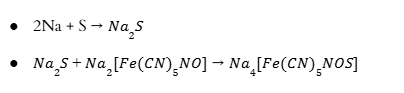
The formation of sodium sulphide during fusion is central to both tests.
Halogen
Halogens (Cl, Br, I) are tested using the silver nitrate test. The extract is first boiled with concentrated nitric acid to remove any interfering ions such as cyanide or sulphide. The solution is then treated with silver nitrate (AgNO₃):
- Chlorine → White precipitate of AgCl (soluble in ammonia)
- Bromine → Pale yellow precipitate of AgBr (sparingly soluble in ammonia)
- Iodine → Yellow precipitate of AgI (insoluble in ammonia)
This distinction makes it possible to identify which halogen is present.
Importance of the Lassaigne Test
The Lassaigne test is replaced by spectroscopic methods like mass spectrometry and elemental analysis. Yet, the Lassaigne test still holds value and finds the following applications:
Educational value: This test is used in schools and other institutions to educate students about covalent and ionic bonding, principles of conversion and detection.
Confirmatory test: It is used as a quick confirmatory test to detect the presence of nitrogen, sulphur or halogens in organic research labs.
Teaching Reactivity: The test demonstrates how harsh conditions like sodium fusion can break stable covalent bonds, giving insight into chemical reactivity.
Summary
The Lassaigne test or sodium fusion test is a classical method to detect the presence of non-metals like sulphur, nitrogen and halogens in organic compounds. These covalently bonded elements react to fuse with metallic sodium to form ionic salts that can be easily identified.
While modern techniques like spectrometry have replaced it, the Lassaigne test remains important. It is used for educational purposes, teaching chemical reactivity and for quick confirmatory checks.
FAQs
Q1. Which salts can not be detected by the Lassaigne test?
The diazonium salts can not be detected through the Lassaigne test because they release nitrogen gas on heating. Further, compounds like urea, hydrazine, glucose, chloroform and other elements do not give the Lassaigne test due to a lack of either elements like nitrogen or carbon or a lack of a carbon-nitrogen bond.
Q2. What are common sources of error in the Lassaigne Test?
Incomplete fusion of the compound, insufficient sodium or improper filtration can be the source of error in the Lassaigne Test.
Q3. What are the precautions to take during the Lassaigne Test?
The precautions to take during the Lassaigne test include avoiding the use of excess sodium, keeping the open side of the test tube away from the face during heating and testing the pH of the extract before adding silver nitrate.


 Call Now
 Let's Chat
 Share
Share