-
Call Now
1800-102-2727


Iodometric Titrations - Introduction, Examples, Practice Problems and FAQ

Swimming is a great way to exercise and keep your body in shape. Consider what it would be like to swim in a filthy, trash-filled pool. Do you believe swimming in such a pool will be healthy?
Obviously not! Many microorganisms found in filthy pools can cause a variety of ailments.
Have you ever wondered how pools are routinely cleaned to maintain their hygienic conditions?
You are correct! The pool cleaners use chlorine or bleaching powder!
When bleaching powder, Ca(OCl)2, or any other chlorine-based chemicals come in contact with water, hypochlorous acid (HOCl), a sanitiser is generated. This sanitiser is used to disinfect swimming pools.
But how can you figure out how much bleaching powder to put in a specific swimming pool?
The answer to this question is a technique called ‘Iodometry’.
Iodometry is routinely employed to determine how much hypochlorite is present in bleach that is actually performing the bleaching activity. With this method, an excessive amount of iodide is added to a known volume of material; only the active (electrophilic) species are able to convert the excess iodide to iodine. The availability of chlorine can be determined using iodometry by measuring the iodine content. The chlorine released when diluted acids and hypochlorite combine is referred to as "available chlorine."
In general, this titration can be used to calculate the concentration of oxidising agents in any sample.

TABLE OF CONTENTS
- What is Titration?
- Iodine Titration
- Iodometric Titrations
- Practice Problems
- Frequently Asked Questions - FAQ
What is Titration?
Titrimetric analysis or titration entails calculating the volume of a solution with an accurately known concentration that must quantitatively react with the measured volume of the solution of a substance whose concentration is to be calculated. The standard solution is the name given to a solution whose concentration is precisely known. The volume of the standard solution used, the chemical equation, and the relative molecular masses of the interacting compounds are used to compute the mass of the substance dissolved in the solution of unknown concentration. Titrant refers to the reagent with a known concentration, while titrate refers to the material being titrated.
Standard solution is typically added from the lengthy graduated tube known as the burette to perform titrimetric analysis. Titration is the process of gradually introducing the standard solution into a solution of uncertain concentration until the reaction is barely complete. The equivalency point, also known as the theoretical or stoichiometric end point, is the point at which a reaction is complete.
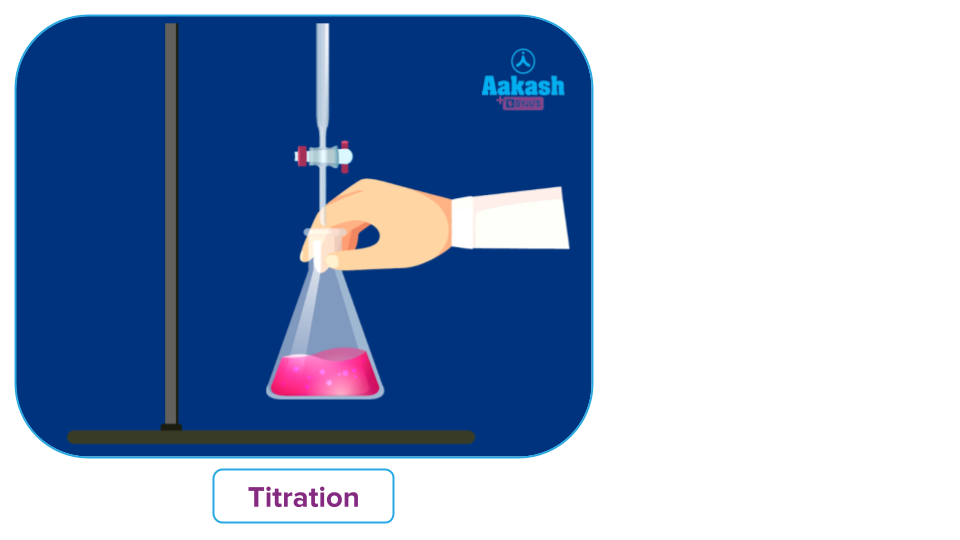
In simple terms, titration is an analytical technique used to determine the concentration of a known volume of an unknown solution (titrate) using a solution of known concentration (titrant).
Iodine Titration
This method of analysis involves the use of iodine/iodide in titration. There are two types of iodine titrations. They are the direct method, also known as ‘Iodimetry’, and the indirect method, also known as ‘Iodometry’.
In the direct method, an iodine solution is used to titrate the reducing agents, which can be quantitatively oxidised at the equivalence point. As iodine is a weak oxidising agent, only a few substances can be oxidised by iodine. Thiosulphate, one of the common reducing agents, must be determined iodimetrically.
Iodine (I2) is a mild oxidising agent.
(reduction)
In the indirect method, also known as ‘Iodometry’, the oxidising agent that has to be estimated is treated with an excess of iodide ions and the liberated iodine is estimated by titrating with a standard thiosulphate solution.
Iodide (I-) is a mild reducing agent.
(oxidation)
In this concept page article, we’ll discuss about iodometry in detail.
Iodometric Titrations
Iodometric titration is used to determine the strength or the concentration of an oxidising agent. In this method, I- is oxidised into I2 in the presence of an oxidising agent. The liberated iodine is estimated quantitatively by titrating with a standard thiosulphate solution. This method can be used to estimate almost all strong oxidising agents. Here, starch is used as an indicator which gives a dark blue colour in presence of I2.
The steps involved in an iodometric titration are as follows.
Step 1: An oxidising agent reacts with iodide ions (example: KI, potassium iodide).
From the equation,
Equivalents of oxidising agent = Equivalents of I- oxidised = Equivalents of I2 formed
Step 2: The iodine liberated is titrated with a standard hypo solution (Na2S2O3).
From the equation, Equivalents of I2 = Equivalents of S2O32-
Therefore, from the amount of iodine consumed by the thiosulphate ions, the amount of oxidising agent can be calculated. The combined schematic representation can be given as
The following are some of the widely used iodometric analyses in the laboratory.
Practice Problems
1. Find the n-factor of S in Na2S2O3 in the reaction
a. 1
b. 2
c. 3
d. 4
Answer: B)
Let the oxidation state of S in Na2S2O3 be ‘x’
Let the oxidation state of S in Na2S4O6 be ‘y’
n-factor of S = number of S atoms in Na2S4O6 ✕ |O.S. of S in Na2S4O6- O.S. of S in Na2S2O3|
n-factor of S = 2 |2.5 - 2| = 1
So, option A) is the correct answer.
2. Find the n-factor of Br in BrO3- in reaction
a. 7
b. 6
c. 5
d. 4
Answer: B)
Let the oxidation state of Br in BrO3- be ‘x’
Let the oxidation state of Br in Br- be ‘y’
n-factor of Br
= number of Br atoms in BrO3- ✕ |O.S. of Br in Br- - O.S. of Br in BrO3-|
n-factor of Br = 1 |-1-5| = 6
So, option B) is the correct answer.
3. An aqueous solution containing 0.20 g KIO3 reacted with an excess of acidified KI with HCl. The liberated I2 consumed 56.0 mL of hypo. Calculate the normality of hypo solution
a. 0.025 N
b. 0.0025 N
c. 0.25 N
d. 2.5 N
Answer: A)
Step 1: KIO3+5KI+6HCl3I2+6KCl+3H2O
Moles of KIO3 = 0.2214=9.310-4 mol
Moles of I2 formed = 3 9.310-4 mol
Step 2: I2+2Na2S2O32NaI+ Na2S4O6
Moles of Na2S2O3 required =
Molarity of Na2S2O3 =
n-factor of Na2S2O3 = 1
Normality of Na2S2O3 = =0.025 N
So, option A) is the correct answer.
4. Find the n-factor of I in IO3- in reaction
a. 5
b. 6
c. 7
d. 8
Answer: B)
Let the oxidation state of I in IO3- be ‘x’
Let the oxidation state of I in I2 be ‘y’
n-factor of I = 1 |5-0| = 5
Frequently Asked Questions - FAQ
1. In an iodometric titration, which indicator is used?
Answer: Starch is typically used as the indication for iodine titrations. Iodine and starch combine to create a deep blue complex. Iodimetry's terminal point is marked by a sharp shift in the colour of the solution to blue.
2. In iodometry, why is acetic acid added?
Answer: Glacial acetic acid's function is to maintain a pH of 3 to 4 so that starch can perform its function in the titration perfectly.
3. Why can not the starch solution be added to an iodometric titration at the beginning?
Answer: Starch cannot be added to the iodometric titration at the beginning because iodine can rapidly react with it to produce a dark blue solution, which will obstruct the end point detection. Therefore, we add starch indicator as soon as the iodine colour in the solution begins to fade, which is when it turns pale yellow and indicates a very low iodine content.
4. How can the end point of an iodometric titration be determined?
Answer: A starch solution is used as an indicator in an iodometric titration because it can absorb the I2 that is released. When titrated with standardised thiosulfate solution, this absorption causes the solution's colour to change from deep blue to light yellow. This represents the titration's end point.

NEET Related Links
JEE MAIN Related Links
JEE Advanced Related Links
JEE Advanced Eligibility Criteria
JEE Advanced Chemistry Syllabus
JEE Advanced Registration Dates
CUET Related Links
Important Topics
Anemometer : Measurement of Wind Speed
Angular Acceleration Atomic Theory Audible and Inaudible Sound Average Speed and Average Velocity Average Velocity Avogadros Number Avogadros Hypothesis Azimuthal Quantum Number Balanced Force Bar Magnet Biconvex Lens Boyles Law Buoyancy Calorimeter Carnot Engine Celestial Bodies Centripetal And Centrifugal Force Concave and Convex Lenses Concave Convex Mirrors Contact and Non Contact Force Controlled Thermonuclear Fusion Convection Currents Convex Lens Convex Mirror Destructive Interference Difference Between Conduction Convection and Radiation Difference Between Electric Field and Magnetic Field Difference Between Heat And Temperature Difference Between Series And Parallel Circuits Differences Between Acceleration And Velocity Distance and Displacement Distance Time Graph Electrical Force : Electric Forces and Their Types Electromagnetic Waves : Definition, Equation and Properties of Electromagnetic Waves Electromagnetism Electron Spin Fluid Flow : Bernoullis Equation Derivation and Fluid Mechanics Fluid Friction : Types and Factors of Fluid Friction Frames of Reference : Inertial and Non- Inertial Frame of Reference Frequency and Wavelength Frictional Force Importance of Hydrosphere Instantaneous Speed and Velocity Introduction to Motion Kinetic and Potential Energy Difference Law Of Conservation of Energy Layers of the Earth Light Energy Light Sources List of physics scientists and Their inventionsLoudness of Sound
Magnetic Dipole Moment Magnetic Field Non - Contact Force Non - Renewable Energy Ohms Law Optics P Wave Physics Symbols Plane Mirrors Poissons Ratio Projectile Motion Properties of Water : Anomalous Expansion of Water Radius of Gyration Reflection of Light Reflection of Waves Relative Density Resonance Reverberation Rolling Friction Rotation and Revolution Screw Gauge Semiconductors and Insulators Sliding Friction Speed Time Graphs Static Friction Stefan Boltzmann Law Stress Tension Tension Force Thermometer: Clinical Laboratory Thermometer Types of Rocks Types of Waves Uniform Motion and Non Uniform Motion Unit of Voltage Uses of Convex Lens Uses Of Convex Mirror Uses of Electromagnet Uses of Optical Fibre Wave Wavelength of Light What is Scattering of Light Working of Electric Bell Conventional and Non-conventional Sources of Energy Buoyant Force Bulk Modulus of Elasticity Bernoulli’s Principle Angular Momentum Difference Between Speed And Velocity ForceUnit of Heat
Difference between Distance and Displacement Simple Microscope Derivation Of Equation Of Motion Thermometer: Clinical & Laboratory Thermometer Difference between Concave and Convex LensDerivation Of Lens Maker Formula
Unit Of Pressure Velocity Uses of Plane Mirror
Wave Theory of Light
Unit of Density Unit of Light Unit of Force Unit of Magnetic Field Unit of wavelength Unit of Viscosity Uses of Electroplating Young's Modulus
What is the Scattering of Light
Lenz Law Space Wave Propagation Schrodinger Wave Equation Relation between Fahrenheit and Celsius Refractive Index Potentiometer Working Pascal Law Oscillatory Motion Optical Instruments Newton's Laws of Motion - First Law Modulation and Demodulation Magnetic Flux Lens Formula and Magnification Kaleidoscope Faradays Law Epsilon Naught Value Energy Bands Electrostatics Electroscope AC Generator Unit of Current Lithosphere Bending Equation Derivation Difference Between Pound and Kilogram Semiconductor Devices OTEC - Ocean Thermal Energy Conversion Hall Effect Rectilinear Propagation of Light Difference Between Ammeter and Voltmeter Coefficient of Linear Expansion Ampere’s Law Cyclone and Thunderstorm Save The Environment From Pollution Particle Nature of Light Types of DC Motor Uses Of Transistor Derivation of Phase Rule Unit of Humidity

 Call Now
 Let's Chat
 Share
Share