-
Call Now
1800-102-2727


Intensive and Extensive Functions - System, Surrounding, Universe, Boundary, Macroscopic Properties of the System, State of the System


You can see two beakers and in each beaker 1L of water is present and the density of water in both the beakers is 1 gcm-3 . Now when we are pouring the water of both the beakers into the third beaker the final volume of the water in the third beaker changes to 2L but the density of water in the third beaker remains the same. Can you answer why the density of water didn’t change even if the amount of water both in terms of mass and volume changed in the third beaker? Let’s understand why exactly this happened, and why density remained constant and we will see more such properties which won’t change. We will see in this article which properties of substances depend on the mass and size of the substance and which are not.
TABLE OF CONTENTS
- System
- Surroundings
- Universe
- Boundary
- Types of Systems
- Macroscopic properties of the system
- State of the system
- Practice Problems
- Frequently Asked Questions - FAQ
System
A system in the thermodynamic term refers to that part of the universe in which thermodynamic observations are made.
Surroundings
Apart from the system, everything else in the universe will be considered as surroundings.
Universe
The system and its surroundings make up the universe.

Boundary
A system is segregated from its surroundings by a real or imaginary wall. A boundary is a physical barrier that separates the system from its surroundings.
Real boundaries and Imaginary Boundaries

Tea in the vessel is defined as a system and everything else as surroundings. Here, the wall of the container which is separating the system and surroundings which exists, in reality, is known as a real boundary.
When a small portion of tea (within the entire volume of the container marked in white colour) is defined as a system, the boundaries of this system are imaginary as it does not exist in reality and it can be changed if some amount of tea is poured out.
Types of Systems
- Open System: There is an interchange of energy and matter between the system and its surroundings in an open system.

- Closed System: In a closed system, there is no exchange of matter. However, an exchange of energy is possible between the system and the surroundings.

- Isolated System: There is no exchange of energy or matter in an isolated system
between the system and the surrounding. Thermos flask is an example of an isolated system where the exchange of matter and energy will not take place.

Systems can also be classified as follows:
- Ideal system: The term ideal system refers to a hypothetical mechanical system in which energy and power are not lost or dissipated through friction, deformation, wear, or other inefficiencies. They exist at high temperatures and low pressures. This does not exist in reality.
- Real system: A real-world system can be thought of as an example of a real system. They exist at high pressure and low temperature. Generally, all open systems where the transfer of energy and matter both takes place are considered real systems.
Macroscopic Properties of the System
The properties of bulk matter are known as macroscopic properties of matter. These properties emerge as per how the constituents of matter are organized in this situation and how the particles are kept intact. These are the properties that can be seen with the naked eye, making measurements simple.
Some general examples of macroscopic properties include pressure, volume, temperature, etc.
These macroscopic properties can be classified into two as follows:
Intensive Properties
- Properties which are independent of the amount of the substance (i.e., quantity or size of matter) present in the system are referred to as intensive properties.
- Temperature, pressure, density, melting and boiling point, etc., are intensive properties as they do not change with the change in the quantity of matter.
Extensive properties
- Extensive properties depend on the amount of the substance (i.e., quantity or size of matter) present in the system.
- Extensive properties include volume, mass, and energy etc.
- If the total value of the property of a system is equal to the sum of the values for the parts of the system (i.e., additive in nature), then such property is known as extensive property.
Relation between extensive and intensive properties
The ratio of two extensive properties is called an intensive property. The amount of mass per unit volume is referred to as "density."Mass and volume are extensive properties, but the ratio of mass and volume (i.e., density) is an intensive property.

Difference between Intensive and Extensive Properties
|
Intensive Properties |
Extensive Properties |
|
Independent of quantity and size of the substance |
Dependent on quantity and size of the substance |
|
Examples: melting point, colour, ductility, conductivity, pressure, boiling point, temperature, freezing point, odour, density, etc |
Examples: length, mass, weight, volume, moles etc. |
State of the System
When the macroscopic properties of a system have definite values, the system is said to be in a definite state. Whenever there is a change in any one of the macroscopic properties, the system is said to be changed into a different state. As a result, the system's state is determined by its macroscopic properties.
- State functions: These are the physical quantities whose values depend only upon the state of the system and do not depend upon the path by which this state has been attained. A few examples of state functions are pressure, volume, temperature, etc.
- Path functions: These are the physical quantities that are dependent on the path/way by which the system has achieved a particular state. Heat and work are examples of path functions.
An illustration of work as a path function is given in the figure below. Here, the work done by the athletes while running around the track will depend on the path followed by them, i.e., if the athlete chooses to run through another path (i.e., the trajectory of the athlete changes), then the work done by the athlete during running will also change.

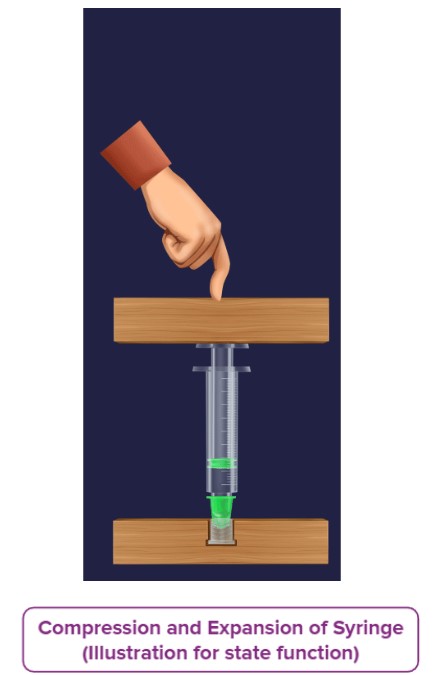
An illustration of the state function is given below. There is a change in volume as a consequence of the expansion and compression when the plunger of the syringe is pushed and pulled. This change in volume, ΔV, will depend only on the initial and final volumes and does not depend upon how we press the syringe.
Recommended video Link: https://youtu.be/Xq0EipqWJJY
Practice Problems
Q 1. The property which is proportional to the mass of the system is:
a. Specific Enthalpy
b. Specific Heat Capacity
c. Internal Energy
d. Temperature
Answer: (C)
All the specific property of a substance is an intensive property because the specific property is the property of the substance per unit mass. Specific property is the ratio of two extensive properties. So, the specific property is an intensive property. Specific enthalpy, specific heat capacity and temperature are intensive properties which do not depend on the mass of the substance. Whereas, the internal energy is a form of energy which is an extensive property which depends on the mass of the substance.
Q 2. Out of boiling point (I), entropy (II), pH (III) and e.m.f. of a cell (IV), intensive properties are
a. I, II
b. II, III
c. III, IV
d. All of these
Answer: (C)
The properties of the system that depend on the amount of substance present in the sample are known as extensive properties.
Examples: All forms of energy, mass, volume etc.
The properties of the system which do not depend on the amount of substance present in the sample are known as intensive properties.
Example: temperature, density, concentration etc.
Analyzing properties of I, II, III and IV given in the question.
(I) Boiling point
It is an intensive property as it does not depend on the amount of matter present in the sample. For example, the boiling point of water is 100°C at 1 atm pressure, which remains true regardless of quantity.
(II) Entropy
It is an extensive property and it does depend on the amount of the substance.
Entropy = Heat (q) Temperature (T)
Heat depends upon the mass, so, entropy is an example of extensive property.
(III) pH
It is an intensive property. As pH measures, the concentration of H+ ions and concentration is an intensive property. So, pH is an intensive property.
(IV) e.m.f of a cell
e.m.f of a cell is an intensive property as it does not depend on the amount of substance.
Q 3. The volume of a system is an:
a. Intensive property
b. Extensive property
c. Neither Extensive nor Intensive
d. Microscopic property
Answer: (B)
An extensive property is a property that depends on the amount of matter in a sample. The volume of a substance is a measure of the space that is occupied by that substance. Hence, volume is an extensive property.
Q 4. Out of the following, which is an intensive property?
a. Enthalpy
b. Entropy
c. Density
d. Mass
Answer: (C)
Mass and volume are extensive properties as they depend on the amount of matter. The ratio of two extensive properties of the same object or system is an intensive property.
The ratio of two extensive properties is always an intensive property, for example, density is the ratio of mass to volume (both are extensive properties) which is an intensive property.
Q 5. Out of the following, which is an extensive property?
a. Temperature
b. Viscosity
c. Surface Tension
d. None of these
Answer: (D)
A property which depends only upon the nature of the substance and not on the amount of the substance present in the system is known as an intensive property and property which depends on the amount of the substance is known as extensive property.
Some common examples of intensive properties are temperature, pressure, concentration, refractive index, viscosity, density, surface tension, specific heat, etc.
An intensive variable is obtained by dividing any extensive variable by another extensive variable. For example, concentration (moles/litre), density (mass/volume), mole fraction (n/N), specific heat (heat capacity per unit mass).
So, out of all the options, none of the properties is extensive.
Frequently Asked Questions – FAQ
Q 1. What is the difference between intensive property and extensive property?
Answer: An extensive property is a property that depends on the amount of matter in a sample. Mass and volume are examples of extensive properties. An intensive property is a property of matter that depends only on the nature of the matter in a sample and not on the amount. Density and temperature are examples of intensive properties.
Q 2. Why is molar volume an intensive property?
Answer: The property which depends upon the quantity of matter present in the system is known as extensive property. The volume of a system is an extensive property. But the volume of one mole of a substance in the system is fixed, and independent of the amount of substance present in the system. Molar volume is the ratio of two extensive properties i.e., the ratio of volume and no. of moles of the substance. Thus, molar volume is an intensive property
Q 3. What is an intrinsic property? Is it the same as intensive property?
Answer: Intrinsic Properties - It refers to the property of a material which is due to the matter contained within the material itself. In short, the natural state or configuration of the material is the intrinsic property.
Intensive Properties - Properties which are independent of the mass of material or amount of substance are called intensive properties.
Example: Temperature, density, etc.
Intrinsic properties are constant everywhere and Intensive properties are constant irrespective of the size of the system. Hence both intrinsic and intensive properties are not the same.
Q 4. Is time an intensive property?
Answer: Intensive properties do not depend on the size of the system, nor the amount present in the system. Therefore it is evident that time is an intensive property as it is independent of the system size.
Related Topics
|
Isothermal Process |
First Law of Thermodynamics |
|
Thermodynamic Processes |
Degrees of Freedom |
|
Heat Capacity Cp Cv relation |
Zeroth Law of Thermodynamics |
|
Second Law of Thermodynamics |
Third Law of Thermodynamics |

NEET Related Links
JEE MAIN Related Links
JEE Advanced Related Links
JEE Advanced Eligibility Criteria
JEE Advanced Chemistry Syllabus
JEE Advanced Registration Dates
CUET Related Links
Important Topics
Anemometer : Measurement of Wind Speed
Angular Acceleration Atomic Theory Audible and Inaudible Sound Average Speed and Average Velocity Average Velocity Avogadros Number Avogadros Hypothesis Azimuthal Quantum Number Balanced Force Bar Magnet Biconvex Lens Boyles Law Buoyancy Calorimeter Carnot Engine Celestial Bodies Centripetal And Centrifugal Force Concave and Convex Lenses Concave Convex Mirrors Contact and Non Contact Force Controlled Thermonuclear Fusion Convection Currents Convex Lens Convex Mirror Destructive Interference Difference Between Conduction Convection and Radiation Difference Between Electric Field and Magnetic Field Difference Between Heat And Temperature Difference Between Series And Parallel Circuits Differences Between Acceleration And Velocity Distance and Displacement Distance Time Graph Electrical Force : Electric Forces and Their Types Electromagnetic Waves : Definition, Equation and Properties of Electromagnetic Waves Electromagnetism Electron Spin Fluid Flow : Bernoullis Equation Derivation and Fluid Mechanics Fluid Friction : Types and Factors of Fluid Friction Frames of Reference : Inertial and Non- Inertial Frame of Reference Frequency and Wavelength Frictional Force Importance of Hydrosphere Instantaneous Speed and Velocity Introduction to Motion Kinetic and Potential Energy Difference Law Of Conservation of Energy Layers of the Earth Light Energy Light Sources List of physics scientists and Their inventionsLoudness of Sound
Magnetic Dipole Moment Magnetic Field Non - Contact Force Non - Renewable Energy Ohms Law Optics P Wave Physics Symbols Plane Mirrors Poissons Ratio Projectile Motion Properties of Water : Anomalous Expansion of Water Radius of Gyration Reflection of Light Reflection of Waves Relative Density Resonance Reverberation Rolling Friction Rotation and Revolution Screw Gauge Semiconductors and Insulators Sliding Friction Speed Time Graphs Static Friction Stefan Boltzmann Law Stress Tension Tension Force Thermometer: Clinical Laboratory Thermometer Types of Rocks Types of Waves Uniform Motion and Non Uniform Motion Unit of Voltage Uses of Convex Lens Uses Of Convex Mirror Uses of Electromagnet Uses of Optical Fibre Wave Wavelength of Light What is Scattering of Light Working of Electric Bell Conventional and Non-conventional Sources of Energy Buoyant Force Bulk Modulus of Elasticity Bernoulli’s Principle Angular Momentum Difference Between Speed And Velocity ForceUnit of Heat
Difference between Distance and Displacement Simple Microscope Derivation Of Equation Of Motion Thermometer: Clinical & Laboratory Thermometer Difference between Concave and Convex LensDerivation Of Lens Maker Formula
Unit Of Pressure Velocity Uses of Plane Mirror
Wave Theory of Light
Unit of Density Unit of Light Unit of Force Unit of Magnetic Field Unit of wavelength Unit of Viscosity Uses of Electroplating Young's Modulus
What is the Scattering of Light
Lenz Law Space Wave Propagation Schrodinger Wave Equation Relation between Fahrenheit and Celsius Refractive Index Potentiometer Working Pascal Law Oscillatory Motion Optical Instruments Newton's Laws of Motion - First Law Modulation and Demodulation Magnetic Flux Lens Formula and Magnification Kaleidoscope Faradays Law Epsilon Naught Value Energy Bands Electrostatics Electroscope AC Generator Unit of Current Lithosphere Bending Equation Derivation Difference Between Pound and Kilogram Semiconductor Devices OTEC - Ocean Thermal Energy Conversion Hall Effect Rectilinear Propagation of Light Difference Between Ammeter and Voltmeter Coefficient of Linear Expansion Ampere’s Law Cyclone and Thunderstorm Save The Environment From Pollution Particle Nature of Light Types of DC Motor Uses Of Transistor Derivation of Phase Rule Unit of Humidity

 Call Now
 Let's Chat
 Share
Share