-
Call Now
1800-102-2727


Important Compounds of Zinc- Definition, Important Compounds of Zinc, Preparations, Properties, Uses, Practice Problems, FAQs

How many of you paint? Most of us have one time or the other come across a situation where we had a paint any scenic visual as a part of our summer holiday homework.
How many of you have seen the similarity between the paint you use to draw such beautiful assemblies to the paint one uses as a colourant for one’s house.
Imagine stocking up the first aid kit in your home and you go out to buy the basic medicines and sanitisers. You rush to the nearest drugstore to pick up a few things such as paracetamol, a bottle of sunscreen, a tube of sanitiser, some cold lozenges, a bar of soap, and a tube of diaper ointment. Have you wondered what constitutes those above-mentioned items?
Every item you purchased contains zinc! Even the coins used to pay for things have zinc in them! Isn’t this interesting? Ask your teacher about zinc and compounds related to zinc.
When zinc reacts with other elements and molecules, zinc compounds are created. Zinc oxide, for example, is utilised in a variety of products such as make-up, rubber, and prescription medications. X-ray equipment, fluorescent lighting goods, and several types of paints include zinc sulphide. The paints used for wall painting contain zinc oxide. Zinc is a versatile element and has vast applications.
Let’s study more about zinc and its important chemical compounds.

Table of content:
- What is Zinc?
- Important compounds of Zinc
- Zinc Oxide
- Zinc Chloride
- Zinc sulphate(white vitriol)
- Practice Problems
- Frequently asked questions-FAQ
What is Zinc?
Zinc has the chemical symbol Zn and the atomic number 30. When oxidation is removed, zinc becomes a silvery-greyish metal that is slightly brittle at normal temperature. It is the first element in the periodic table's group 12 (IIB). Although traces of zinc in the native state have been documented from Melbourne,(Australia). zinc is mainly found in the combined state. It has been known since prehistoric times, and compounds and metals have been utilised for many years before anyone thought about elements! Zinc (Zn) is a moderately strong, hard, and ductile blue-white metal.
Important compounds of Zinc:
Zinc compounds are chemical compounds that contain the element zinc, which belongs to the periodic table's group 12. In most compounds, the oxidation state of zinc in these compounds is basically group oxidation state +2.
Some of the major compounds of Zinc are mentioned below:
- Zinc oxide
- Zinc Chloride
- Zinc sulphate( white vitriol)
Let’s discuss these above-mentioned compounds in detail.
Zinc oxide (ZnO):
Zinc oxide is also known as philosopher's wool, Chinese white, or zinc white. The mineral zincite, often known as red zinc ore, is found in nature.
Preparation of Zinc oxide (ZnO):
1. Zinc oxide can be obtained by burning zinc or calcining zinc carbonate, zinc nitrate, or zinc hydroxide. Below are the reactions mentioned;
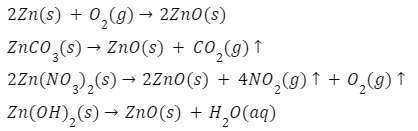
2. A solution of zinc sulphate and sodium carbonate is used to make very pure zinc oxide. When the basic zinc carbonate is heated, pure zinc oxide is formed.

Properties and Reaction of Zinc oxide (ZnO):
- The Zinc oxide powder is white. It turns yellow when heated and returns to its original colour when cooked.
- It is extremely light and water-insoluble.
- At 400°C, it reaches its sublime state.
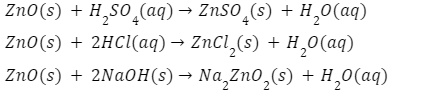
- It is an amphoteric oxide that rapidly dissolves in acids to generate zinc salts and alkalies to form zincates.
- It is converted to metal when heated in hydrogen over 400°C.

- Carbon reduces zinc oxide to zinc as well.

- When zinc oxide is heated with cobalt nitrate, a green mass called Rinmann's green forms due to the creation of cobalt zincate.

Uses of Zinc oxide (ZnO):
- As a white pigment, zinc oxide is used as paint. Although it has less covering power than white lead, it is preferable since it does not blacken in a hydrogen sulphide atmosphere.
It works well as oil and water paint.
- Rinmann's green, which is used in many dishes, is made with Zinc oxide as a pigment of green colour.
- It is used as a catalyst in the production of methyl alcohol from water gas, together with Cr2O3.
- It's employed as a soft rubber filler as well as an absorbent in surgical dressings.
- It's also used as a glaze in pottery and as a zinc ointment in medicine.
- Cosmetic powders and creams are made with Zinc oxide.
Zinc Chloride (ZnCl2):
Preparation of Zinc chloride (ZnCl2):
- It's made by mixing weak hydrochloric acid with zinc oxide, zinc carbonate, or zinc hydroxide. After concentration and chilling, the solution yields hydrated zinc chloride crystals, ZnCl2.2H2O.


- Heating hydrated zinc chloride crystals does not produce anhydrous zinc chloride because hydrolysis occurs, forming basic chloride (zinc hydroxy chloride), which is then heated to produce zinc chloride.

Anhydrous zinc chloride is made by heating zinc in dry chlorine or dry HCl gas environment.

Zinc powder can also be made by distilling it with mercuric chloride.

Properties and Reactions of Zinc chloride (ZnCl2):
- Anhydrous zinc chloride is a deliquescent white solid that is water-soluble.
- It melts at 660 ℃ and boils at 730℃
- Heat transforms hydrated zinc chloride into zinc hydroxy chloride or zinc oxychloride.

- A whitish substance forms when H2S is circulated through the solution. A zinc sulphide precipitate is generated.

- When NaOH is added, a white zinc hydroxide precipitate forms, which dissolves excess sodium hydroxide to create sodium zincate.

- When you add NH4OH solution, a white zinc hydroxide precipitate forms, which dissolves in excess ammonia to form a complex salt.

- A white precipitate of basic zinc carbonate is generated when zinc chloride solution is treated with sodium carbonate solution.

When a sodium bicarbonate solution is employed, however, a white precipitate of typical zinc carbonate is created.

- Ammonia gas is absorbed by anhydrous zinc chloride, which forms an addition compound called adduct.

- It dissolves cellulose with its syrupy solution.
- When combined with zinc oxide, ZnO, the syrupy solution forms a hard substance called oxychloride,ZnCl2.3ZnO.
Uses of Zinc chloride (ZnCl2):
- Timber is impregnated with a strong solution of zinc chloride to protect it from being destroyed by microorganisms.
- Dental fillings are made up of a syrupy zinc chloride solution and zinc oxide.
- It functions as a dehydrating agent.
- It is used to clean the surface of metals before soldering since it is acidic in an aqueous solution.
- It's used in the production of parchment paper, vulcanised fibre, and cold water glues and adhesives. It's also utilised in dry cell manufacturing.
Zinc Sulphate (White vitriol), ZnSO4.7H2O
Water of crystallisation as the heptahydrate, with the formula ZnSO4.7H2O, is the most prevalent form of zinc sulphate. It is also referred to as "white vitriol."
Preparation of Zinc sulphate:
- Zinc is combined with dilute sulfuric acid to make it. Zinc oxide or carbonate can also be dissolved in dilute sulfuric acid to make it.
Colourless crystals of zinc sulphate, ZnSO4.7H2O, form when the solution is concentrated and crystallised below 39°C.

Properties and Reactions of Zinc sulphate:
- It's a crystalline, colourless substance. It's a phosphorescent material. It dissolves easily in water.
- The following changes occur as a result of heating.

- When sodium hydroxide is added to a zinc sulphate solution, a white zinc hydroxide precipitate forms, which dissolves in excess of the NaOH forms sodium zincate.

- A white precipitate of basic zinc carbonate is generated when sodium carbonate solution is introduced to a zinc sulphate solution.

When sodium bicarbonate solution is added, however, typical zinc carbonate is generated.

- It creates double sulphates such as K2SO4.ZnSO4.6H2O. with alkali metal sulphates and (NH4)2SO4.
Uses of Zinc sulphate:
- As an eye lotion, a weak solution of zinc sulphate is utilised.
- It's used to make lithopone (ZnS+BaSO4 ), which is a popular white paint.
- It's used in dyeing and calico printing as a mordant.
- Zinc plating and electrolytic refining are both done with zinc sulphate solutions.
- Other zinc compounds are made from zinc sulphate as a starting material like zinc sulphide, sodium zincate etc.
Practice Problems:
Q1. Zinc when treated with concentrated nitric acid ___________ gas is evolved.
A. NO2
B. N2O
C. N2
D. N2O5
Answer: A
Solution: Zinc when treated with concentrated nitric acid NO2 gas is evolved.Below is the required reaction for this.

Q2. In humid air, zinc gets dull due to the formation of _______.
A. Zinc oxide
B. Zinc hydroxide
C. Zinc carbonate
D. Zinc sulphide
Answer: C
Solution: When zinc is exposed to moisture, it causes a coating of basic zinc carbonate to develop on the surface. Zinc gets dull as a result of this.
Q3. The powdered ore is concentrated using the ________technique when zinc blende is employed.
A. gravity process
B. froth flotation
C. smelting
D. vertical retorts
Answer: B
Solution: The froth flotation technique concentrates the powdered ore when zinc blende is employed. By reducing zinc oxide (ZnO) with carbon and condensing the resultant zinc vapour, the retort process creates zinc metal. Smelting is the process of extracting a metal from its ore, either as an element or as a simple compound, by heating it over its melting point.
Q4. ___________is the name for impure zinc.
A. Amalgams
B. Blister
C. Spelter
D. Matte
Answer: C
Solution: The zinc derived during the metallurgical process is impure, having 97.8% zinc and the remainder contaminants such as lead, iron, cadmium, and arsenic. Spelter is the name for impure zinc. Distillation is used to purify it even further.
Frequently asked questions-FAQ
Q1. Does the body store zinc?
Answer: Zinc is found everywhere over the body. Zinc accumulates most quickly in the blood and bones following exposure. Zinc can persist in the bone for days after being exposed to it. Zinc is normally excreted in the urine and faeces.
Q2. What is vitriol?
Answer: Vitriol is the common name for sulphate. The sulphate ion was previously called vitriol. So, Vitriol is the generic term for a class of chemical compounds made up of sulphates of some metals, such as iron, zinc or copper.
Sulphate is also known as vitriol, which is an old name for it. Copperas and green vitriol, the blue-green heptahydrate, have been known since ancient times as the most common form of this material. The colour of these mineral elements, such as green vitriol for hydrated iron(II) sulphate and blue vitriol for hydrated copper(II) sulphate, distinguishes them.
Q3. Why does toothpaste contain zinc?
Answer: Oral health treatments containing zinc helps to control plaque, minimise bad breath, and prevent calculus formation. It has strong oral substantivity, and elevated concentrations in plaque and saliva can last for hours after delivery through mouth rinses and toothpaste.
Q4.What happens if you don't get enough zinc in your body?
Answer: Hair loss, diarrhoea, eye and skin sores, and a loss of appetite are all symptoms of zinc insufficiency. Weight loss, wound healing issues, a diminished ability to taste food, and decreased attentiveness are all possible side effects. Many of these indications could indicate something other than zinc insufficiency.
Related topics
|
Iron |
Potassium Permanganate |
|
f block elements |
Water |
|
Hydrogen |
Important compounds of copper |

 Call Now
 Let's Chat
 Share
Share