-
Call Now
1800-102-2727


Understanding Hydrogen Peroxide: Properties and Preparation

Hydrogen peroxide (H₂O₂) is also known as dihydrogen dioxide. It has 2 H and 2 O atoms and a single bond between its two oxygen atoms. H₂O₂ has an open-book structure with non-planar geometry. Commonly, hydrogen peroxide is used as a disinfectant, bleaching agent, and even oxidiser. It’s one of the simplest examples of peroxides in chemistry.
Let us understand how to prepare hydrogen peroxide in detail. Read on to learn its properties and preparation methods.
What is Hydrogen Peroxide?
Hydrogen Peroxide consists of two oxygen atoms and two hydrogen atoms. H₂O₂ has very unique oxidising and reducing properties. This compound is very widely used in industrial, medical and even in environmental applications.
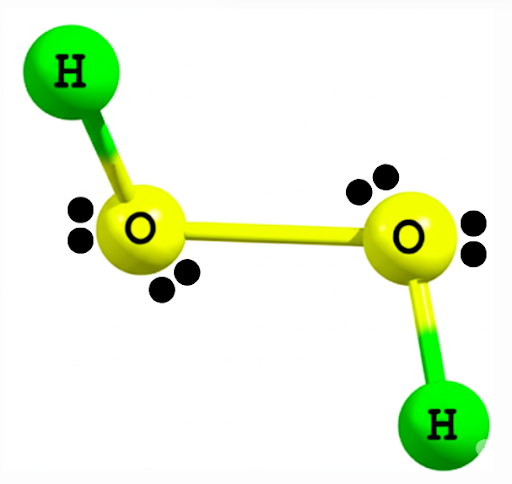
Bonding in H₂O₂
Breakdown of Hydrogen Peroxide Properties
For the molecular structure and chemical behaviour it exhibits, hydrogen peroxide is widely studied.
Here is a complete understanding of its properties.
Physical Properties
The physical properties of H₂O₂ :
- Appearance: Pale blue, colourless (only seen in dilute solutions)
- It has a bitterish taste along with a faint but present odour
- Melting point: –0.43 °C
- Since H₂O₂ decomposes before boiling, the boiling point: 150.2 °C
- It is a viscous fluid.
- In any proportion to water, H₂O₂ is miscible.
Chemical Properties
The chemical properties of H₂O₂ :
- According to its nature and depending on the reaction, it can act in both acidic as well as basic media.
- Able to oxidise substance → Oxidising agent (E.g., can convert PbS → PbSO₄)
- Able to reduce substance (in some reactions only) → Reducing agent (E.g., Acidified KMnO₄ is reduced to Mn²⁺, while H₂O₂ is oxidised to O₂)
- Due to its unstable nature, it breaks down into oxygen and water after undergoing decomposition.
Reaction: 2H₂O₂ → 2H₂O + O₂
Preparation of Hydrogen Peroxide
H₂O₂ can be prepared on both small and large scales. Small-scale preparation is usually done in laboratories, whereas large-scale ones are done on an industrial level.
1. Laboratory Preparation
- By Hydrolysis of Sodium Peroxide (Na₂O₂):
- Na₂O₂ + 2H₂O → 2NaOH + H₂O₂
- By Hydrolysis of Barium Peroxide (BaO₂):
- BaO₂ + H₂SO₄ → BaSO₄ ↓ + H₂O₂
- H₂O₂ is left in solution after BaSO₄ precipitates out.
BaO₂ + dilute HCl is not used (forms Cl₂).
2. Industrial Preparation
By Anthraquinone Process: This is the most economical method used in industries.
- Firstly, hydrogenation happens when anthraquinone is hydrogenated to anthrahydroquinone.
- Secondly, this is then oxidised with oxygen to again form anthraquinone, but this time along with hydrogen peroxide.
Details At A Glance
| Property | Details |
| Compound | Hydrogen Peroxide (H₂O₂) |
| Appearance | Pale blue liquid (colourless in dilute form) |
| Nature | Unstable, oxidising and reducing agent |
| Melting Point | –0.43 °C |
| Boiling Point | 150.2 °C (with decomposition) |
| Solubility | Completely miscible with water |
| Common Prep Method | Hydrolysis of peroxides, Anthraquinone process |
| Oxidation state of O | -1 |
| Stability | Decomposes on heating/light (stored in dark bottles) |
Formal Charge in H₂O₂
To determine if the Lewis structure of H₂O₂ is stable, we calculate the formal charge on each atom using the formula:
Formal charge = Valence electrons – (Lone pair electrons + ½ × Bonding electrons)
Step-by-step for each atom:
Oxygen (O) – each
- Valence electrons: 6
- Lone pairs: 2
- Bonding electrons: 4 (2 from one single bond with another O, 2 from one single bond with H)
Formal charge = 6 – (4 + ½×4) = 6 – (4 + 2) = 6 – 6 = 0
Hydrogen (H) – each
- Valence electrons: 1
- Lone pairs: 0
- Bonding electrons: 2 (1 single bond with oxygen)
Formal charge = 1 – (0 + ½×2) = 1 – 1 = 0
Thus, all atoms in H₂O₂ carry zero formal charge, which confirms that the Lewis structure is stable and correct.
Summing Up
We have understood that H₂O₂ is a unique compound which contains both oxidising and reducing properties. The importance of H₂O₂ ranges from the environmental sector to even the medical sector, showing its versatility as a compound.
Frequently Asked Questions
Q1. Why is hydrogen peroxide unstable?
It releases energy while readily decomposing into water and oxygen.
Q2. Is H₂O₂ an oxidising or reducing agent?
The nature of H₂O₂ to act as an oxidising or reducing agent depends on the conditions of reaction.
Q3. What is the most common industrial method of H₂O₂ preparation?
The Anthraquinone process.
Q4. What is the oxidation state of oxygen in H₂O₂?
–1, since it lies between O₂ (0) and H₂O (–2).
Q5. State some common uses of hydrogen peroxide.
The common uses are:
- As an antiseptic (“perhydrol” 20% solution).
- As a bleaching agent for hair, silk, wool.
- As an oxidiser in rocket fuels.


 Call Now
 Let's Chat
 Share
Share