-
Call Now
1800-102-2727


Hydrogen: Types & Methods of Preparation

In the whole universe, the lightest and the most abundant element is none other than Hydrogen (H₂). It plays quite an important role in many sectors like industries, energy systems, and chemical processes, as a diatomic molecule. Hydrogen is used in the Haber process (NH₃), hydrogenation of oils, rocket fuel, welding, and fuel cells.
Let us understand more about hydrogen. Read on to learn what its types are, and also the methods of preparation.
What is Hydrogen?
In the free state, hydrogen is present on Earth in trace amounts, but in reality, it is abundant in compounds such as water (H₂O), hydrocarbons, and organic molecules. The gas is colourless, odourless, and tasteless, along with being flammable.
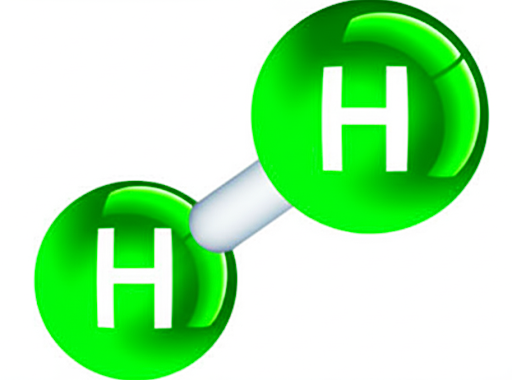
H 2 Molecule structure
Breakdown of Types of Hydrogen
Hydrogen can be classified on the basis of two parameters: one based on isotopes and the other on its production methods. Here is a complete understanding of its types.
Based on Isotopes
- Protium (¹H) → has no neutrons in its nucleus and is the most abundant isotope.
- Deuterium (²H or D) → has one neutron in the atom and is used in nuclear reactors.
- Tritium (³H or T) → has two neutrons, is radioactive (β-emitter), used in nuclear fusion research
Note: Protium = 99.98% abundant
Based on Production (Energy Source)
- Grey Hydrogen → These are produced from natural gas / coal without carbon capture (CO₂ released)
- Blue Hydrogen → These are produced the same way as grey but with CO₂ captured & stored.
- Green Hydrogen → These types are produced from water electrolysis using renewable energy.
- Brown/Black Hydrogen → These are from coal gasification (brown = lignite coal, black = bituminous coal).
- Pink Hydrogen → Nuclear energy (electrolysis powered by nuclear energy) produces pink hydrogen.
Preparation of Hydrogen
Hydrogen can be prepared on both small and large scales. Small-scale preparation is usually done in the laboratories, whereas large-scale productions are done on industrial level.
1. Laboratory Preparation
- Reaction of Metals with Dilute Acids
- Example: Zn + 2HCl → ZnCl₂ + H₂↑
- Hydrogen is liberated when dilute HCl or H₂SO₄ reacts with metals (like zinc, iron, and magnesium)
- Reaction of Metals with Alkali
- Example: 2Al + 2NaOH + 6H₂O → 2Na[Al(OH)₄] + 3H₂↑
- Hydrogen is liberated when strong bases react with amphoteric metals (like Al, Zn)
- Electrolysis of Water
- H₂ and O₂ are produced after decomposition of acidified or alkaline water by passing electricity through it.
2. Industrial Preparation
- Steam Reforming of Natural Gas
- CH₄ + H₂O → CO + 3H₂
- This is the most common method of large-scale hydrogen production. CO further reacts with H₂O in water–gas shift reaction:
- Coal Gasification
- C + H₂O → CO + H₂
- H₂ and CO (water gas) mixture is formed.
- Electrolysis of Water (for green hydrogen)
- 2H₂O → 2H₂ + O₂
- This method is powered by renewable or nuclear energy.
- Partial Oxidation of Hydrocarbons
- CH₄ + ½O₂ → CO + 2H₂
Details At A Glance
|
Property |
Details |
|
Symbol |
H |
|
Atomic Number |
1 |
|
Atomic Mass |
1.008 |
|
Isotopes |
Protium (¹H), Deuterium (²H), Tritium (³H) |
|
Types (by source) |
Grey, Blue, Green, Brown/Black, Pink |
|
Common Lab Methods |
Metals like Zn, Fe, Mg + dilute HCl/H₂SO₄ (not HNO₃) |
|
Industrial Methods |
Steam reforming, Coal gasification, Electrolysis |
Summing Up
We have understood that hydrogen is the fuel for the future and a versatile energy source. It can be easily produced on both industrial and laboratory levels using various methods. Regarding the growing requirement for renewable energy technologies, green hydrogen is gaining much importance in this sustainable sector.
Frequently Asked Questions
Q1. Which is the most abundant isotope of hydrogen?
Protium (¹H), with no neutrons, is the most abundant isotope.
Q2. What is syngas or water gas?
A mixture of CO and H₂, produced by the reaction of carbon with steam.
-
C + H₂O → CO + H₂
Q3. Why is electrolysis of water not widely used industrially?
Since it would require a lot of electricity for production on such a large scale.
Q4. Which metals are commonly used in the lab to prepare hydrogen?
Zinc, iron, and magnesium are commonly used with dilute acids.
Q5. Why is hydrogen called the fuel of the future?
It is a clean and sustainable energy carrier, as it produces only water on combustion.


 Call Now
 Let's Chat
 Share
Share