-
Call Now
1800-102-2727


Understanding Hybridisation of SF₄: Sulfur Tetrafluorid

Sulfur tetrafluoride (SF₄) is a sulfur fluoride. It is an inorganic compound and has a see-saw-like molecular shape. It’s an excellent example of sp³d hybridisation in chemistry. Let us understand how hybridisation happens in SF₄. Read on to learn how it leads to its bonding and molecular shape.
What is the Hybridisation of SF₄?
SF₄ consists of one sulfur atom and four fluorine atoms. Each fluorine atom is bonded to sulfur with single covalent bonds. In all, it also has one lone pair of electrons. In order to form these bonds, sulfur undergoes sp³d hybridisation.
Using the Hybridisation Formula
We can determine the hybridisation of sulfur tetrafluoride using the simple formula:

Calculation:
- Valence electrons of central atom (S): 6
- Number of monovalent atoms (F): 4
- Negative charge: 0
- Positive charge: 0
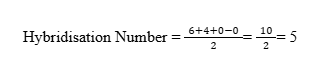
Interpretation:
- A hybridisation number of 5 corresponds to sp³d hybridisation.
- This explains the seesaw molecular shape of SF₄: four bonding pairs and one lone pair around sulfur
Breakdown of SF₄ Hybridisation
Sulfur tetrafluoride consists of one pair of lone electrons and has a seesaw molecular shape. It has 4 covalent single S–F bonds. It is a well-known example in interhalogen compounds (surrounded by 4 F).
Here is a complete understanding of its hybridisation.
Electronic Configuration of Sulfur
The atomic number of sulfur is 16.
The ground state of sulfur :
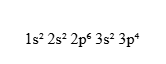
Only two unpaired electrons → insufficient to form four bonds
Excited state configuration:
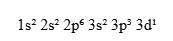
Four unpaired electrons → enough to form 4 bonds and also have one lone pair arrangement
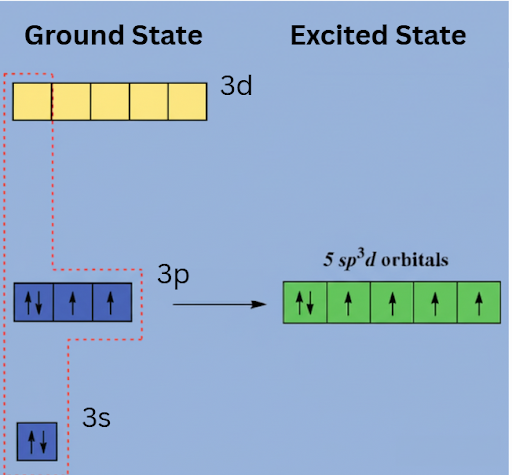
Ground state vs excited state orbital diagram
Formation of Hybrid Orbitals
sp³d hybridisation occurs when 1 s orbital, 3 p and 1 d orbitals mix.
The result:
→ 5 sp³d hybrid orbitals on sulfur atom
→ 4 sp³d hybrid orbitals used for σ bonding with fluorine atoms
→ 1 sp³d hybrid orbital has the lone pair of electrons
Bond Formation in SF₄
Each sulfur atom uses:
- 4 sp³d orbital to form a σ bond with fluorine
- 1 sp³d orbital to have the lone pair
Result:
- 4 S–F σ bonds
- 1 Lone Pair (on the sulfur atom)
- Hybridisation type: sp³d
- Bond angle: ~102° and ~173°
- Geometry: Seesaw
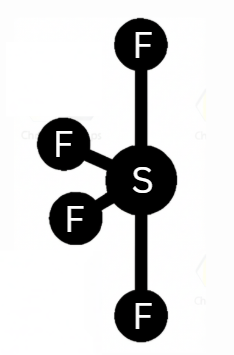
Geometry and bonding of SF₄
Details At A Glance
| Property | Details |
| Molecule | Sulfur tetrafluoride (SF₄) |
| Hybridisation | sp³d |
| Geometry | Seesaw |
| Bond angle | ~102° (equatorially), ~173° (axially) |
| Bonding | 4 σ bonds (S–F), 1 LP (lone pair) |
| Unhybridised Orbitals | 0 (hybridisation happens for all orbitals) |
| Sulfur valency satisfied? | Yes, by forming 4 bonds and having 1 lone pair of electrons |
Formal Charge in SF₄
To determine if the Lewis structure of SF₄ is stable, we calculate the formal charge on each atom using the formula:
Formal charge = Valence electrons – (Lone pair electrons + ½ × Bonding electrons)
Step-by-step for each atom:
Sulfur (S) – central atom
- Valence electrons: 6
- Lone pairs: 1
- Bonding electrons: 8
( from four single bonds with F)
Formal charge = 6 – (2 + ½×8) = 6 – (2 + 4) = 6 – (6) = 0
Fluorine (F) – each
- Valence electrons: 7
- Lone pairs: 3
- Bonding electrons: 2
(1 single bond with sulfur)
Formal charge = 7 – (6 + ½×2) = 7 – (6 + 1) = 7 – (7) = 0
Thus, all atoms in SF₄ carry zero formal charge, confirming that the Lewis structure is stable and correct.
Summing Up
The sulfur in SF₄ forms 4 single covalent bonds with fluorine and has one lone pair of electrons. sp³d hybridisation leads to a seesaw shape with ~102° (equatorially), ~173° (axially) bond angles. The distortion in bond angle is because of the presence of lone pair.
Frequently Asked Questions
Q1. Why does sulfur undergo hybridisation in SF₄?
To form 4 covalent bonds and accommodate lone pair, sulfur mixes orbitals (s, p, d) to form hybrid orbitals.
Q2. How many σ and π bonds are present in SF₄?
There are 4 σ bonds and 0 π bonds in total.
Q3. What is the shape of SF₄?
Seesaw, due to the presence of lone pairs, which repulse bonding pairs.
Q4. Is SF₄ polar or non-polar?
SF₄ is polar, due to the asymmetrical electron distribution, as there is presence of lone pair of electrons.
Q5. What are some uses of SF₄ in our daily lives?
SF₄ is commercially used as a fluorinating agent in organic synthesis. It is also widely used for producing fluorinated pharmaceuticals and agrochemicals.


 Call Now
 Let's Chat
 Share
Share