-
Call Now
1800-102-2727


Understanding Hybridisation Of ClF₃: Chlorine Trifluoride

Chlorine Trifluoride (ClF₃) has one chlorine and three fluorine atoms. It is an interhalogen compound and undergoes sp³d hybridisation, attaining a T-shaped molecular structure.
Let us understand how hybridisation happens in ClF₃. Read on to learn how it leads to its bonding and molecular shape.
What is the Hybridisation of ClF₃?
Chlorine Trifluoride consists of one central chlorine atom, which is bonded to fluorine atoms and has two lone pairs left. Since chlorine has 5 sets of electrons (3 bonding pairs + 2 lone pairs), it undergoes sp³d hybridisation and follows the principle of expanded octet.
Using the Hybridisation Formula
We can determine the hybridisation of chlorine trifluoride using the simple formula:

Step-by-step calculation:
- Valence electrons of central atom (Cl): 7
- Monovalent atoms (F): 3 (each fluorine is monovalent)
- Negative charge: 0
- Positive charge: 0

Interpretation:
Hybridisation number = 5, which corresponds to sp³d hybridisation.
Breakdown of ClF₃ Hybridisation
ClF₃ has a trigonal bipyramidal electron geometry, but it acquires a T-shaped structure. The lone pairs take up equatorial positions, which results in greater repulsion.
Here is a complete understanding of its hybridisation.
Electronic Configuration of Chlorine
The atomic number of chlorine is 17.
The ground state of chlorine:
1s² 2s² 2p⁶ 3s² 3p⁵
Only has one unpaired electron → insufficient to form 3 bonds
Excited state configuration:
1s² 2s² 2p⁶ 3s² 3p⁴ 3d¹
Now, three unpaired electrons → enough to form 3 Cl–F bonds
Also includes lone pairs → total of 5 regions of electron density
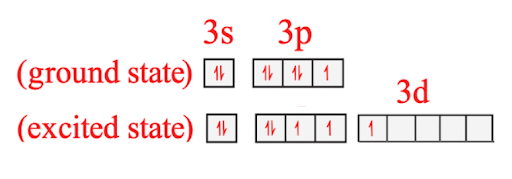
Ground state vs excited state orbital diagram of Cl
Formation of Hybrid Orbitals
sp³d hybridisation occurs when 1 s orbital, 3 p orbitals, and 1 d orbital mix to form equivalent hybrid orbitals.
The result:
→ 5 sp³d hybrid orbitals are formed
→ These accommodate lone pairs and are used to form bonds between atoms.
Bond Formation in Chlorine Trifluoride
- 3 sp³d hybrid orbitals overlap with the p orbitals in the fluorine atom and form 3 σ bonds.
- The remaining 2 sp³d hybrid orbitals contain lone pairs of electrons.
Result:
- The molecule adopts a T-shape in order to minimise lone pair repulsion.
- Hybridisation type: sp³d
- Bond angle: 175° and ~87.5° ( due to lone pair repulsion)
- Geometry: T-shaped

Geometry and bonding of Chlorine Trifluoride
Details At A Glance
| Property | Details |
|---|---|
| Molecule | Chlorine Trifluoride (ClF₃) |
| Hybridisation | sp³d |
| Geometry | T-shaped |
| Bond angle | 175° and ~87.5° |
| Bonding | 3 σ bonds (Cl–F), 2 lone pairs |
| Unhybridised Orbitals | d-orbitals are involved |
| Chlorine valency satisfied? | Yes, expanded octet with 10 electrons around Cl |
| Boiling Point | 11.75 °C |
| Melting Point | −76.34 °C |
Formal Charge in ClF₃
To determine if the Lewis structure of ClF₃ is stable, we calculate the formal charge on each atom using the formula:
Formal charge = Valence electrons – (Lone pair electrons + ½ × Bonding electrons)
Step-by-step for each atom:
Chlorine (Cl) :
- Valence electrons: 7
- Lone pairs: 2 (4 electrons)
- Bonding electrons: 3
(3 Cl–F bonds with 2 shared electrons each)
Formal charge = 7 – (4 + ½×6) = 7 – (4 + 3) = 0
Fluorine (F) – each
- Valence electrons: 7
- Lone pairs: 3 (6 electrons)
- Bonding electrons: 2
Formal charge = 7 – (6 + 1) = 0
Thus, all atoms in ClF₃ carry zero formal charge, which confirms that the Lewis structure is stable and correct.
Summing Up
Chlorine in ClF₃ forms 3 σ bonds, and ends up with 2 lone pairs. The molecule follows the concept of an expanded octet and thus ends up undergoing sp³d hybridisation. ClF₃ has T-shaped molecular geometry and bond angles of 175° and ~87.5° (due to lone pair repulsion).
Frequently Asked Questions
Q1. Why does chlorine undergo hybridisation in ClF₃?
To form 3 three bonds with fluorine and also accommodate 2 lone pairs, chlorine hybridises into sp³d orbitals.
Q2. How many σ and π bonds are present in ClF₃?
There are 3 σ bonds and 0 π bonds in total.
Q3. What is the shape of Chlorine Trifluoride?
T-shaped, due to 3 bonding pairs and 2 lone pairs.
Q4. Is ClF₃ polar or non-polar?
Polar, because the T-shape of ClF₃ causes an uneven distribution of charge.
Q5. What are some uses of Chlorine Trifluoride in our daily lives?
ClF₃ is highly reactive. It is advised to be handled with care and is used for nuclear fuel processing and rocket propellants. Chlorine Trifluoride is also used as a fluorinating agent.


 Call Now
 Let's Chat
 Share
Share