-
Call Now
1800-102-2727


Chemical Properties of Group 13 Elements- Introduction, Covalent Character, Oxidation States, Practice Problems & FAQs

You must have observed that when you order the food from some online app, they pack the food with the foil and then deliver it to your address. But do you know what this foil is made up of, what material is used to manufacture foils and the most important question, why it is used?
Let me give you a hint. The same material is also used in the manufacturing of utensils. It is nothing but the most abundant metal of the earth's crust and is named aluminium. Aluminium is the element of the 13th group placed in the periodic table along with the other elements and due to its properties like malleability and less reactive nature, it is used to preserve food once it is cooked. Now, let's learn more about group 13 elements and about the chemical properties of the elements which belong to group-13.
Table of Contents
- Introduction to Group 13 Elements
- Covalent Character of Group 13 Elements
- Oxidation States of Group 13 Elements
- Chemical Properties of Group-13 Elements
- Practice Problems
- Frequently Asked Questions - FAQs
Introduction to Group 13 Elements
Group 13 of the periodic table consist elements which include - Boron (B), Aluminium (Al), Galium (Ga), Indium (In) and Thallium (Tl) with an outermost electronic configuration of ns2np1 in which last electron enters into the p-subshell and is classified as a p-block element. Due to similar outer electronic configuration, the physical and chemical properties are related. Still, there are some variations in the nature and the properties of the elements belonging to this group which include the non-metallic nature of boron. In contrast, other elements of this group possess a metallic character. Borax is the principal source of boron in nature, aluminium exists in the form of bauxite, cryolite and alumina silicate minerals. Other elements like indium, gallium and thallium exist in the form of sulphide minerals.
Covalent character of Group 13 Elements
- Boron compounds are covalent in nature because the sum of the first three ionisation energies of boron is extremely high due to its small size which makes it impossible for boron atoms to form +3 an ion. Even if +3 an ion is formed in boron and it will have very high polarising power due to its small size resulting in covalent character in the compounds of boron.
- Other elements of group 13 in +3 oxidation state is aluminium chloride (AlCl3) which is covalent in nature in an anhydrous form but in aqueous solution, it exists as a hydrated cation because in the aqueous solution hydration energy overcomes the ionisation energy.
Oxidation States of Group 13 Elements
- Elements of this group show two different types of oxidation states +1 and +3. However, the stability of +1 the oxidation state increases on moving down the group and the stability of + 3 oxidation state decreases due to the inert pair effect.
- The inert pair effect describes the unwillingness of s-subshell electrons to participate in chemical bonding. The effective nuclear charge pulls valence electrons present in the s-subshell tightly down the group due to poor shielding of d and f-orbitals, limiting their participation in bonding.
- Inert pair effect starts from n > 4 (here ‘n’ belongs to period number) due to poor shielding of d-orbital electrons which starts in the 4th period but is significant in the 6th and 7th period of the periodic table as electrons are filled in the f-subshell.
- Both +1 and +3 oxidation states have been seen in Ga, In, and Tl and compounds of Tl1+ are more stable than Tl3+.
Order of stability of compounds with +1 oxidation state of central atom: Ga<In<Tl
Order of stability of compounds with +3 oxidation state of central atom: Al>Ga>In>Tl
Chemical Properties of Group-13 Elements
Reaction with air
- Boron does not react with air in its crystalline form and aluminium forms a thin layer of oxide (Al2O3) on its surface which prevents from the further reaction, this reaction of aluminium with air is highly exothermic in nature and the amount of energy released depends upon the surface area of aluminium exposed to the air.
- Gallium and indium are stable in air, thallium forms an oxide layer when reacts with air.
- Amorphous boron and other elements of group 13 react with oxygen to form sesquioxide with the general formula M2O3(Here ‘M’ represent the element of group 13).
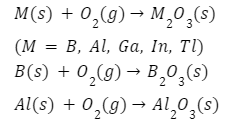
- Thallium form two different compounds when reacted with oxygen, Tl2O and Tl2O3. Tl2O is more stable than Tl2O3 due to the inert pair effect.
- Nature of oxide formed by group-13 elements changes from boron to thallium in which oxide of boron is acidic whereas oxide of thallium is basic in nature.

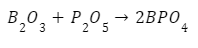
- Acidic nature of boron oxide can be seen as it reacts with basic metal oxides (like cobalt oxide) to form metaborates (Cobalt metaborate). For example,

It can react only with strong acidic oxides like P2O5 to form phosphate.
- Only boron and aluminium react with nitrogen present in the air to form corresponding nitrides at high temperature. For example,

(E=B, Al)
Reaction with water
- Boron does not react with cold water, hot water or steam but red hot boron reacts with steam liberating hydrogen gas.

- Aluminium does not react with the cold water due to the formation of an oxide layer of aluminium (Al2O3) over its surface. But when aluminium is dipped in salt water it gets corroded as the salt present in the solution removes the oxide layer formed on the surface of the aluminium. Aluminium can be decomposed when reacted with steam liberating hydrogen gas.

- Gallium, indium and thallium cannot react with water directly. Gallium and indium react with water in the presence of oxygen, thallium reacts with moist air to form TlOH.

Reaction with metal
- Only boron reacts directly with the metals to form metal borides which show the non-metallic nature of boron. Whereas other elements of this group do not react with metal. For example,

Reaction with acid
- Boron does not react with non-oxidising acids like dil. HCl or dil. H2SO4 but can react with oxidising acid-like Conc H2SO4 or Conc HNO3 .
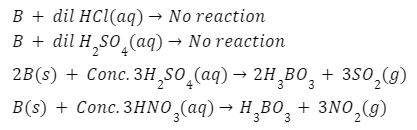
- Aluminium can react with mineral acids like dil. HCl or dil. H2SO4 to liberate hydrogen gas but in the presence of conc. H2SO4 it gets dissolved and sulphur dioxide gas is released.

- Aluminium when allowed to react with conc. HNO3 , it makes the aluminium passive in nature due to the formation of the oxide layer over its surface.
- Other elements of group-13 (i.e., Ga, In, Tl) also react with dilute mineral acids.
Reaction with alkali
- Boron does not react with alkali at low temperature but at high-temperature boron reacts with alkali to form borates.

- Aluminium react with a strong base to form meta-aluminate and releases hydrogen gas.

- Gallium get dissolved in alkali to form gallate.
- Indium and thallium do not react with alkali.
Reaction with Halide
- Elements present in group 13 form three different types of halides (i.e., monohalide, dihalide and trihalide).
- Dihalide is formed by boron element of form B2X4 which is planar in solid-state but in vapour state it attains non-eclipsed configurational form due to rotation along with B-B single bond. Galium and indium can also form dihalide.

- All the elements of group 13 forms trihalide with general formula MX3( Here, ‘M’ denotes the element of group 13). TlCl3, TlBr3 are unstable compounds and TlI3 exist in form ofTl+ and I3- due to inert pair effect.
- Boron form trihalides with general formula BX3 (Here, ‘X’ denotes the halogen element) which is sp2 hybridised making boron trihalides planar with the bond angle of 120, form electron deficient compounds which generally act as a lewis acid.
- The lewis acidic nature of boron trihalide increases from BF3 to BI3 due decrease in the extent of back bonding from BF3 to BI3.
- Chlorides of Al, Ga, and In dimerises in vapour state which increases the stability of the molecule as the monomer of Al, Ga, and In are electron deficient in nature. During dimerisation two different types of bonds are formed 3C-4e bond and 2C-2e bond. The two 3C-4ebond formed in the dimer molecule is also known as a bridge bond or banana bond which has a higher bond length as compared with the terminal bonds. Four 2C-2e bonds are formed which are known as terminal bonds. A bridge bond or banana bond is formed due to the complete transfer of pair of electrons present in the form of lone pair on a chlorine atom to the vacant p-orbitals of the aluminium atom through co-ordinate bonds.

- All the boron trihalides except BF3 get hydrolysed to form boric acid.

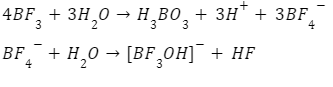
- BF3 get hydrolysed partially as it is a weak Lewis acid to form acid and hydrogen fluoride which further reacts to form fluoroborates.

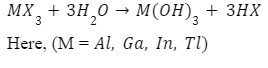
- Halides of other elements get hydrolysed to form corresponding hydroxides.
Recommended video:
Practice problems
Q1. Select the correct option for the final product formed when boron trifluoride is hydrolysed.
A. H3BO3
B. BH4-
C. BF3
D. [BF3OH]-
Answer: (D)
Solution: All the boron trihalides except BF3 gets hydrolysed to form boric acid.

BF3 get hydrolysed partially as it is a weak Lewis acid to form boric acid and hydrogen fluoride which further react to form fluoroborates.
Q2. Select the correct option with respect to the halide of the group-13 element.
A. AlCl3 get dimerise to form Al2Cl6 in vapour form.
B. Al2Cl6 contains two different types of bonds.
C. Boron forms dihalides as B2X4 where ‘X’ is a halogen atom attached with boron.
D. All of these are correct
Answer: (D)
Solution: In the case of aluminium chloride, dimerisation takes place in a vapour state which increases the stability of the molecule as the monomer of Al is electron deficient in nature. During dimerisation, two different types of bonds are formed 3C-4ebond and 2C-2e bond. The two 3C-4ebonds formed in the dimer molecule is also known as bridge bond or banana bond which has higher bond length as compared with the terminal bonds. Four 2C-2e bonds are formed which are known as terminal bonds.
Bridge bond or banana bond is formed due to the complete transfer of electrons present in the form of lone pairs on chlorine atoms to the vacant p-orbitals of aluminium through co-ordinate bonds.

Dihalide is formed by boron element to form B2X4 which is planar in solid-state but in vapour state it attains non-eclipsed configurational form due to rotation along with B-B single bond. Galium and indium can also form dihalide.

Q3. Which of the following element does not react with non-oxidizing acids like dil. HCl but can only react with oxidizing acids like conc. HNO3 at high temperature?
A. Aluminium
B. Gallium
C. Boron
D. Thallium
Answer: (C)
Solution: Boron does not react with non-oxidising acids like dil. HCl or dil. H2SO4 but can react with oxidising acids like conc. H2SO4 or conc. HNO3 at high temperatures.

Aluminium and other elements present in the group 13 can react with non-oxidising acids like dil. HCl or dil. H2SO4.
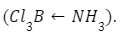
Q4. The element 'X' belonging to group-13 reacts with chlorine gas to produce a compound XCl3 which is electron deficient in nature and easily reacts with ammonia to form an adduct  However the halide compound formed cannot get dimerise. The element X would be:
(A) B
(B) Al
(C) In
(D) Ga
Answer: (A)
Solution: Trichlorides of aluminium, boron, and gallium are electron-deficient and they get dimerise to form a stable molecule. In the case of boron trichloride dimerisation does not take place due to the small size of the boron atom. In case of NH3 due to its small size and presence of lone pair, it acts as a Lewis base and when lewis acid (BCl3) and lewis base (NH3) react together it results in adduct formation
Frequently asked questions-FAQs
Q1. Why does nitrogen react with boron and aluminium only at high temperatures?
Answer: Nitrogen reacts with boron and aluminium at high temperatures because nitrogen exists in the form of a diatomic nitrogen molecule where nitrogen atoms are bonded with a triple bond. In order to react with boron and aluminium atoms, the bond present between the nitrogen atoms in the nitrogen molecule needs to be broken. Therefore, a high temperature is required to break the stable triple bond.
Q2. What are the reasons for the anomalous behaviour of boron which is a group-13 element?
Answer: Boron shows the anomalous behaviour in group 13 due to the following reason:
- Boron has a small size and has a high ionisation enthalpy value as compared with the other elements present in the group so it also does not exhibit +3 an oxidation state.
- Boron does not contain d-orbitals and therefore it cannot expand the octet.
Due to these reasons, boron can show the allotropy property while other element does not exhibit the property. Boron does not exhibit the inert pair effect due to the absence of d and f-orbital electrons. Boron is a non-metal which is a bad conductor of electricity while the other elements present in the group have metallic character and good conductors of electricity.
Q3. Why is boric acid said to be a weak monobasic acid?
Answer: Boric acid is classified as a weak monobasic acid because it contains three B-OH bonds and one vacant p-orbital and therefore due to the presence of a vacant p-orbital it acts as a lewis acid. When boric acid is allowed to react with water it takes the hydroxide ion (OH-) present in the water and furnishes H3O+ ions in the solution making the solution acidic in nature.
B(OH)3 (aq) + 2H2O (l) ⇋ [B(OH)4] - (aq) + H3O+ (aq)

Q4. Why Aluminium oxide is said to be amphoteric in nature?
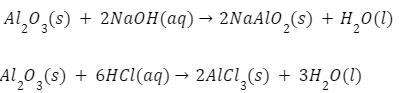
Answer: Aluminium oxide is said to be amphoteric because it can react with both acids and a base to form products. When Al2O3 react with HCl , It results in the formation of aluminium trichloride but when Al2O3 reacts with a base like NaOH it results in the formation of sodium aluminate.
Related topics
|
Group 13 elements |
physical properties of group- 13 elements |
|
Group-14 elements |
Fluorine |
|
Dinitrogen |
Group-17 elements |

 Call Now
 Let's Chat
 Share
Share