-
Call Now
1800-102-2727


Graham's Law of Diffusion- Diffusion, Effusion, Formula, Factors Affecting Rate of Effusion of Gases, Practice problems and FAQs

Have you ever noticed why you get the aroma of hot food from a far distance when it is getting prepared in your neighbour’s house? Did you observe when you burn incense sticks, the smell of burning incense sticks can even be identified from the other part of the room? Well! All these are examples of diffusion which takes place in our daily life. In the year 1848, Thomas Graham studied the diffusion and effusion of gases. So, let’s dig in a bit deeper into the concept and try to understand what diffusion and effusion are and what Thomas Graham proposed.

Table of contents
- Diffusion
- Effusion
- Graham’s Law of effusion/diffusion
- Factors affecting rate of effusion of gases
- Practice problems
- Frequently asked questions-FAQs
Diffusion
It is defined as the movement of gas from the region of high concentration to the region of low concentration without any physical aid or its just intermixing of different gases on its own due to pressure difference.
Diffusion is an important phenomenon occurring in our daily life. Diffusion is maximum in the case of gases and then followed by liquids and solids.

Let us consider the above example in which when the valve is opened and the gases present in both the containers start mixing due to the concentration or pressure difference and get distributed uniformly in the beaker till the equilibrium is reached.
Effusion
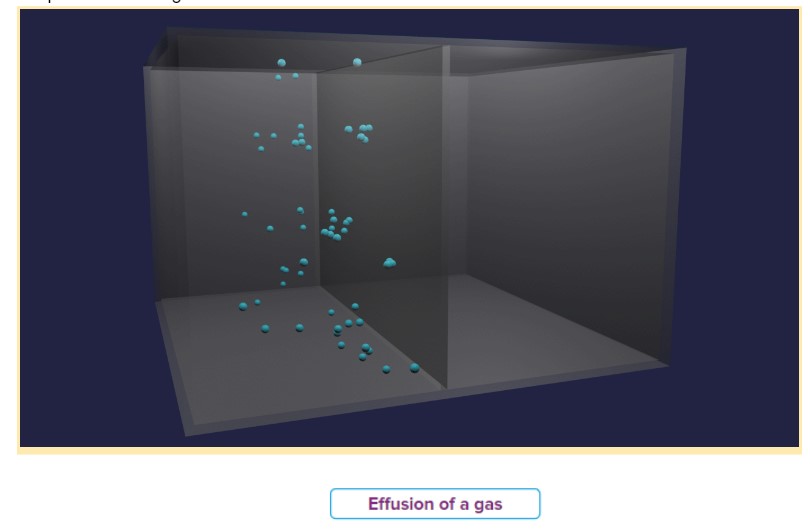
The movement of gas molecules through a small orifice due to the difference in pressure is known as effusion. It occurs when the size of the orifice is smaller than the mean free path of the particles of the gas.
Graham’s Law of effusion/diffusion
In the year 1848, Thomas Graham through his experiments observed that the rate of effusion/diffusion of a lighter gas is more than the rate of effusion/diffusion of heavier gas and stated a law known as Graham’s law of effusion/diffusion.
According to Graham's law “Rate of effusion/diffusion of a gas at a constant temperature and pressure is inversely proportional to the square root of its molar mass”.
Mathematically,

Where, r is the rate of the effusion/diffusion and M is the molar mass of the gas.
From the ideal gas equation, we can say;
density (d) 
Where d is the density of the gas, P is the pressure of the gas, M is the molar mass of the gas, R is the universal gas constant and T is the temperature of the gas.
For an ideal gas at constant pressure and temperature;
d ∝ M
So, it can be said that;
r ∝ 1d
Rate of effusion/diffusion can be defined in multiple ways.
- Rate of effusion/diffusion can be defined as the no. of moles of gas diffused.

- Rate of effusion/diffusion is also defined as the volume of the gas diffused per unit time.

- Rate of effusion/diffusion can also be defined as the distance travelled by the gas per unit time.

Factors affecting rate of effusion of gases
In fact, apart from molar mass and density of the gas, the rate of effusion/diffusion of a gas depends on other factors as well:
Pressure: Rate of effusion/diffusion is directly proportional to the pressure of the gas. The higher the pressure of the gas in the container, the more will be the rate with which the gas will effuse or diffuse.
Mathematically,
r ∝ P
Where, r is the rate of the effusion/diffusion and P is the pressure of the gas in the container.
Area of the orifice: The rate of effusion/diffusion is directly proportional to the area of the orifice through which a gas is effusing. The bigger the area of the orifice, the higher will be the rate of effusion/diffusion.
Mathematically,
r ∝ A
Where, r is the rate of the effusion/diffusion and A is the area of the orifice.
Temperature: The rate of effusion/diffusion is inversely proportional to the temperature of the gas. More the temperature of the gas, the lower will be the rate with which the gas will effuse or diffuse.
Mathematically,
r ∝ 1T
Where, r is the rate of the effusion/diffusion and T is the temperature of the gas.
Number of moles: The rate of effusion/diffusion is directly proportional to the number of moles of gas which were present initially in the container.
Mathematically,
r ∝ n
Where, r is the rate of the effusion/diffusion and n is the number of moles of gas present initially in the container.
Suggested video link
https://www.youtube.com/watch?v=3QcH9-rEB_c
Practice problems
Q 1. If two gases A and B are present in two different containers which are connected with a cylindrical tube of a certain length that is allowed to diffuse. Select the correct option for the gas, where the first time these two gases are meeting.
Assume that the molar mass of gas A = 64 gmol-1 and molar mass of gas B=32 gmol-1 respectively.
a. Closer to the container containing gas A
b. Closer to the container containing gas B
c. At an equal distance from both the containers
d. None of the above
Answer: (A)
According to the given data,
Molar mass of gas A = 64 gmol-1
Molar mass of gas B=32 gmol-1
Using Graham’s law of diffusion we know,
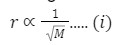
Where, r is the rate of the effusion/diffusion and M is the molar mass of the gas.
Rate of diffusion can be defined as the distance travelled by the gas per unit time.

Comparing equation (i) and (ii) we get,
Higher the molar mass of the gas, the lesser the distance it will travel. Therefore, the first intermixing will take place closer to the container containing gas A.
Q 2.Select the correct option in which the rate of effusion of the given gas will be maximum at a constant temperature and pressure.
a. SO2
b. O2
c. CH4
d. CO2
Answer: C
According to the Graham’s law (At constant temperature and pressure),
r1M
Molar mass of SO2=64 g mol-1
Molar mass of O2=32 g mol-1
Molar mass of CH4= 16 g mol-1
Molar mass of CO2= 44 g mol-1
As the molar mass of CH4 is minimum. Therefore, the rate of effusion will be maximum.
Q 3. If the rate of diffusion of CH4 and some unknown gas is 2:1, measured under constant temperature and pressure. The molecular mass of unknown gas is:
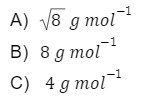
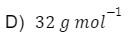
Answer: (D)
Molar mass of CH4 =16 gmol-1
Let the rate of diffusion of unknown gas be rdX.
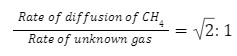
Let the molar mass of unknown gas be MX g mol-1.
According to Graham’s law at constant temperature and pressure;
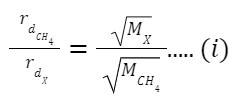
Putting the value in the equation (i) we get,

Squaring both the sides, we get;
MX=2 x 16 =32 gmol-1
Q 4. What will be the ratio of the rate of diffusion of SO2:SO3 if the initial moles of SO2 and SO3 2 mol and 3 mol respectively?
a. 2:3
b. 5:2
c. 5 :3
d. 5:3
Answer: (C)
Initial no. of moles of SO2=2 mol
Initial no. of moles of SO3=3 mol
Molar mass of SO2=64 g mol-1
Molar mass of SO3=80 g mol-1
According to Graham's law;
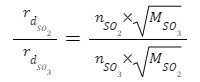
Putting the values in the above equation;
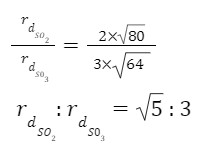
Frequently Asked Questions-FAQs
Q 1. What is the difference between osmosis and diffusion?
Answer: Osmosis is the process of movement of solvent molecules through a semipermeable membrane from the region of lower concentration to the region of higher concentration. Diffusion is defined as the spontaneous movement of gas molecules from the high concentration region to the low concentration region without any physical aid.
Q 2. Why is diffusion in gases faster as compared with solids?
Answer: Diffusion is faster in the case of gases as compared with liquids or solids because in case of gases, interparticle forces of attraction between the particles are minimum and particles possess higher kinetic energy but in the case of solids interparticle forces of attraction between particles are maximum and kinetic energy is minimum therefore diffusion in case of solids is almost negligible.
Q 3. State some examples of effusion in daily life.
Answer: Some of the examples of effusion are:
- Air coming out of the balloon when it is pricked.
- Air coming out of a tyre when got punctured.
- Water vapours coming out of a pressure cooker.
Q 4. What are the applications of Graham’s law of diffusion?
Answer: There are some important applications of Graham’s law of diffusion which include:
- It helps in the determination of the molecular mass of unknown gases
- It helps in the separation of gases having different densities
- It helps in the separation of isotopes of some of the elements
Related topics
|
Kinetic Theory of Gases |
Boyle’s Law |
|
Avogadro’s Law |
Gay Lussac's law |
|
Maxwell-Boltzmann Distribution Curve |
Real Gas |

NEET Related Links
JEE MAIN Related Links
JEE Advanced Related Links
JEE Advanced Eligibility Criteria
JEE Advanced Chemistry Syllabus
JEE Advanced Registration Dates
CUET Related Links
Important Topics
Anemometer : Measurement of Wind Speed
Angular Acceleration Atomic Theory Audible and Inaudible Sound Average Speed and Average Velocity Average Velocity Avogadros Number Avogadros Hypothesis Azimuthal Quantum Number Balanced Force Bar Magnet Biconvex Lens Boyles Law Buoyancy Calorimeter Carnot Engine Celestial Bodies Centripetal And Centrifugal Force Concave and Convex Lenses Concave Convex Mirrors Contact and Non Contact Force Controlled Thermonuclear Fusion Convection Currents Convex Lens Convex Mirror Destructive Interference Difference Between Conduction Convection and Radiation Difference Between Electric Field and Magnetic Field Difference Between Heat And Temperature Difference Between Series And Parallel Circuits Differences Between Acceleration And Velocity Distance and Displacement Distance Time Graph Electrical Force : Electric Forces and Their Types Electromagnetic Waves : Definition, Equation and Properties of Electromagnetic Waves Electromagnetism Electron Spin Fluid Flow : Bernoullis Equation Derivation and Fluid Mechanics Fluid Friction : Types and Factors of Fluid Friction Frames of Reference : Inertial and Non- Inertial Frame of Reference Frequency and Wavelength Frictional Force Importance of Hydrosphere Instantaneous Speed and Velocity Introduction to Motion Kinetic and Potential Energy Difference Law Of Conservation of Energy Layers of the Earth Light Energy Light Sources List of physics scientists and Their inventionsLoudness of Sound
Magnetic Dipole Moment Magnetic Field Non - Contact Force Non - Renewable Energy Ohms Law Optics P Wave Physics Symbols Plane Mirrors Poissons Ratio Projectile Motion Properties of Water : Anomalous Expansion of Water Radius of Gyration Reflection of Light Reflection of Waves Relative Density Resonance Reverberation Rolling Friction Rotation and Revolution Screw Gauge Semiconductors and Insulators Sliding Friction Speed Time Graphs Static Friction Stefan Boltzmann Law Stress Tension Tension Force Thermometer: Clinical Laboratory Thermometer Types of Rocks Types of Waves Uniform Motion and Non Uniform Motion Unit of Voltage Uses of Convex Lens Uses Of Convex Mirror Uses of Electromagnet Uses of Optical Fibre Wave Wavelength of Light What is Scattering of Light Working of Electric Bell Conventional and Non-conventional Sources of Energy Buoyant Force Bulk Modulus of Elasticity Bernoulli’s Principle Angular Momentum Difference Between Speed And Velocity ForceUnit of Heat
Difference between Distance and Displacement Simple Microscope Derivation Of Equation Of Motion Thermometer: Clinical & Laboratory Thermometer Difference between Concave and Convex LensDerivation Of Lens Maker Formula
Unit Of Pressure Velocity Uses of Plane Mirror
Wave Theory of Light
Unit of Density Unit of Light Unit of Force Unit of Magnetic Field Unit of wavelength Unit of Viscosity Uses of Electroplating Young's Modulus
What is the Scattering of Light
Lenz Law Space Wave Propagation Schrodinger Wave Equation Relation between Fahrenheit and Celsius Refractive Index Potentiometer Working Pascal Law Oscillatory Motion Optical Instruments Newton's Laws of Motion - First Law Modulation and Demodulation Magnetic Flux Lens Formula and Magnification Kaleidoscope Faradays Law Epsilon Naught Value Energy Bands Electrostatics Electroscope AC Generator Unit of Current Lithosphere Bending Equation Derivation Difference Between Pound and Kilogram Semiconductor Devices OTEC - Ocean Thermal Energy Conversion Hall Effect Rectilinear Propagation of Light Difference Between Ammeter and Voltmeter Coefficient of Linear Expansion Ampere’s Law Cyclone and Thunderstorm Save The Environment From Pollution Particle Nature of Light Types of DC Motor Uses Of Transistor Derivation of Phase Rule Unit of Humidity

 Call Now
 Let's Chat
 Share
Share