-
Call Now
1800-102-2727


Glycine - Definition, Structure, Properties, Biological Role, Commercial Uses, Practice Problems and FAQ

Look at the picture given below!

What do you observe? A mason building a wall, right?
What materials do you think are required to build a wall?
We can all agree that building a wall requires bricks, cement, sand, water, etc, with the major ingredient being the bricks.
But what relevance does the building of a wall have on this concept page?
Just like how bricks are the building blocks of the wall, amino acids are the building blocks of proteins. Long peptide chains are formed with the help of peptide linkages between different amino acids. There are 20 amino acids that make up our body, but in this concept page article, let’s focus on the simplest amino acid–– Glycine.
TABLE OF CONTENTS
-
Glycine – Introduction
- Glycine – Structure
- Glycine – Properties
- Glycine – Biological Roles
- Glycine – Commercial Uses
- Practice Problems
- Frequently Asked Questions – FAQ
Glycine – Introduction
The simplest amino acid, glycine, is most frequently found in animal proteins. It is one of the twenty amino acids present in our body. It is denoted by the letters Gly or G. When it was extracted from the protein gelatin in 1820, glycine became one of the first amino acids to be discovered. Because of its sweet flavour, the amino acid receives its name from the Greek word glyco, which means sugar.
Glycine is encoded by all the codons beginning with the nitrogenous bases GG. In simple terms, GGU, GGC, GGA, GGG are all codes for glycine. Because it is produced in the body from the amino acid L-Serine, glycine is a non-essential amino acid. Because of its tiny size, it is a significant component of a variety of structural polypeptides. The two amino acids glycine and proline are found in abundance in the loops of a polypeptide structure.
Glycine – Structure
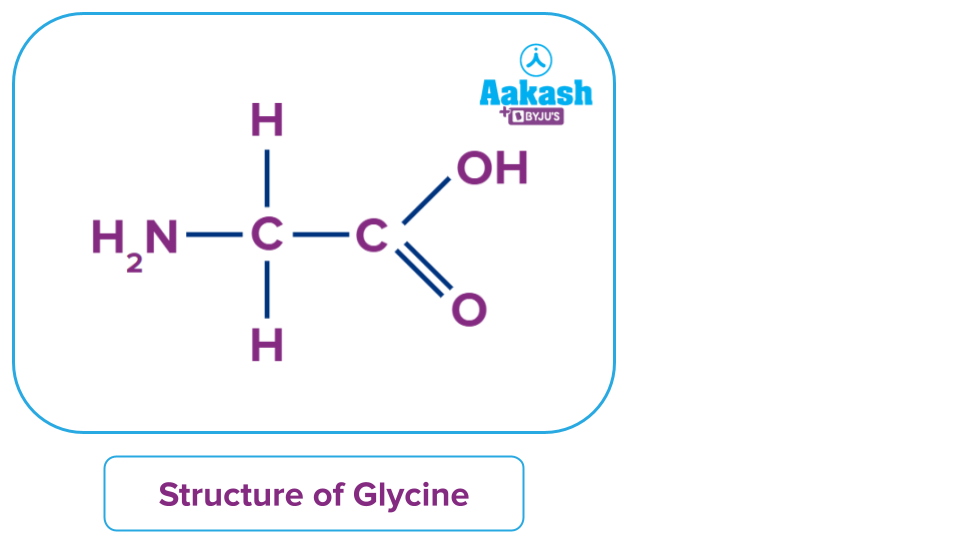
Glycine being one of the simplest amino acids, has an amino group, a carboxylic group and a hydrogen atom as the side chain. Glycine's chemical formula is C2H5NO2.
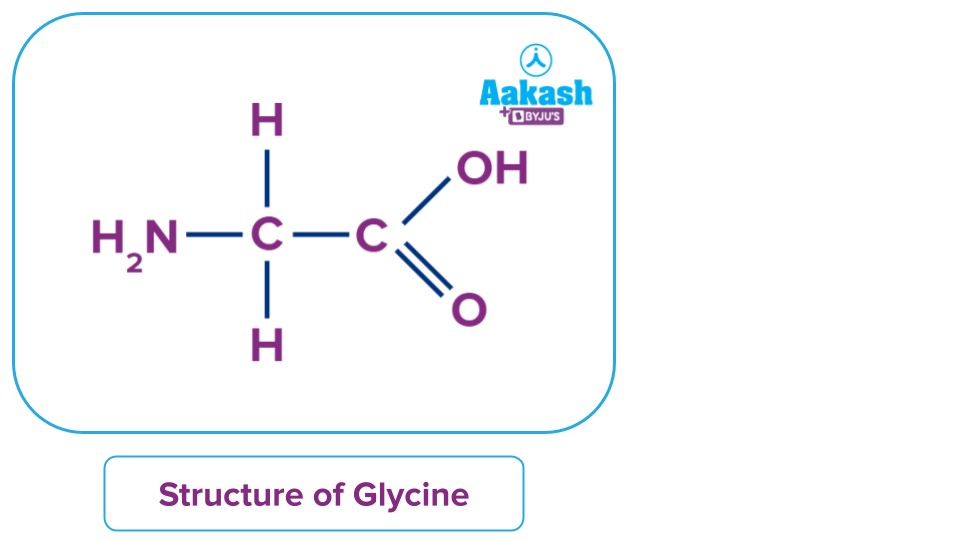
It is the smallest amino acid and has the most rotational mobility due to the presence of only one small hydrogen atom as a side chain. This explains why glycine and proline, which possesses a cyclic side chain, are crucial for the folding of proteins..
Glycine is achiral because not all of the four side groups linked to the carbon atom are different, as shown in the above figure. All other amino acids, with the exception of glycine, have at least one chiral carbon atom and so they have enantiomers. Glycine has no enantiomeric structures since it lacks chirality. Glycine is a non-polar amino acid.
Glycine – Properties
- A sweet-tasting crystalline solid with a molecular weight of 75.066 u.
- At 20℃, the density of glycine is 1.161 .
- Glycine is highly soluble in water.
- Its melting point cannot be determined as it begins to decompose at high temperatures around 233℃.
- Glycine is synthesised in the body from another amino acid, L-Serine.
Glycine – Biological Roles
In the biological system, glycine plays a critical role.
- It functions as a biological intermediary in the creation of the purine ring and the porphyrin ring of haemoglobin.
- Glycine is an inhibitory neurotransmitter that prevents a nerve impulse from being sent from one neuron to another or from one neuron to a muscle.
- Glycine can fit into any hydrophilic or hydrophobic environment because of its short side chain.
- Because it is common in alpha-helices, it is also a crucial amino acid when it comes to protein folding.
- Glycine is abundant in the triple helix structure of collagen.
Glycine – Commercial Uses
- Glycine is used as an additive in pet food and feedstock because of its nutritional benefits.
- Glycine is used in the polishing and complexing of metals in several industries.
- It serves as a buffer in antacids, cosmetics, analgesics, and other products.
- Parenteral nutrition incorporates glycine as well.
- It is used to treat strokes, schizophrenia, benign prostatic hyperplasia, and a few other metabolic problems that are rarely inherited.
Practice Problems
Q1. In the year 1820, glycine was extracted from __________.
A. Methane
B. Methanol
C. Glycol
D. Gelatin
Answer: D)
Solution: Glycine became one of the first amino acids to be discovered when it was extracted from gelatin in the year 1820. The amino acid gets its name from ‘glyco’ meaning sugar; this is based on its sweet taste.
So, option D) is the correct answer.
Q2. Which amino acid from the list below lacks enantiomers?
A. Arginine
B. Cysteine
C. Glutamine
D. Glycine
Answer: D)
Solution: Glycine being one of the simplest amino acids, has an amino group, a carboxylic group and a hydrogen atom as the side chain. Glycine is achiral because not all of the four side groups linked to the carbon atom are different. All other amino acids, with the exception of glycine, have at least one chiral carbon atom and so they have enantiomers.
So, option D) is the correct answer.
Q3. What is the molecular formula of glycine?
A. C3H5NO2
B. C2H5NO2
C. C2H6NO2
D. C2H5NO3
Answer: Glycine is an organic molecule with two carbon atoms, five hydrogen atoms, one nitrogen atom, and two oxygen atoms. Glycine is an organic molecule with the molecular formula C2H5NO2.
So, option B) is the correct answer.
Q4. The taste of glycine is
A. Sweet
B. Salty
C. Sour
D. Bitter
Answer: A)
Solution: Because of its sweet flavour, the amino acid receives its name from the Greek word ‘glyco’, which means sugar. Therefore, glycine tastes sweet.
So, option A) is the correct answer.
Frequently Asked Questions – FAQ
Q1. Is it essential to take glycine on an empty stomach?
Answer: Glycine, like other amino acids, has to be taken on an empty stomach, preferably between meals. It has a lot of benefits including liver protection, blood pressure reduction, mental health improvement and anxiety reduction. For three to six months, use this as a booster to treat liver problems and enhance health.
Q2. What effect does glycine have on the brain?
Answer: Glycine is a neurotransmitter that affects cognition, emotion, hunger and digestion, immunological function, perception of pain, and sleep by both stimulating and inhibiting brain and central nervous system cells. Other biochemicals that affect various bodily activities are also produced by glycine.
Q3. Glycine vs. glycerin; what is the difference?
Answer: Glycerin (C3H8O3) s a colourless, odourless chemical that is commonly used in pharmaceuticals. Glycine is an organic compound with the chemical formula C2H5NO2 and is the simplest stable amino acid
Q4. Is it safe to consume glycine on a daily basis?
Answer: Supplements containing glycine are generally regarded as safe. However, there has been minimal long-term research. So, always consult your healthcare practitioner before starting a new supplement.
Q5. What occurs if glycine intake is excessive?
Answer: A condition known as nonketotic hyperglycinemia is characterised by excessively high amounts of glycine in the body. Glycine accumulates in excess in tissues and organs, especially the brain. People who are affected suffer severe neurological issues.
Q6. Is the amino acid glycine a stable one?
Answer: The amino acid glycine has a single hydrogen atom as its side chain. It has the chemical formula C2H5NO2 and is the simplest stable amino acid (carbamic acid is unstable).

 Call Now
 Let's Chat
 Share
Share