-
Call Now
1800-102-2727


Gibbs Free Energy - Definition, Equations and Second Law of Thermodynamics

Gibbs free energy is frequently called Gibb’s function or Gibb’s energy, or free enthalpy. It is defined as a unit utilised to quantify utilised to calculate the maximum work amount performed in a thermodynamic system when pressure and temperature are maintained constant. It is denoted by the letter G and is measured in Joules or kiloJoules. The maximum work amount that can be isolated from the closed system defines Gibbs free energy.
Table of Contents:
- Gibbs Free Energy Equations
- Variations of the Equation
- Standard Energy Change of Formation
- Graphical Interpretation by Gibbs
- Second Law of Thermodynamics
- How to Calculate the Change in Gibbs Free Energy
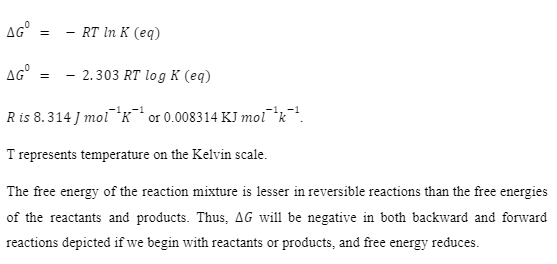
- Free Energy and Equilibrium Constant
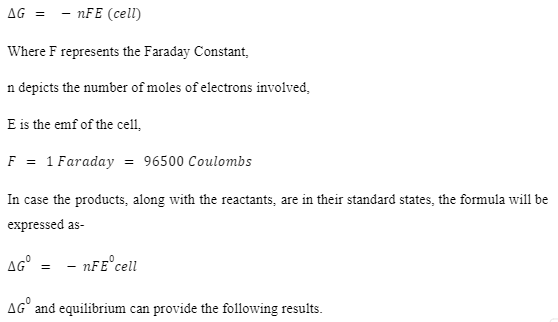
- Gibbs Free Energy and Emf of a Cell
- Practice Problems
- Frequently Asked Questions
Gibbs Free Energy Equations
Gibbs free energy is expressed as the product of the temperature and entropy deducted from enthalpy, i.e.,
G = H - TS
Where G denotes the Gibbs free energy,
H represents the enthalpy,
S is the entropy, and
T illustrates the temperature.
The equation can also be written as
G = U + PV - TS
Where U denotes the internal energy in Joule,
V denotes the volume measured in m3,
T is the temperature in Kelvin,
S illustrates the entropy in  , and
, and
P determines the pressure in Pascal.
Variations of the Equation
As a state function, Gibbs free energy does not rely on the path. Therefore, change in enthalpy will be reduced by the product of the system's temperature and entropy change determines the Gibbs free energy, i.e.,
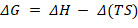
If the reaction is performed at the constant temperature, then  will be equal to 0, i.e.,

The equation is popularly known as the Gibbs-Helmholtz equation.
- The reaction is non-spontaneous

- The reaction is at equilibrium if

- If G < 0, the reaction is spontaneous and exothermic.
It is important to remember the following points.
- The universe's entropy rises spontaneously as per the second law of thermodynamics.
- 𝐺 can illustrate the direction and extent of chemical change.
- G works in cases where pressure and temperature are constant. It is so because the system is typically open to the atmosphere possessing constant pressure at the start of the process, and stops the process at room temperature, where any amount of heat added or released has been dissipated.
- The only controlling factor that describes if a particular chemical change is thermodynamically applicable is G. Therefore,

- The reaction is said to be exogenic and occurs spontaneously if G is negative.
Standard Energy Change of Formation
fG denotes a compound generation's standard Gibbs free energy. It can be defined as the alteration in Gibbs free energy followed by creating 1 mole of that substance from its component element, which exists in their standard states or the most suitable element form, i.e., at 25 degrees Celsius and 100kPa.
Standard Gibbs free Energy alteration of formation is equal to 0 for each element in its standard form, i.e., graphite, diatomic oxygen gas, and so on, because there is no change. It can be expressed as

Where Qr denotes the reaction quotient.
At equilibrium,  , and
, and 
Therefore, the equation can be written as follows:
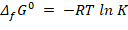
Where K illustrates the equilibrium constant.
Graphical Interpretation by Gibbs
It's fascinating to understand Gibbs's free energy using a graph. "Graphical Methods in the Thermodynamics of Fluids”, the title of William Gibb’s first article, was published in 1873 and utilised two coordinates of entropy and volume to demonstrate the state of the body. Furthermore, Gibbs involved a method for geometrical illustration of a substance’s thermodynamic characteristics utilising surfaces in his next article, published later, that added the figure-based coordinate for the body’s energy that was depicted by three figures.

Image: Graphical Representation of Gibbs free energy.
Second Law of Thermodynamics
The second law of thermodynamics is elaborated using the concepts of entropy and spontaneity on the following basis:
- Thermodynamically, all reactions are irreversible.
- Heat can not be transformed into work without wastage.
- The entropy of the universe is continuously heightening.
- The entropy change of the system, i.e. the total entropy change plus the entropy change of the surrounding, is +ve.
Spontaneous reactions are natural due to the reaction occurring itself without utilising external action towards it. The non-spontaneous reaction requires constant external energy to continue, but if external actions are hampered, the process will cease.
 denotes the standard state free energy. Therefore, at the standard condition, the free reaction's energy will be expressed as

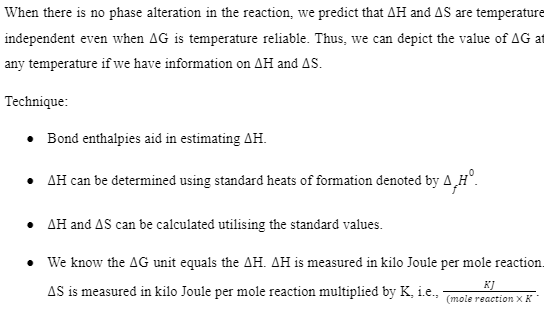
How to Calculate the Change in Gibbs Free Energy
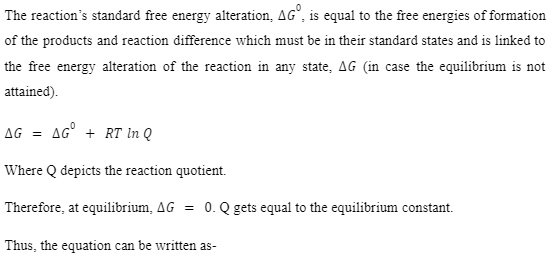
Free Energy and Equilibrium Constant
Gibbs Free Energy and Emf of a Cell
In galvanic cells, Gibbs free energy alteration G is linked with electrical work executed by the cell.
|
G0 |
Reaction |
Keq |
|
|
At equilibrium |
0 |
|
- |
Spontaneous reaction |
>>1 |
|
+ |
Non-spontaneous reaction |
<<1 |

Practice Problems
Q1. All spontaneous processes are thermodinamically_______. Fill in the blank.
a. Reversible
b.Standard
c. Irreversible
d. None of the above
Ans. c. Irreversible.
Thermodynamically, all spontaneous reactions are considered to be irreversible.
Q2. Maxwell’s 3D surface figure using Gibbs free energy by James Clerk Maxwell demonstrated
a. Energy-entropy-volume thermodynamic surface of a fictitious water-like substance.
b. Energy-temperature-volume thermodynamic surface of a fictitious water-like substance.
c. Temperature-entropy-volume thermodynamic surface of a fictitious water-like substance.
d. None of the above
Ans. a. Energy-entropy-volume thermodynamic surface of a fictitious water-like substance.
In 1874 Maxwell utilised Gibb’s figures to produce an energy-entropy-volume thermodynamics surface.
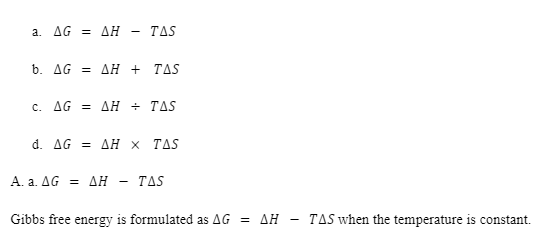
Q3. At constant temperature, Gibbs free energy can be expressed as
Frequently Asked Questions
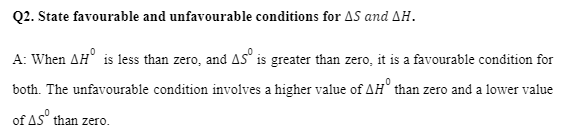
Q1. Define standard state conditions.
A: The standard state conditions include
- In the reaction, the partial pressure of any gas must be 0.1 MPa.
- 1M must be the concentration of all aqueous solutions.
- Solid pressure must be 1 atm, and liquid hydrostatic pressure must be 1 atm.
Q3. Is Gibbs free energy limited to chemical reactions?
A: No, Gibbs's free energy is not restricted to chemical reactions. It is applicable to any process or system, including physical and biological processes. G accounts for the work done by or on a system throughout processes such as phase transitions in physical changes.

 Call Now
 Let's Chat
 Share
Share