-
Call Now
1800-102-2727


Understanding the Gas Laws and How to Implement Them

Gases are all around us, from the air we breathe to the fuel we use in our vehicles. Understanding their behaviour and properties is crucial in various scientific fields. Gas laws provide a framework for comprehending how gases behave under different conditions. Gas laws are a set of rules that describe how gases behave under different conditions of temperature, pressure, and volume.
Table of Contents:
- What is Gas?
- What are the Gas Laws?
- Boyle’s Law
- Charles’s Law
- Gay-Lussac’s Law
- Avogadro’s Law
- Combined Gas Law
- The Ideal Gas Law
- Dalton’s Law of Partial Pressure
What is Gas?
Gases are one of the three states of matter, along with solids and liquids. They are characterised by their ability to fill containers uniformly and expand to fill any available space. The atoms or molecules that make up the gas move rapidly and randomly, colliding with each other and the walls of the container.
What are the Gas Laws?
Gas laws analyse the behaviour of gases under varying physical conditions. The variables of the state that affect the behaviour of gases are pressure, volume, temperature and number of moles of the gas.
The gas laws describe how these variables are related to each other for some amount of gas. They are based on the assumption that gases behave ideally, meaning that they follow certain rules:
- The gas molecules are tiny and far apart compared to the size of the container.
- The gas molecules move randomly and rapidly in all directions.
- Gas molecules do not interact with each other or with the walls of the container except for elastic collisions.
- The average kinetic energy of the gas molecules is proportional to the absolute temperature.
These assumptions are valid for most gases at low pressures and high temperatures. However, intermolecular forces and finite molecular size can cause real gases to differ from ideal behaviour.
Boyle’s Law
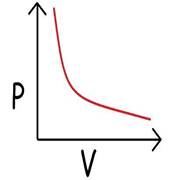
Boyle’s law states that at constant temperature and no. of moles, the pressure and volume of a gas are inversely proportional to each other. This means that as the pressure increases, the volume decreases, and vice versa.
Mathematically, Boyle’s Law is expressed as shown below:

or,
PV=k
Where k is a constant, P is the pressure, and V is the volume of the gas.
For two different states of the gas, Boyle’s Law is expressed in the following way:

Where Pi and Vi are the initial conditions of the gas while Pf and Vf are the final conditions of the gas.
Charles’s Law
Charles’s law states that at constant pressure and no. of moles, the volume and temperature of a gas are directly proportional to each other. This means that as the temperature increases, the volume increases, and vice versa.
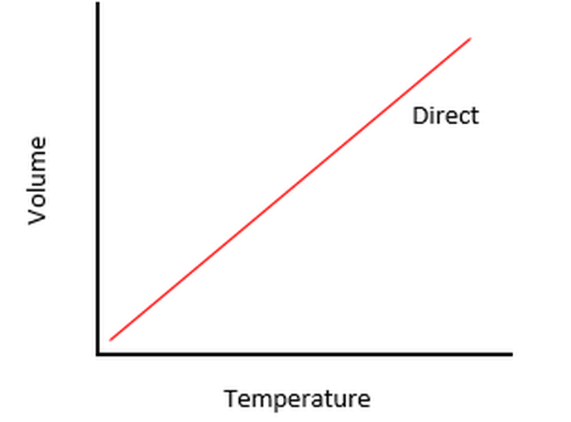
Mathematically, Charles’s Law is expressed as shown below:
V∝T
Or,

Where k is a constant, V is the volume, and T is the gas temperature.
For two different states of the gas, Charles’s Law can be expressed as follows:

Here, Vi and Ti are the initial volume and temperature of the gas, respectively, while Vf and Tf are the final volume and temperature of the gas, respectively.
Gay-Lussac’s Law
Gay-Lussac’s law states that at constant volume and no. of moles, the pressure and temperature of a gas are directly proportional to each other. This means that as the temperature increases, the pressure increases, and vice versa.
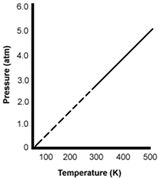
Mathematically, Gay-Lussac’s Law is expressed as
P∝T
Or,

Where k is a constant, P is the pressure, and T is the temperature of the gas.
For two different states of the same gas, Gay-Lussac’s Law is represented as follows:

Where, Pi and Ti are the initial pressure and temperature of the gas, respectively. Pf and Tf are the final pressure and temperature of the gas, respectively.
Avogadro’s Law
Avogadro’s law states that at constant temperature and pressure, the volume of a gas is directly proportional to the amount of gas. This means that the volume increases as the amount of gas increases, and vice versa.
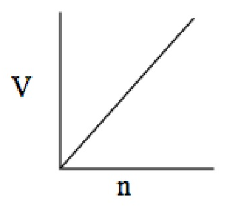
Mathematically, we represent Avogadro’s Law as follows:
V∝n
Or,

Where ‘V’ is the volume of the gas, ‘n’ is the no. of moles in the gas, and ‘k’ is a constant.
If you compare two different states of the same gas, then you can express Avogadro’s Law as follows:

Where Vi and ni are the initial volumes and moles of the gas. Vf and nf are the final volumes and moles of the gas.
Combined Gas Law
The Combined Gas Law combines Boyle’s, Charles’s, and Gay-Lussac’s Laws. It provides a relationship between the pressure, volume, and temperature of a gas at a constant amount.
Mathematically, we express this law as follows:

Where P is the pressure, V is the volume, and T is the temperature of the gas. ‘k’ is a constant.
For two different states of the same gas, the Combined Gas Law can be expressed as follows:

Where Pi, Vi and Ti are the initial pressure, volume and temperature of the gas respectively. While Pf, Vf and Tf are the final pressure, volume and temperature of the gas, respectively.
The Ideal Gas Law
So far, the gas laws discussed have focused on the change of one or more characteristics of a gas, such as volume, pressure, and temperature. But one gas law correlates all these characteristics under any condition. This is called the Ideal Gas Law. Since it’s hard to describe a relation between these properties of a real gas, people have suggested the concept of an Ideal Gas. The ideal gas follows the following rules:
- Ideal gas molecules do not repel or attract each other.
- Ideal gas molecules do not take any volume.
In the molar form, we express this law as follows

In the molecular form, and we express this law as follows:

In the above equations, the terminologies used are:
- ‘P’ is the pressure of the gas. It has a unit of either Pascals (Pa) or atmosphere (atm).
- ‘V’ is the volume of the gas and has a unit of either cubic metres (m3) or litres (L).
- ‘T’ is the temperature of the gas and has a unit of Kelvin (K)
- ‘n’ is the number of moles in the gas and takes the unit of Moles (mol).
- ‘N’ is the number of molecules in the gas.
- ‘R’ is the Universal gas constant, and it has a value depending on the units of the other quantities.
- If pressure, volume and temperature are measured in Pa, m3 and K, the R takes the value of 8.31

- If pressure, volume and temperature are measured in atm, L and K, the R takes the value of 0.0821

- If pressure, volume and temperature are measured in Pa, m3 and K, the R takes the value of 8.31
- ‘kB’ is the Boltzmann Constant and takes the value of

Dalton’s Law of Partial Pressure
In all the other gas laws discussed so far, only one gas has been dealt with. What happens when there is more than one gas in a container? In that case, we use Dalton’s Law of Partial Pressure.
This law states that the total pressure of the gases in a container is equal to the sum of the partial pressures of all the gases inside the container.
Mathematically, we express this law as follows:
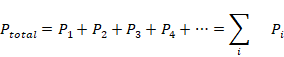
Because in these cases only moles of the gases change while volume and temperature remain constant, an alternative way of expressing this law is as follows:

Solved Problems
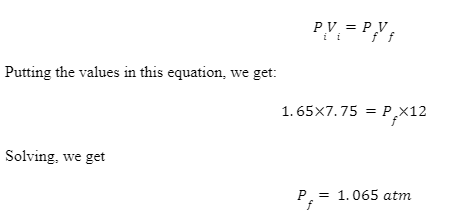
Q1. If a sample of gas has an initial pressure of 1.65 atm and an initial volume of 7.75 L, what is the final pressure if the volume is increased to 12 L? Assume that the amount and the temperature of the gas remain constant.
Solution:
According to Boyle’s Law:
Q2. A gas sample at 20°C has an initial volume of 40.0 L. At what temperature will the gas have a volume of 45 L? 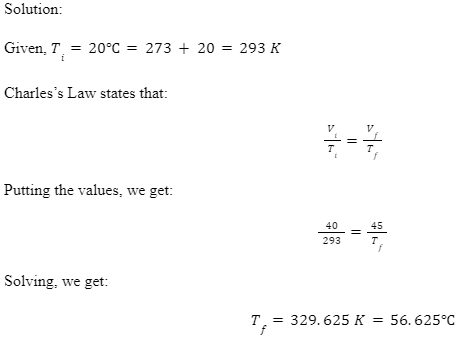
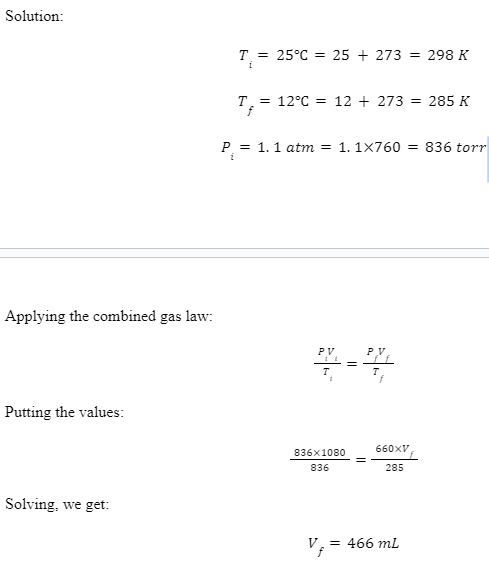
Q3. A balloon containing a sample of gas has a temperature of 25°C and a pressure of 1.1 atm in an airport in Cleveland. The balloon has a volume of 1,080 mL. The balloon is transported by plane to Denver, where the temperature is 12°C, and the pressure is 660 torr. What is the new volume of the balloon?
Q4. What is the volume in litres of 1.35 mol of N2 gas at 298 K and 3.965 atm?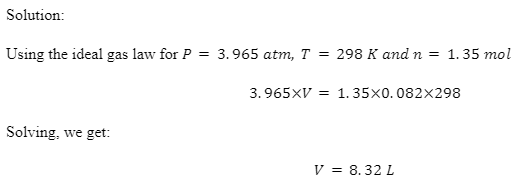
Practice Problems
- What is the pressure of a sample of CO2 gas if 0.57 mol is held in a 20.0 L container at 452 K?
- A gas sample at 35°C has an initial volume of 6.05 L. What is its volume if the temperature is changed to −35°C?
- A gas in a container of 5L is at a pressure of 1.25 atm at room temperature. A piston is fitted to the container tightly, and the gas is compressed such that its volume is decreased to 4L and the pressure has increased. What is the pressure of the gas?
Frequently Asked Questions
Q1. What is the use of the ideal gas law?
Answer: The ideal gas law gives us an understanding of how gas works. Even though there are no ideal gases in real life, ideal gas law helps us to understand gases better.
Q2. Is there a relation between the combined gas law and the ideal gas law?
Answer: Yes. The combined gas law can be considered the ratio form of the ideal gas law.
Q3. Why do we need gas laws?
Answer: Gas laws establish a relation between the volume, temperature and pressure of a gas which are important characteristics of a gas. Knowing how these quantities vary with each other helps us to create a lot of important things.

 Call Now
 Let's Chat
 Share
Share