-
Call Now
1800-102-2727


Fusion Reactions - Introduction, Reactions in the Sun, Practice Problems and FAQs

You must be aware of how electricity is produced from solar energy. The solar panel which are fitted on the open field or rooftop are being used as an alternative source of electricity along with the traditional method of supply.
But do you know from where the sun is generating huge amounts of energy and how this energy can be converted into electricity?
Inside the sun a large amount of energy is produced due to nuclear reactions in which lighter nuclei of an element combine to form heavier nuclei. When the solar radiation reaches the earth's surface from a long distance, it still has a sufficient amount of energy that can be concentrated through a panel or mirror and the solar energy can be transformed into electrical energy.
Solar energy is a renewable source of energy and will also help in decreasing the pollution problems in the country and will also act as a helping hand in addressing the world’s power crisis problem.
Let’s learn more in this article about the nuclear fusion reactions that drive the sun.
Table of Contents
- Introduction to Nuclear Fusion Reaction
- Nuclear Fusion Reactions in the Sun
- Advantages of nuclear fusion reaction
- Practice Problems
- Frequently Asked Questions - FAQs
Introduction to Nuclear Fusion Reaction
A nuclear fusion reaction occurs when two light nuclei combine to form heavier nuclei. The product also generates subatomic particles such as protons and neutrons. A thermonuclear reaction is another name for this type of reaction.
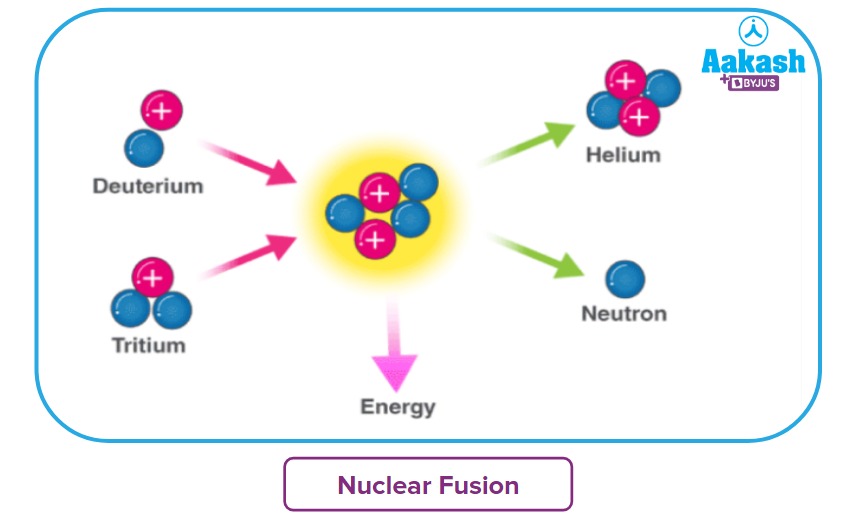
Consider the fusion of deuterium and tritium to produce helium and neutrons. This particular nuclear reaction releases enormous amounts of energy and is exothermic in nature due to the mass loss when heavier nuclei are formed from two lighter nuclei. The deuterium and tritium reactions are triggered by the massive amount of energy released during a nuclear explosion which is used as fuel in nuclear bombs.
For the nuclear fusion reaction to occur, the participating nuclei must be brought together. They should be brought so close that the nuclear forces activate and bind the nuclei together.

Nuclear Fusion Reactions in the Sun
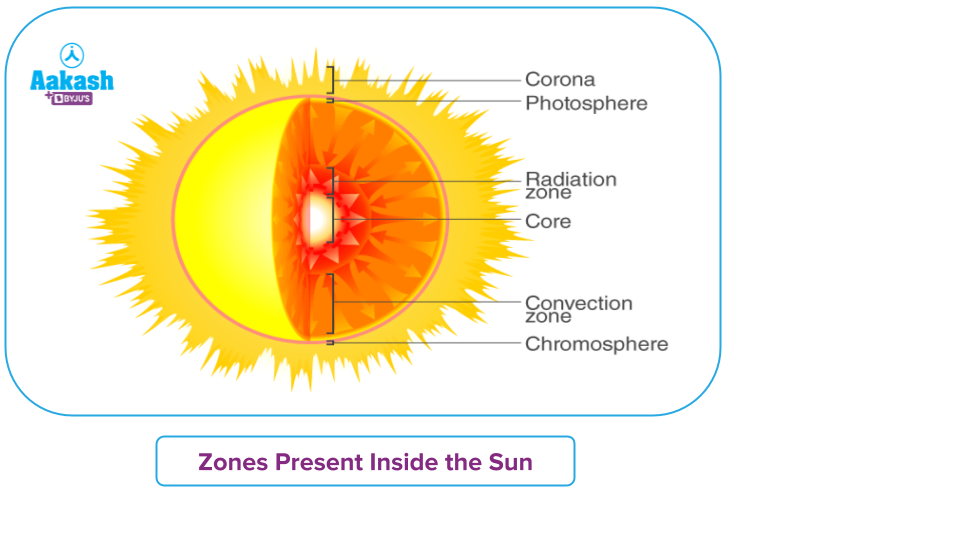
Nuclear fusion reactions keep every star in the universe, including the sun, alive. They generate a tremendous amount of heat and energy in this process. The pressure and temperature at the core of any star are enormous, stripping electrons from the hydrogen atoms, thus making the atoms exist in a plasma state. The participating nuclei come closer such that the gravitational force of the sun overcomes the electrostatic repulsion between the combining nuclei and thus prompting nuclear fusion.
The temperature at the core of the sun is approximately 15 million ℃. At this pressure and temperature, two Hydrogen isotopes ( Deuterium and Tritium), fuse to form Helium nuclei and release a massive amount of energy in the form of heat. Every second, the sun converts approximately 600 million tonnes of hydrogen into helium. The reactions that occur in the sun are an example of a nuclear fusion reaction.
Advantages of Nuclear Fusion Reaction
- It is non-polluting because there is no combustion taking place in case of fusion reactions.
- Less nuclear waste is produced because fusion reactors do not generate high-level nuclear waste disposal. Disposal is easier in contrast to fission reactors in which the product formed is radioactive and is generally carried in a lead container.
- Unlike in fission reactors, the wastes will not contain weapons-grade nuclear materials as they does not produce radioactive waste during the nuclear fusion reaction.
Practice Problems
Q. Select the correct option for the nuclear reaction that takes place in the core of the sun?
A.
B.
C. 
D. Both A and B
Answer: (C)
Solution: In the core of the sun, nuclear fusion reactions take place in which the lighter nuclei combine together to form heavier nuclei at higher temperature and pressure. 
Nuclear fission occurs as a result of a nuclear reaction in which the nucleus of atoms of heavier radioactive nuclei splits into lighter nuclei. For example,


Therefore, option (C) is the correct answer.
Q. Select the correct option for the atomic number and mass number of the product formed in the given nuclear fusion reaction.
- 2,4
- 2,2
- 2,3
- 1,2
Answer: (C)
Solution: As we know in the nuclear chemical reaction the atomic number and mass number remains constant in the reactant and product side.
Therefore, the atomic number of the product formed (X) will be 2 and the mass number will be 3 respectively.
Q. Which of the following option is correct with respect to the nuclear fusion reaction?
- Nuclear fusion reaction does not produce any nuclear waste
- The product obtained during the reaction is not radioactive in nature
- In this reaction lighter nuclei combine to form heavier nuclei at high temperature
- All of the above are correct
Answer:(D)
Solution: In case of nuclear fusion reaction lighter nuclei combine together to form heavier nuclei at higher temperature and pressure. This type of reaction is also known as the thermonuclear reaction. In this reaction product obtained is non-radioactive in nature and does not produce nuclear waste. Therefore all the given options are correct.
Frequently asked question-FAQ
Q. What is nuclear force?
Answer: The nuclear force is a force that exists between atoms' protons and neutrons. The nuclear force holds neutrons and protons together in a nucleus. This force can exist between two protons, neutrons and protons or can also exist between neutrons and neutrons. This force is also responsible for the nucleus's stability as it binds the nucleons.
Q. What is the difference between the product obtained in the nuclear fusion and fission reaction?
Answer: In nuclear fusion reaction lighter nuclei combines at high temperature and pressure to form heavier nuclei and release a large amount of energy without producing any radioactive waste. Whereas in the case of nuclear fission reaction heavier nuclei split into lighter nuclei accompanied by the release of energy by the product formed are generally radioactive in nature and therefore produce radioactive waste.
Q. What causes nuclear fusion reactions?
Answer: The joining of two atomic nuclei to form a new, larger nucleus is known as nuclear fusion. High amounts of pressure and thermal energy (heat) are required to overcome the repulsive force between the two protons in the nucleus, because like charges repel.
When atoms combine the mass of the combined atom is slightly lighter than the individual small atoms put together which generates a large amount of energy. According to this theory of Einstein, we know that mass converts into energy ( (E=mc2), the weight difference generates energy (mass times the speed of light squared equals energy). Large stars, including our sun, get their energy from this.
Q. What are the three steps involved in the nuclear fusion reaction that takes place in the core of the sun?
Answer: The three major steps involves in the core of the sun are:
Step 1: Within the Sun, two protons fuse. The pair usually separates again, but occasionally one of the protons transforms into a neutron due to the weak nuclear force. A positron and neutrino are formed as part of the neutron transformation. The resulting proton-neutron pair is sometimes referred to as deuterium.
Step 2: A third proton collides with the deuterium that has formed. A helium-3 nucleus and a gamma-ray are formed as a result of this collision. These gamma rays escape from the Sun's core and are released as sunlight.
Step 3: When two helium-3 nuclei collide, a helium-4 nucleus is formed, along with two extra protons that escape as two hydrogens. Technically, a beryllium-6 nucleus forms first, but it is unstable and disintegrates from a helium-4 nucleus.

 Call Now
 Let's Chat
 Share
Share