-
Call Now
1800-102-2727


Froth Floatation Process

H.F.K. Pickard, John Ballot, and Sulmanin 1906 initially patented the Froth floatation process. The technique came into the limelight among the researchers during the Cattermole process experimentation. The froth floatation process involves the segregation of minerals from the impurities that leads to the extraction of individual minerals from the mixtures.
Table of Contents:
- What is Froth Floatation?
- Methodology of Froth Floatation
- Basic Principles of Froth Floatation
- Mechanism of Froth Floatation
- Materials and Equipments Utilised in Froth Floatation
- Advantages of Froth Floatation
- Disadvantages of Froth Floatation
What is Froth Floatation?
Hydrophobic materials can be selectively separated from hydrophilic waste gauges using a crucial concentration process called Froth Floatation. It is a popular method for mineral beneficiation. The Froth floatation process is used in ore or mineral beneficiation to isolate commercially essential minerals from contaminants, impurities, and other minerals by accumulating them on the froth layer surface.
The beneficial minerals are segregated from the mixtures through the method of floatation that involves producing froth on which minerals are separated. The mineral processing technique involves the selective segregation of distinct minerals.
Extraction of certain metals from ores like zinc, lead and copper is possible through the froth floatation technique. The floatation tails or tailing refers to the minerals that do not float on the froth.
Methodology of Froth Floatation
The method of froth floatation can be categorised in three forms, i.e.,
a. True Floatation
The process involves the attachment of minerals to the froth. The process is important as the stage illustrates the extraction of valuable minerals, while the other two describe mineral and gauge separation efficiency.
b. Entrainment
Air bubbles are introduced into the liquid water under the process of Entrainment, where the froth forms them.
c. Aggregation
Aggregation involves the trapping of mineral particles.
The size of the ore particles must be very fine, like powder form, to meet the key requirement for the froth floatation process of mineral separation. It is a crucial criterion for the segregation of mineral particles. It is so because larger or heavier particles would need a stronger adhesive force to adhere to the froth and accumulate in the bottom, making it infeasible to separate. Thus froth floatation operates under two common techniques.
Direct Floatation Technique: The minerals adhere to the air bubble, and the leftover gauge accumulates at the bottom during the floatation technique.
Reverse Floatation Technique: The technique involves the accumulation of ore particles while adhering the gauge to the air bubble.
Basic Principles of Froth Floatation
The process is initiated with a comminution process that enhances the ore’s surface area in the froth floatation process. The ores are initially ground into extremely fine powdery form particles and added to the water. The mixture formed is called slurry. A collector, which functions as a surfactant chemical, is added to the slurry to increase the mineral's hydrophobicity.
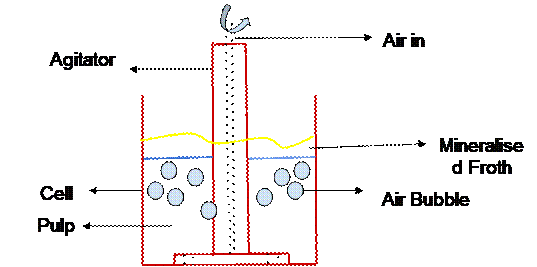
Image: Froth Floatation Process
Furthermore, the pulp is transformed from the slurry. Air jets are forced into the water-filled containers once the pulp has been mixed to produce bubbles. Water repels the required mineral that causes adherence to the air bubbles. The air bubbles are called froths due to their rise to the surface and adhere to the mineral particles.
Additionally, extraction and purification take place after the segregation of the froth. It is important to note that froth floatation does not completely rely on the material’s density. The hydrophobic characteristics of the material are also essential to the froth floatation process.
For example, froth floatation is abundantly used in mining industries where particles of interest are physically segregated from the liquid phase. It can be achieved primarily due to air bubbles that selectively adhere to the surface of particles relying on their hydrophobicity. Air bubbles linked to the hydrophobic particles are transported to the surface, generating froth that can be eliminated. At the same time, hydrophobic materials are left over in the liquid phase.
Mechanism of Froth Floatation
The difference between the ore’s wetting ability and any leftover impurities is the basic principle in the froth floatation technique. According to their wetting capability, the particles are categorised into two types, i.e.,
- Hydrophobic Particles
- Hydrophilic Particles
Minerals adhere to the froth and are not drawn to water if they are naturally hydrophobic. The particle bubble contact will only remain intact if a stable foam has been generated once these minerals come to the surface due to the buoyant force exerted on the froth. The capability of the bubble to attach strongly to minerals determines the stability of the froth. It can be calculated using Young-Dupre Equation, which explains the relationship between the interfacial energies and adhesive strength.
Materials and Equipments Utilised in Froth Floatation
The materials and equipment required to experiment using the froth floatation techniques are as follows.
- Froth floatation column
- Gauge
- Collector
- Frother
- Regulator
- pH modifier
- Activator
- Depressant
Advantages of Froth Floatation
There are numerous advantages of the froth floatation process. Some include-
- Nearly all minerals can be segregated through the process.
- The floatation reagent can regulate and alter surface characteristics.
- The separation of sulphide minerals is a perfect example of this technology.
Disadvantages of Froth Floatation
Despite numerous advantages, the froth floatation process has certain limitations. It includes-
- Extremely complex process.
- The technique is expensive.
- Results may vary due to being easily influenced by slime.
Practice Problems
Q1. Frothers can be divided into two types.\
a. Organic and inorganic
b. Natural and synthetic
c. Standard and fluctuating
d. None of the above
Ans b. Natural and synthetic
Natural and synthetic frothers are the two types of frothers.
Q2. Natural frothers include
a. Oil
b. Cresol
c. Pine
d. All of the above
Ans: All of the above.
Natural frothers commonly involve cresol, oil and pine.
Q3. Collectors are categorised as
a. Anionic and cationic
b. Nonionic and anionic
c. Cationic, anionic and nonionic
d. None of the above
Ans: c. Catanic, anionic and nonionic.
Collectors are distinguished into three types, i.e., cationic, anionic and nonionic.
Q4. Because of the wetting ability, particles can be categorised into two types.
a. Hydrophobic
b. Hydrophilic
c. Both a and b
d. None of the above
Ans: c. Both a and b
Particles can be categorised into two types based on their wetting characteristics, i.e., hydrophilic and hydrophobic particles.
Q5. The froth floatation process can separate minerals like
a. Gold
b. Phosphate
c. Potassium
d. All of the above
e. Both b and c
Ans: d. All of the above
The froth floatation process involves separating almost all types of minerals like gold, silver, potassium and potassium.
Frequently Asked Questions
Q1. State environmental application of froth floatation process.
Answer: Froth floatation process can be used for water treatment to eliminate the pollutants and contaminants of wastewater. For example, suspended solid or spilt oil. Furthermore, numerous crucial minerals can be segregated and refined from waste streams to recycle them.
Q2. Is the froth floatation technique sustainable?
Answer: Froth floatation process enables the recovery and renewability of valuable minerals from waste and wastewater. Thus, play a key role in managing waste usage, chemicals, and energy that aids in mitigating the environmental problems
Q3. What is the most common use of the froth floatation process?
Answer: The mining industry commonly uses the froth flotation process, particularly in extracting minerals from ore.

 Call Now
 Let's Chat
 Share
Share