-
Call Now
1800-102-2727


Understanding the First Law of Thermodynamics and Hess's Law

Energy conservation is a fundamental principle that governs various physical and chemical processes. In thermochemistry, the First Law of Thermodynamics provides insights into energy transfer and transformation. Hess Law is a consequence of the First Law of Thermodynamics and is often not considered a separate thermodynamic law.
Table of Contents:
What is the First Law of Thermodynamics?
The First Law of Thermodynamics is also called the Law of Conservation of Energy. It states that energy can neither be created nor destroyed; it can, however, be transformed from one form to another.
The First Law of Thermodynamics can also be expressed alternatively, which states that the total energy of the universe is constant.
The first law of thermodynamics can apply to any system that changes its state, such as a chemical reaction or a phase transition. The change in the internal energy of the system (ΔU) is equal to the difference between the heat absorbed or released by the system (q) and the work done by or on the system (w). Mathematically, this can be expressed as:


The internal energy of a system depends only on its current state and not on how it reaches that state. Therefore, internal energy is a state function, a quantity whose value is determined only by the state of the system in question.
Sign Conventions
|
∆U (change in internal energy) |
q (heat) |
w (work done) |
|
Positive if the temperature increases |
Positive if heat enters the system |
Positive if the system is compressed |
|
Negative if temperature decreases |
Negative if heat is released by the system |
Negative if the system is expanded |
|
Zero if the temperature remains constant |
Zero if no heat transfer occurs |
Zero if the volume of the system remains constant |
What is the Hess Law?
Hess law, also known as Hess's law of constant heat summation, states that at a constant temperature, heat energy changes (enthalpy - ΔH) accompanying a chemical reaction will remain constant, irrespective of the way the reactants react to form a product.
Hess's law is based on the state function character of enthalpy and the first law of thermodynamics. The enthalpy of reactant and product molecules is constant and does not change with the origin and path of formation. The first law of thermodynamics states that the total energy of the substances before and after any (physical or chemical) change should be equal.
According to Hess Law, the total energy of the reactants should be equal to the total energy of the products.
Mathematically, we represent the law as follows:
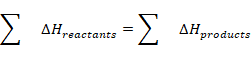
The Hess Law can alternatively be stated as the enthalpy change for a reaction is equal to the sum of the enthalpy changes for any set of steps that lead from the reactants to the products.

Or,

Solved Problems
Example 1: A container is filled with a specific gas and fitted with a securely fitting movable piston that prevents any gas from escaping. During a thermodynamic process, 300 joules of heat enter the gas, making the gas do 400 joules of work. What will be the change in the internal energy during the process?
Solution:
Since heat is entering the gas, q will be positive, i.e., 
Also, the gas is doing the work, so w will be negative, i.e.,
Therefore, the change in internal energy is:

Example 2: Calculate the enthalpy change for the combustion of methane gas using the following data:
 of
of 
of 
of 
Solution: The target reaction is:

The hidden reactions that are taking place in this reaction are:
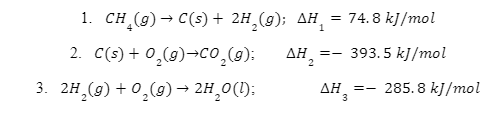
If we were to add all these reactions, we would get the target reaction. Thus, the enthalpy of change is given by:
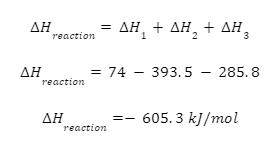
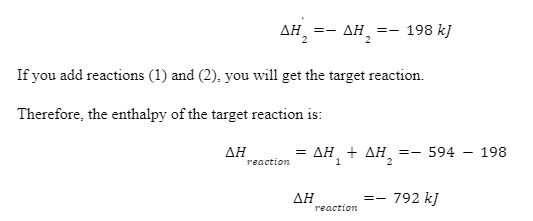
Example 3: Calculate the enthalpy for the combustion reaction of sulphur to sulphur trioxide using the enthalpies of
the two reactions shown below:
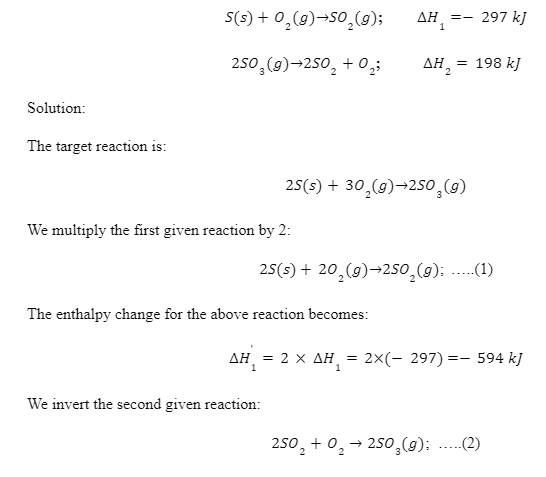
The enthalpy change for the above reaction becomes:
Practice Problems
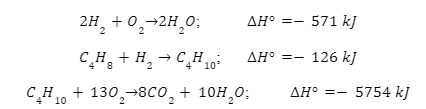
Q1. Using Hess's law, calculate ΔH˚ for the combustion reaction of butene. Use the following reactions and the given ΔH˚:
Q2. A container 2m in length is filled with gas and is then tightly closed with a piston such that no gas can escape. The piston is pushed with a force of 5 N for a distance of 0.6 m. 100 Joules of heat are released from the gas. Is the change in internal energy negative or positive?
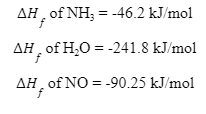
Using Hess's law and the information given below, calculate the enthalpy of the following oxidation reaction of ammonia.
Frequently Asked Questions
Q1. What does the Second Law of Thermodynamics state?
Answer: According to the Second Law of Thermodynamics, entropy (a measure of disorder) in any isolated system tends to rise with time, and processes occur in the direction of increasing total entropy.
Q2. What is the limitation of the First Law of Thermodynamics?
Answer: It fails to explain the feasibility of thermal processes. It does not quantify the energy transfer that takes place.
Q3. What is Hess Law, and which thermodynamic law is it related to?
Answer: Hess Law states that the energy in a reaction remains constant throughout the process. It is related to the First Law of Thermodynamics.

 Call Now
 Let's Chat
 Share
Share