-
Call Now
1800-102-2727


Fajan's Rule: Polarization, Factors Affecting Polarization of Anion, Fajans’ Rules, Consequences and Applications With Examples & Percentage of Ionic Character

Do you remember any molecule or compound which has 100 % pure ionic bond?
NaCl comes to mind, right? Is this the correct answer?
NO
While it is commonly taught that chemical bonds are broadly classified as ionic or covalent, in reality, the majority of bonds are neither purely ionic nor purely covalent. These terms are are terms used to denote two extreme situations. The term ionic bond refers to the complete transfer of electrons from one atom to the next, whereas the term pure covalent bond refers to the equal sharing of electrons. HoweverNevertheless, the nature of chemical bonds in most compounds is somewhere between the two extreme situations mentioned above.
In general, ionic compounds are expected to be soluble in polar solvents such as water, to have high melting and boiling points, and to be electrically conductive in the liquid state. As a general rule, these compounds should be sparingly soluble in nonpolar solvents such as benzene, carbon tetrachloride, etc.. However, a few of the ionic compounds are fairly decently soluble in them nonpolar solvents, and have slightly lower melting points and electrical conductivity in the molten state than expected.
It is observed that some of the covalent compounds are also found to be soluble in water and to have some electrical conductivity in the molten state. This clearly shows more or less covalent nature as a scale is also possible for the ionic compounds and vice versa.
Table of content:
- Polarization
- Factors affecting polarization of anion
- Fajan’s rule of polarization
- Consequences of polarization
- Applications of Fajan’s rule with examples
- Percentage of ionic character
- Practice problems
- Frequently asked questions(FAQs)
Polarization:
An isolated anion's negative charge is evenly distributed around the nucleus. However, when a cation is present nearby the anion, the electron density of the anion is distorted towards it. As a result, the anion's negative charge is unevenly distributed. The negative charge on one end of the anion is higher than on the other. This condition is referred to as polarization. We know that negative charge is evenly distributed in an anion, around the nucleus. However, presence of a cation nearby distorts the anion towards it. Thus, there is an uneven distribution of charge of the anion i.e. negative charge is greater on one end. This phenomenon is called polarization.
In the presence of an anion, the cation is also gets slightly polarized. Because of polarization, the electron density between the anion and the cation is now more evenly distributed. This condition is more or less similar to covalent bonding.
Factors affecting polarization of anion:
The concept behind Fajan's principles is that "the more the polarization of an anion, the greater the covalent nature of the molecule." As listed below, two criteria are crucial in understanding the extent of polarization.
1. Polarizing power of cation:
Polarizing power refers to the ability or power of a cation to polarize an anion. It is proportional to the charge density, which means it is proportional to the charge on the cation, and inversely proportional to the size of the anion.
The polarizing power of a cation increases with decreases in size, hence smaller cations are more effective at polarizing an anion. However, as the charge on the cation increases, the polarizing power also increases.
The ability to polarize an anion is called the polarizing power of a cation. This is inversely proportional to the size of the anion and directly proportional to the charge density (or even charge) on the cation.
An increase in size increases the polarizing power of the cation. Thus, smaller cations have a higher polarizing power.
2. Polarizability of anion:
An anion's polarizability is the tendency for an anion to become polarized. It describes how easily an anion can be distorted in the presence of a cation.
It is directly proportional to the size of the anion as well as its negative charge.
The larger anions are more easily distorted than the smaller ones.
It's also important to note that anions having a greater negative charge also undergo polarization easily.
We may easily conclude that the greater the polarizing power of the cation and the greater the polarizability of the anion, the greater the polarization and thus the covalent nature of the molecule.
Polarizability is the tendency of the anion to undergo distortion in the presence of a cation. It is directly proportional to the charge and size of the anion. Larger anions undergo polarization more easily than smaller ones, thereby implying that larger anions have higher polarizability.
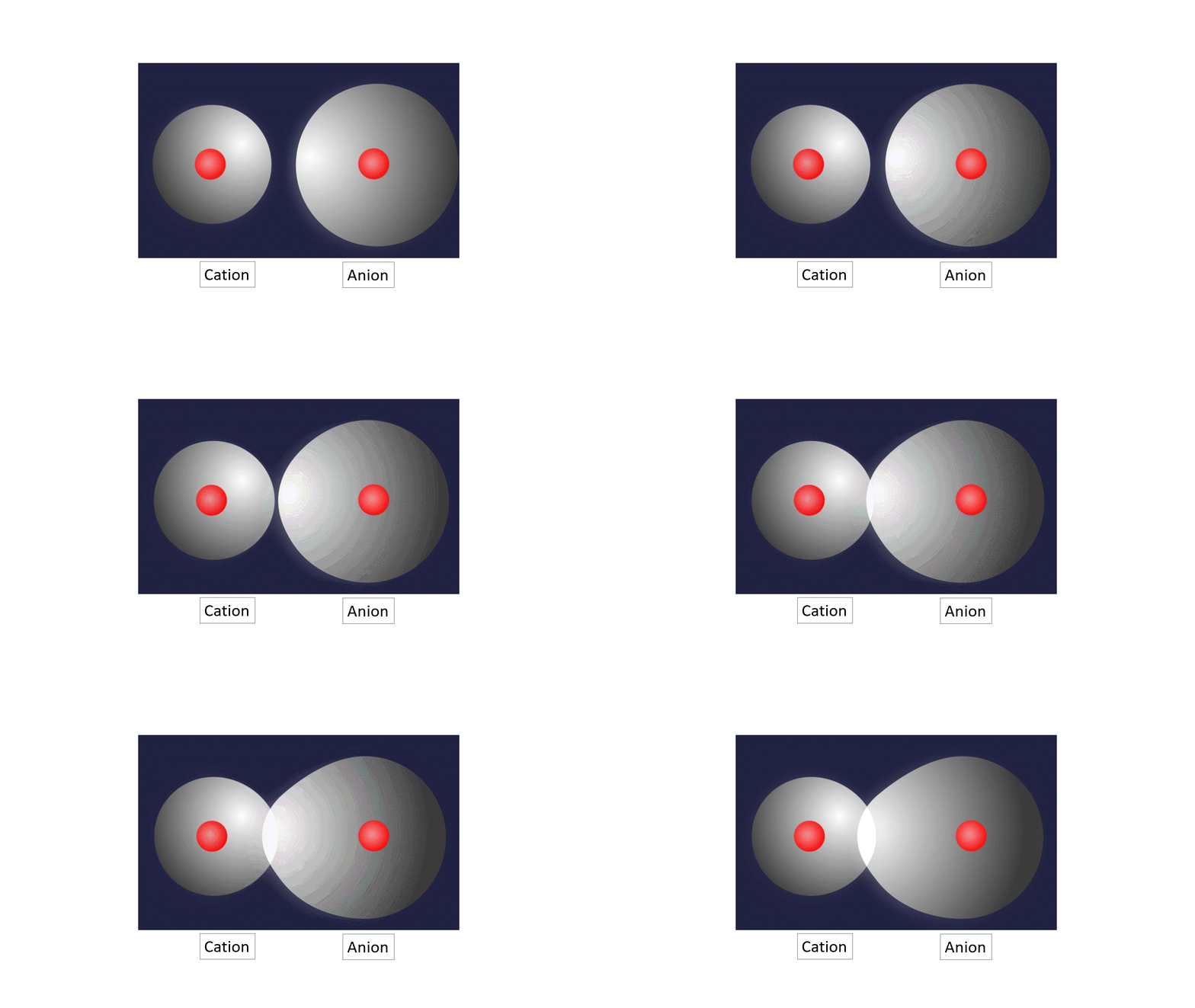
Fajan’s Rules of polarization:
Rule 1: The smaller the cation or the larger the anion, the greater the polarization and the covalent nature of an ionic compound.
Rule 2: The greater the charge on the cation or anion, the greater the polarization and the covalent nature of an ionic compound.
Rule 3: Ionic compounds containing octet-configured cations have greater ionic nature, while those containing pseudo-octet-configured cations have appreciable covalent character.
Consequences of polarization:
Ionic compounds exhibit abnormal behavior as a result of anion polarization and increased covalent nature, as shown below.
1. Solubility in nonpolar solvents:
Ionic compounds with a covalent nature are found to be soluble in non-polar solvents with low dielectric constants.
2. Low melting points:
Ionic compounds with covalent character have lower melting points than expected.
3. Stability:
When exposed to certain conditions, the anions may easily oxidize due to polarization. In the presence of cations with greater polarizing power, polyatomic oxyanions such as carbonates, sulfates, and other oxyanions are easily distorted and decomposed.
Applications of Fajan’s rule with examples:
Rule 1:
Alkali metal halides have a covalent nature. We know that tThe size of cations increases from top to bottom in a periodic table group. The cation size of alkali metals is grows, as shown below.
According to Fajan's rule-1, the covalent nature of alkali metal halides (containing the same halide ion) decreases from Lithium halide to Cesium halide.
For example, the decreasing order of covalent nature of alkali metal chlorides is:
It's also worth noting that the solubility of these compounds decreases in the same order in non-polar solvents with low dielectric constants.
The trend in covalent nature depends on the size of anion when the alkali metal ion is fixed while the halide is changed.
For example, the order of covalent character for various Lithium halides with various halide ions is as shown below.
The size of the anion increases from fluoride to iodide ion in the above case, and thus the covalent nature increases.
However, as the polarization of the anion increases, the stability of these compounds decreases from LiF to LiI.
For ex: when exposed to air, lithium iodide turns yellow due to the oxidation of iodide to iodine. BecauseThis happens because of the strong polarization of the larger Iodide anion in the presence of the smaller lithium ion, this occurs.
Rule 2 :
The covalent nature of Na, Mg, and Al chlorides is listed below.
It is due to an increase in the positive charge on cations,i.e.
Rule 3:
The effective nuclear charge is properly shielded by the inner s and p electrons when the cations have an octet configuration or an inert gas configuration (ns2 np6) in their outer shells. As a result, their polarizing power is lower than expected. As a resultThus, the ionic compound containing these cations has a lower covalent character.
When there are electrons in the d-sublevel, the nuclear attraction is not properly shielded. As a result, cations with pseudo-octet configurations, such as ns2 np6 nd10, have a high polarizing power.
Therefore the main group metal compounds are more ionic while the transition metal compounds are more covalent.
CaCl2 is more ionic, for example, due to the inert gas configuration (3s2 3p6) in the Ca2+ ion. Because of the pseudo-inert gas configuration in the Zn2+ ion(3s2 3p6 3d10), ZnCl2 is more covalent.
Percentage of ionic character:
Every ionic compound is expected to have at least some covalent character, according to Fajan's rules. Dipole moments can be used to estimate the percentage of ionic character in a compound. The bond dipole moment is a measurement of the polarity of a chemical bond within a molecule that is based on the electric dipole moment concept. It occurs whenever positive and negative charges are separated. The bond dipole is calculated as follows:
= ✕ d
The coulomb-meter is the SI unit for an electric dipole moment (C m). Bond dipole moments are commonly measured in Debye, which is represented by the symbol D.
% ionic character = observedcalculated(assuming 100 % ionic bond) ✕ 100 %
Example:
HCl molecule,obs= 1.03 D and bond length = 1.275 Å. percentage ionic character can be calculated as follow:Let q be the magnitude of charge on the H or Cl -atom in HCl molecule and e=1.610-19 C. be the charge on the H or Cl -atom when the molecule is assumed to be purely ionic. Therefore,obs= 1.03 D, Dipole moment (μ) = Charge (e) × Distance of separation (d)∴theoretical= 1.610-19 C1.27510-10m

1D = 3.3310-30C m
Hence, % ionic character = 16.81%
Practice problems:
Q.1. Despite the fact that the crystal radii of K+ and Ag+ are nearly identical, the melting point of AgCl is only 455o C, while that of KCl is 776o C. The best explanation is as follows:
(A) AgCl is has more ionic character than KCl due to greater polarizing power of potassium ion.
(B) KCl is has more ionic character than AgCl due to greater polarizing power of potassium ion.
(C) AgCl is has more covalent character than KCl due to greater polarizing power of silver ion.
(D) KCl is has more covalent character than AgCl due to greater polarizing power of silver ion.
Answer: (C)
Solution: In the outer shell, the K+ ion has an octet configuration (3s2 3p6). As a result, it has less polarizing power, and thus KCl is more ionic. In contrast, the outer shell of Ag+ ion has a pseudo octet configuration (4s2 4p6 4d10). As a result of the ineffective shielding of nuclear charge by d-electrons, it has greater polarizing power and more covalent character.
Q.2. The compound that has the highest covalent character:
(A) NaI
(B) MgI2
(C) AlCl3
(D) AlI3
Answer: (D)
Solution: Al3+ has the greatest polarizing power among cations due to its smaller size and higher charge. Iodide (I-) is the largest anion and thus easily polarized. As a result, the combination of these two ions Al3+ and I-results in more covalent character than other compounds.
Q.3. Which of the following is a more stable compound?
(A) LiF
(B) LiCl
(C) LiBr
(D) LiI
Answer: (A)
Solution: The size of the anion increases from fluoride to iodide ion in the above case, and thus the covalent nature increases.
However, as the polarization of the anion increases, the stability of these compounds decreases from LiF to LiI. So LiF is more stable as compared to other lithium halides.
Q.4. Polarization is the distortion of an anion's shape caused by a nearby cation. Which of the following is the correct statement:
(A) Maximum polarization is brought about by a cation of high charge A cation of high charge can bring about maximum polarization
(B) A large cation is likely to bring about a large degree of polarization A larger cation would bring about a higher degree of polarization
(C) Minimum polarization is brought about by a cation of low radius A cation of smaller radius will bring about minimum polarization
(D) A small anion is likely to undergo a large degree of polarization A large degree of polarization is expected in a smaller anion
Answer: (A)
Solution: According to Fajans’ rule, maximum polarization in anion is caused by the cation of higher charge.
Frequently asked questions(FAQs):
1. How to increase Polarizability ?
Answer: Polarizability generally increases as the volume of electrons occupied increases. This happens because large atoms have loosely held electrons, whereas smaller atoms have tightly bound electrons. As a result, polarizability decreases from left to right in the periodic table row. Ions with smaller sizes are less polarizable, while ions with larger sizes are more polarizable. Furthermore, atoms with a negative charge are more polarizable than atoms with a positive charge.
2. Why does SnCl4 have more covalent character than SnCl2?
Answer: Sn has an oxidation state of +2 in SnCl2. In SnCl4, Sn has an oxidation state of +4. Fajan's rule states that the central metal with the highest oxidation number is the most covalent. As a result, SnCl4 has a more covalent character than SnCl2.
3. Why is LiF is more soluble than LiI?
Answer: In water, LiF is more soluble. According to Fajan’s rule, the I- ion will be polarized to a greater extent than the F- ion because it is smaller in size. As a result, LiF will be less covalent than LiI, and thus LiF will be more water soluble than LiI.
4. What is polarizing power and polarizability?
Answer: The negative charge of an isolated anion is evenly distributed, but in the presence of a cation, the anion's negative charge density is distorted. Polarizing power is defined as a cation's ability or power to distort the electron density of an anion towards itself, or to pull the electron density of an anion towards itself.
Polarizability is the tendency for an anion to become polarized.
According to this, the smaller the degree of polarization, the greater the ionic nature. The more polarization there is, the more covalent nature there will be.

NEET Related Links
JEE MAIN Related Links
JEE Advanced Related Links
JEE Advanced Eligibility Criteria
JEE Advanced Chemistry Syllabus
JEE Advanced Registration Dates
CUET Related Links
Important Topics
Anemometer : Measurement of Wind Speed
Angular Acceleration Atomic Theory Audible and Inaudible Sound Average Speed and Average Velocity Average Velocity Avogadros Number Avogadros Hypothesis Azimuthal Quantum Number Balanced Force Bar Magnet Biconvex Lens Boyles Law Buoyancy Calorimeter Carnot Engine Celestial Bodies Centripetal And Centrifugal Force Concave and Convex Lenses Concave Convex Mirrors Contact and Non Contact Force Controlled Thermonuclear Fusion Convection Currents Convex Lens Convex Mirror Destructive Interference Difference Between Conduction Convection and Radiation Difference Between Electric Field and Magnetic Field Difference Between Heat And Temperature Difference Between Series And Parallel Circuits Differences Between Acceleration And Velocity Distance and Displacement Distance Time Graph Electrical Force : Electric Forces and Their Types Electromagnetic Waves : Definition, Equation and Properties of Electromagnetic Waves Electromagnetism Electron Spin Fluid Flow : Bernoullis Equation Derivation and Fluid Mechanics Fluid Friction : Types and Factors of Fluid Friction Frames of Reference : Inertial and Non- Inertial Frame of Reference Frequency and Wavelength Frictional Force Importance of Hydrosphere Instantaneous Speed and Velocity Introduction to Motion Kinetic and Potential Energy Difference Law Of Conservation of Energy Layers of the Earth Light Energy Light Sources List of physics scientists and Their inventionsLoudness of Sound
Magnetic Dipole Moment Magnetic Field Non - Contact Force Non - Renewable Energy Ohms Law Optics P Wave Physics Symbols Plane Mirrors Poissons Ratio Projectile Motion Properties of Water : Anomalous Expansion of Water Radius of Gyration Reflection of Light Reflection of Waves Relative Density Resonance Reverberation Rolling Friction Rotation and Revolution Screw Gauge Semiconductors and Insulators Sliding Friction Speed Time Graphs Static Friction Stefan Boltzmann Law Stress Tension Tension Force Thermometer: Clinical Laboratory Thermometer Types of Rocks Types of Waves Uniform Motion and Non Uniform Motion Unit of Voltage Uses of Convex Lens Uses Of Convex Mirror Uses of Electromagnet Uses of Optical Fibre Wave Wavelength of Light What is Scattering of Light Working of Electric Bell Conventional and Non-conventional Sources of Energy Buoyant Force Bulk Modulus of Elasticity Bernoulli’s Principle Angular Momentum Difference Between Speed And Velocity ForceUnit of Heat
Difference between Distance and Displacement Simple Microscope Derivation Of Equation Of Motion Thermometer: Clinical & Laboratory Thermometer Difference between Concave and Convex LensDerivation Of Lens Maker Formula
Unit Of Pressure Velocity Uses of Plane Mirror
Wave Theory of Light
Unit of Density Unit of Light Unit of Force Unit of Magnetic Field Unit of wavelength Unit of Viscosity Uses of Electroplating Young's Modulus
What is the Scattering of Light
Lenz Law Space Wave Propagation Schrodinger Wave Equation Relation between Fahrenheit and Celsius Refractive Index Potentiometer Working Pascal Law Oscillatory Motion Optical Instruments Newton's Laws of Motion - First Law Modulation and Demodulation Magnetic Flux Lens Formula and Magnification Kaleidoscope Faradays Law Epsilon Naught Value Energy Bands Electrostatics Electroscope AC Generator Unit of Current Lithosphere Bending Equation Derivation Difference Between Pound and Kilogram Semiconductor Devices OTEC - Ocean Thermal Energy Conversion Hall Effect Rectilinear Propagation of Light Difference Between Ammeter and Voltmeter Coefficient of Linear Expansion Ampere’s Law Cyclone and Thunderstorm Save The Environment From Pollution Particle Nature of Light Types of DC Motor Uses Of Transistor Derivation of Phase Rule Unit of Humidity

 Call Now
 Let's Chat
 Share
Share