-
Call Now
1800-102-2727


Factors Deciding the States of Matter - Effect of Pressure, Effect of Temperature, Practice Problems and FAQs

One day on a sunny afternoon I thought of preparing a vanilla shake and to do so I took out ice from the refrigerator and kept it on a kitchen slab but suddenly my friend came to my house and I forgot what I was preparing. When I returned I saw that there is no evidence of ice left in the ice tray. What do you think would have happened to the ice? Yes, you might be recalling the different states of matter which you have learned in junior classes. In this case, the ice cube present in the ice tray first melted to get converted into liquid form then it evaporated. But how is this change in the state of the matter taking place? To answer this question it is essential to know the factors that affect the states of matter.
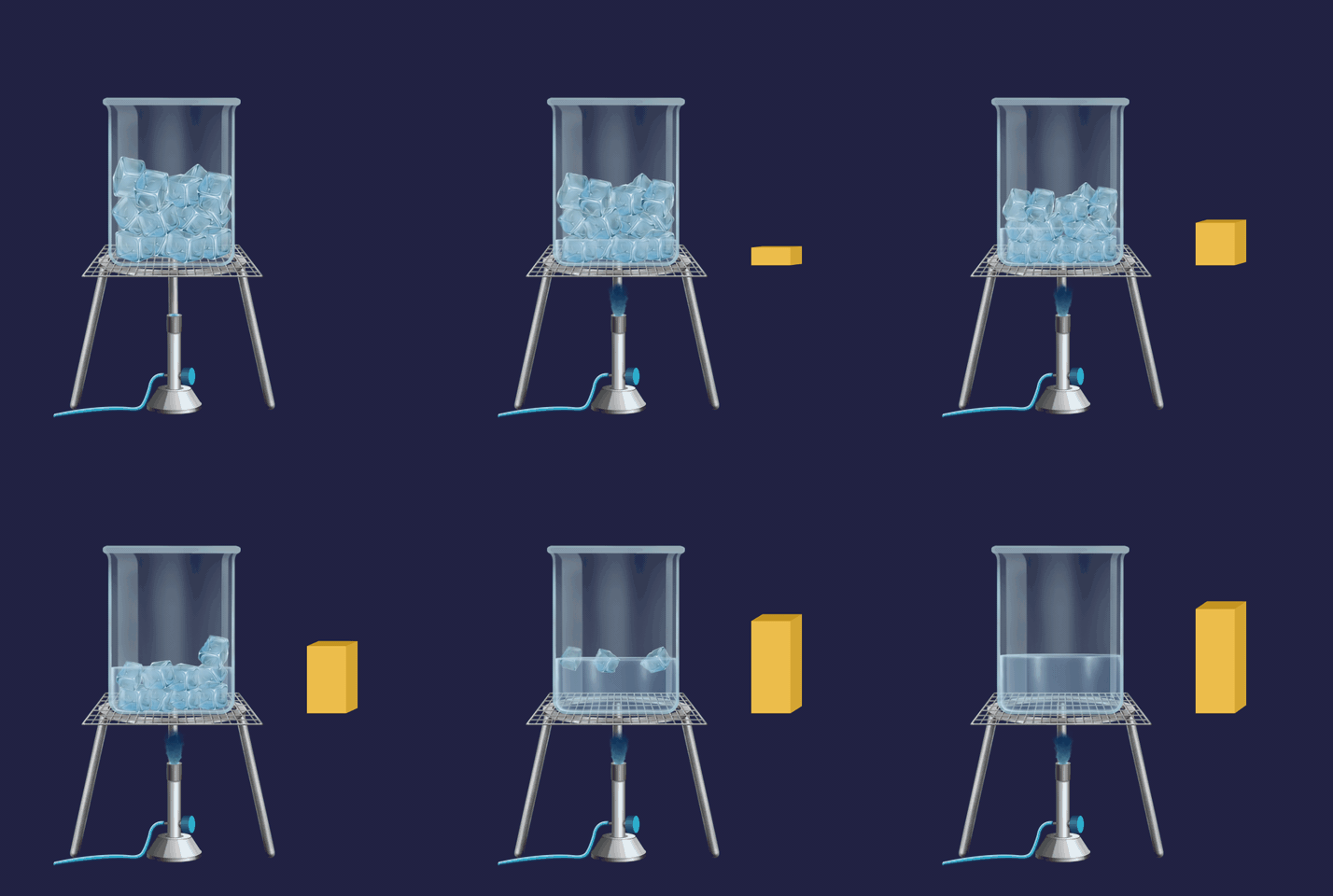
Table of content
Effect of pressure
When the pressure is applied to a substance the constituting particles cannot move as freely as compared to when there was no pressure. With the application of pressure on the gas particles, they come closer to each other and interparticle forces increases and get compressed to form a liquid or a solid. There is no effect of pressure on solids and liquids as they are incompressible.
When the pressure is decreased, the state of the matter changes in the following way;
Solid --> liquid --> gas
When the pressure is increased, the state of the matter changes in the following way;
Gas --> liquid --> solid
Effect of temperature
Temperature refers to measuring the hotness or coldness of a body. It is generally measured in degree celsius with the help of a thermometer and the S.I unit of temperature is Kelvin (K).
The kinetic energy of particles of substance increase with the increase in temperature. Therefore, when the temperature of a matter is increased it absorbs energy in the form of heat and increases the thermal energy due to which vibration between the molecules increases and results in an increase in the kinetic energy of substances.
When the temperature is increased, the state of the matter changes in the following way;
Solid --> liquid --> gas
When the temperature is decreased, the state of the matter changes in the following way;
Gas --> liquid --> solid
Both temperature and pressure decides the physical state in which the matter will exist. At low temperatures, the thermal energy is very low. At the same time, the intermolecular forces are so high that the particles come closer to each other, so it can be said that the substance is in solid state as interparticle forces are stronger.
Now if we increase the temperature, thermal energy will be high and particles will start moving due to an increment in the kinetic energy. The intermolecular forces will try to bring them closer but once the thermal energy is greater than the interparticle forces, particles won’t remain in their fixed positions and they start moving around and a substance is converted into liquid or a gas.
Practice problems
Q1. Which among the given options can change when it is subjected to an increase in the temperature?
A. No of moles of the substance
B. Arrangement of the constituent particles
C. Kinetic energy of the particles
D. Both B and C
Answer: D
Solution: When the temperature of a substance increases, it means the thermal energy of the substance increases which increase the molecular vibration. This will cause a change in the arrangement of the constituent particles and the overall kinetic energy.
Q2. What happens to the arrangement of the particles, when the heat is supplied to the substances at the melting point?
Solution: When heat is supplied to the substances at the melting point it does not increase the temperature of the substance, rather the heat supplied is utilised to overcome the attraction force present between the constituent particles till the complete melting process takes place.
Frequently asked questions(FAQs)
Question 1. What is the difference between temperature and heat?
Answer: Heat is the amount of energy transferred from one body to another due to the temperature difference. If we supply heat to a body, we can say we are increasing the number of collisions of particles inside the body. The temperature on the other hand tells us how much heat is present in a body. So, temperature is the measurement of the degree of hotness and coldness of any substance.
Question 2. What is thermal energy and how is it related to the factor deciding the state of matter?
Solution: Thermal energy is directly proportional to the temperature and with the increase in the temperature, thermal energy also increases. Due to this the kinetic energy of the particles of the substance increases and interparticle force between the particles decreases and if a substance is in a solid-state, it converts into liquid and gas.
Question 3. Which among the three states of matter has higher kinetic energy and why?
Answer: Among the given three states of matter gases will have the highest kinetic energy as the interparticle force of attraction between the particles is less in gases as compared to liquid or solid particles. So they have more freedom of movement, as a result, kinetic energy is higher.
Question 4. What is the difference between the standard boiling point and the normal boiling point of a liquid?
Answer: Standard boiling point is defined as the temperature at which the vapour pressure of a liquid equals the atmospheric pressure which corresponds to 1 bar. Whereas, a normal boiling point is defined as the temperature at which the vapour pressure of a liquid equals the atmospheric pressure which corresponds to 1 atm.
Related topics
|
Charles's Law |
Gay-Lussac’s Law |
|
Avogadro’s Law |
Dalton's Law of Partial Pressure |
|
Ideal Gas Equation |
Real Gas |

 Call Now
 Let's Chat
 Share
Share