-
Call Now
1800-102-2727


F Block Elements-Definition, General Characteristics, Lanthanoids, Characteristics of Lanthanoids, The Actinoids, Chsaracteristics of Actinoids, Practice Problems, FAQ

You must have seen nowadays, science and technology are developing at a rapid speed. Modern India has placed a high emphasis on science and technology, realising that it is a critical component of economic development. In the field of scientific research, India is ranked among the top five countries in the world, and it is one of the top five nations in the field of space exploration.
You must have seen projectors used in the classroom for smart studies. Many of you have projectors available at your school. Have you found those classes much more interesting than whatever teachers taught on the blackboard?
The motive behind asking this question is to let you know that Praseodymium, alongside other lanthanide elements, is used in carbon electrodes for lighting and projections in the studio.
While reading history, you must be surprised how one can remember the old dates. Whenever you went to a museum you must have seen things around thousand of years ago. Do you find these interesting?
Events, discoveries, and innovations are a part of human history. To make it easier to remember, we label events with the dates they occurred and how is possible for historians to find dates related to pasts. Inner transition metals are used by scientists and archaeologists to assess the age of fossils and other materials such as rocks.
Let’s begin with the study of some interesting facts about inner transition metals. These metals are remarkable because they were among the latest to be identified in the periodic table.
Table of content:
- What are inner transition metals?
- General characteristics of inner transition metals
- The Lantanoids
- General Characteristics of Lanthanoids
- The Actinoids
- Characteristics of Actinoids
- Practice Problems
- Frequently asked questions-FAQ
What are inner transition metals?
Inner transition elements are those in which an additional electron enters the (n-2)f orbitals. The electrical configuration of these elements' valence shells is Because the extra electrons travel to f-orbitals in the (n-2)th main shell, these are known as
f-block elements.
Lanthanides, or rare-earth, are elements in the 4f-block. 5f-block elements are also known as actinides or actinones. Because of their strong resemblance to Lanthanum and Actinium, the names Lanthanides and Actinides were given. The first inner transition series is lanthanides, while the second inner transition series is actinides.
The lanthanides and actinides are frequently represented as a distinct tiny "island" beneath the main body of the periodic table in order to condense it.
General Characteristics of inner transition metals:
- The third last shell of the inner transition elements are filled with electrons.
- The inner transition elements form coloured ions.
- Variable valencies are shown by the inner transition elements.
- Actinides are naturally radioactive.
- Beyond atomic number 92, the inner transition elements are both synthetic and radioactive. They aren't found in the earth's crust in nature.
The Lanthanoids:
From lanthanum to lutetium, the lanthanide series of chemical elements consist of fifteen metallic chemical elements with atomic numbers 57 to 71. The rare earth elements are made up of these fifteen lanthanide elements, as well as the chemically related elements scandium and yttrium.
It should be noted that the atoms of these elements have a common electrical structure of 6s2 but varied occupancy of the 4f level. All tri-positive ions (the most stable oxidation state of all lanthanoids) have electronic structures of the form 4fn (n = 1 to 14 with increasing atomic number).
Let us cover some important trends in the periodic table:
- Electronic configuration:
For lanthanoids starting with cerium and finishing with lutetium
(Z = 71), the electronic configuration of the inner transition elements is .
Example: Electronic configuration of Lanthanoids are mentioned below:
|
Atomic Number |
Element |
Symbol |
Configuration |
|
57 |
Lanthanum |
La |
|
|
58 |
Cerium |
Ce |
|
|
59 |
Praseodymium |
Pr |
|
|
60 |
Neodymium |
Nd |
|
|
61 |
Promethium |
Pm |
|
|
62 |
Samarium |
Sm |
|
|
63 |
Europium |
Eu |
|
|
64 |
Gadolinium |
Gd |
|
|
65 |
Terbium |
Tb |
|
|
66 |
Dysprosium |
Dy |
|
|
67 |
Holmium |
Ho |
|
|
68 |
Erbium |
Er |
|
|
69 |
Thulium |
Tm |
|
|
70 |
Ytterbium |
Yb |
|
|
71 |
Lutetium |
Lu |
- Atomic size and Ionic size:
- The additional electron reaches the 4f-subshell in lanthanides but not the valence-shell or sixth shell.
- Because the shape of the f-sub shell is very diffused, there is no similar rise in the mutual shielding effect of 4f-electrons, the shielding effect of one electron in the same sub-shell by another in the same sub-shell is very modest, even smaller than that of d-electrons.
- The outermost shell electrons in the nucleus suffer more significant nuclear attraction as a result of this. As a result, as we progress from La (57) to Lu (71), the atomic and ionic radii continue to decrease.
- Below is the graph which shows the atomic radii of Lanthanoids
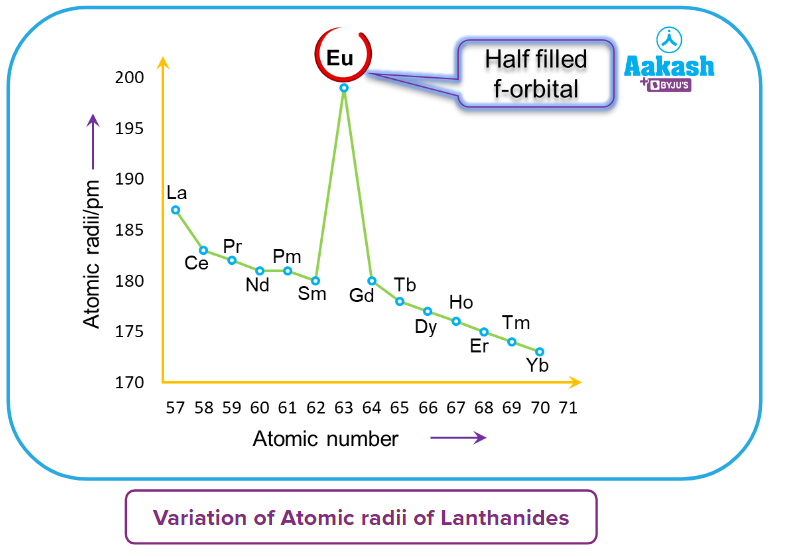
- The lanthanoid contraction (a decrease in atomic and ionic radii from lanthanum to lutetium) is a distinctive aspect of the lanthanoids' chemistry.
- It has far-reaching implications in the chemistry of the elements' third transition series. The drop in atomic radii (derived from metal structures) is not as consistent as it is in M+3 ions.
- Of course, this contraction is comparable to that seen in a regular transition series and is due to the same cause i.e; improper shielding of one electron by another in the same sub-shell. With the increase in nuclear charge down the series, however, the shielding of one 4f electron by another is smaller than that of one d electron by another. With rising atomic number, the diameters shrink in a pretty regular pattern.
- The radii of the members of the third transition series are remarkably similar to those of the corresponding members of the second series due to the cumulative effect of the lanthanoid series contraction, known as lanthanoid contraction.
- The nearly identical radii of Zr (160 pm) and Hf (159 pm), which result from the lanthanoid contraction, account for their coexistence in nature and the difficulties in separating them.
- Oxidation state:
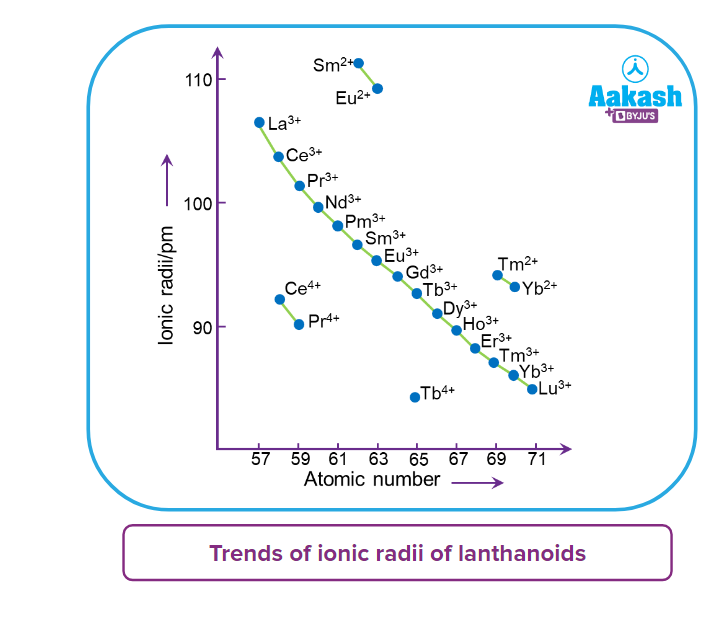
- The +II and +III chemicals are the most common lanthanoids. However, +2 and +4 ions are occasionally found in solution or in solid compounds.
- The increased stability of empty, half-filled, or filled f subshells causes this irregularity in ionisation enthalpies. The noble gas structure favours the creation of CeIV, although it is a strong oxidant that reverts to the common +3 state. Ce+4/ Ce+3 has an value of + 1.74 V, indicating that it may oxidise water. However, because the reaction rate is slow, Ce(IV) is an excellent analytical reagent.
- Pr, Nd, Tb, and Dy have a +4 state as well, but only in oxides, MO2. Eu+2 is created by losing two s electrons, and its f7 configuration is responsible for its production. Yb+2, which has the f14 configuration, is also a reductant. Tb+4 is an oxidant with half-filled f-orbitals. Samarium behaves similarly to europium in that it has both +2 and +3 oxidation states.
- Coloured ions: Many lanthanide ions are coloured both in solid form and in solutions. Partially filled f-orbitals allow for f-f transitions, hence the colour. Colourless M3+ ions with , 4f7, or 4f14 configurations. are colourless in nature.
The colour of pairs of M3+ ions with the same amount of unpaired electrons in 4f-orbitals are the same.
Colours of Lanthanides ions are mentioned in the below table:
|
M3+(M = lanthanide ion) |
Number of 4f electrons |
Colour |
|
La3+ |
0 |
colourless |
|
Ce3+ |
1 |
colourless |
|
Pr3+ |
2 |
Green |
|
Nd3+ |
3 |
Lilac |
|
Pm3+ |
4 |
Pink |
|
Sm3+ |
5 |
Yellow |
|
Eu3+ |
6 |
Pale pink |
|
Gd3+ |
7 |
Colourless |
|
Tb3+ |
8 |
Pale pink |
|
Dy3+ |
9 |
Yellow |
|
Ho3+ |
10 |
Pale yellow |
|
Er3+ |
11 |
Pink |
|
Tm3+ |
12 |
Pale pink |
|
Yb3+ |
13 |
Colourless |
|
Lu3+ |
14 |
Colourless |
General Characteristics of Lanthanoids:
- Lanthanoids are silvery-white soft metals that tarnish quickly when exposed to air.
- With rising atomic numbers, the hardness of metal rises with samarium being steel hard metal.
- They have a conventional metallic structure and are good heat and electricity conductors.
- Except for Eu and Yb, and infrequently Sm and Tm, density and other characteristics shift smoothly.
- In the solid-state and in aqueous solutions, many trivalent lanthanoid ions are coloured. The existence of f electrons accounts for the colour of these ions.
- Neither the La+3 nor the Lu+3 ion exhibit any colour because of empty f-orbitals and fully filled f-orbitals respectively.
- Because of the excitation within the f level, the absorption bands are narrow.
- Other than the f0 type (La+3 and Ce+4) and the f14 type (Yb+2 and Lu+3), all lanthanoid ions are paramagnetic.
- In terms of chemical behaviour, the series' initial members are extremely reactive, almost similar to calcium, but as the atomic number increases, they behave more like aluminium. E values for the half-reaction, except for Eu, which has a value of –2.0 V, for the half-reaction, is in the range of –2.2 to –2.4 V. The general half-cell reaction is:
- When metals are heated with carbon, carbides such as Ln3C, Ln2C3, and LnC2 are produced.
- They burn halogens to produce halides (LnX3) .
- On reacting with dilute acids, they liberate hydrogen gas.
- Lanthanides when burned in presence of air(O2) forms lanthanide oxides(Ln2O3).
The Actinoids:
Electrons obtained by sequentially filling 5f orbitals are known as actinides or actinides. They get their name from the fact that they are the next element after actinium (Ac) in the periodic table. The actinide series is also known as the second inner transition series, as it contains 14 elements spanning from Th(90) to Lw(103). Despite the fact that actinium (Z=89) contains no 5f electrons, actinoids are commonly used to study it.
Let's look at some key tendencies in the periodic table:
- Electronic configuration: The electrical configuration of 7s2 is thought to be shared by all actinoids, with varied occupancy of the 5f and 6d subshells. The fourteen electrons are formally added to 5f, though not in thorium (Z = 90) but from Pa onwards the 5f orbitals are completed at element 103. The stabilities of the f0, f7, and f14 occupancies of the 5f orbitals are related to the abnormalities in the electronic configurations of actinoids, as they were also in lanthanoids. Am and Cm configuration are and respectively. Although the 5f orbitals are similar to the 4f orbitals in terms of their angular component of the wave function, they are not as buried, and so 5f electrons can engage in bonding to a far higher amount.
Electronic configurations of actinoids are given below:
|
Atomic Number |
Element |
Symbol |
Configuration |
|
89 |
Actinium |
Ac |
|
|
90 |
Thorium |
Th |
|
|
91 |
Protactinium |
Pa |
|
|
92 |
Uranium |
U |
|
|
93 |
Neptunium |
Np |
|
|
94 |
Plutonium |
Pu |
|
|
95 |
Americium |
Am |
|
|
96 |
Curium |
Cm |
|
|
97 |
Berkelium |
Bk |
|
|
98 |
Californium |
Cf |
|
|
99 |
Einsteinium |
Es |
|
|
100 |
Fermium |
Fm |
|
|
101 |
Mendelevium |
Md |
|
|
102 |
Nobelium |
No |
|
|
103 |
Lawrencium |
Lr |
- Atomic size and Ionic size: The actinoids, like the lanthanoids, have a similar general tendency.
The size of atoms or M3+ ions diminishes gradually throughout the run. Actinoid contraction is the term for this (similar to lanthanoid contraction). The shrinkage is higher from element to element in this series due to inadequate shielding by 5f electrons.
- Oxidation states of Actinoids: The actinides, like the lanthanides, have the most frequent oxidation state of +3. However, unlike the first four elements (Th,Pa,U,Np) this state is not always the most stable.In the air and in solution, for example, U3+ is easily oxidised. For the later elements , the +3 state is the most stable (except No). Th(+4), Pa(+5), and U(+6) are the most stable oxidation states for the first four elements. All of the outer electrons, including the electrons, are used for bonding in these high oxidation states.
Np has an oxidation state of +7, however, it is oxidising, and its most stable state is +5. Pu shows all oxidation states from +3 to +7, with +4 being the most stable. Am represents oxidation states ranging from +2 to +6. The configuration of the Am2+ is f7. It's the equivalent of Eu2+, however it only exists as fluoride in solid form. However, the +3 state is the most stable for Am and practically all of the remaining elements.
All elements from Th to Bk occur in the +4 oxidation state. Cf2+, Es2+, Fm2+. In solution, Md2+ and No2+ exist as ions.
General Characteristics of Actinoids:
- The actinoid metals all have a silvery appearance but differ in structure.
- Metallic radii have significantly more irregularities than lanthanoids, which gives rise to structural variety.
- Actinoids, especially when finely separated, are highly reactive metals.
- When boiling water is applied to them, for example, a mixture of oxide and hydride is formed.
- The majority of non-metals combine with them at moderate temperatures.
Related link: https://www.youtube.com/watch?v=EAQGKdam8sE(39:57–1:18:20)
D and F Block Elements Class 12 Chemistry One Shot & Mind Maps L- 2 (Ep 29) | NEET 2022 Exam Prep
Practice Problems:
Q1. The electronic configuration of cerium in the +3 oxidation state is
A.
B.
C.
D.
Answer: C
Solution: The electronic configuration of cerium is . Cerium in the +3 oxidation state loses +3 electrons and thus gets a configuration of .
Q2. In flashlight powder alloy of ___________ is used.
A. Cerium-calcium
B. Cerium-magnesium
C. Samarium-magnesium
D. Samarium-calcium
Answer: B
Solution: Flashlight powders contain cerium-magnesium alloys. Magnesium-based alloy is the world's strongest and lightest metal, and it has the potential to revolutionise the world.
Q3. ___________salts are used in glass industries for imparting colours
A. Uranium
B. Plutonium
C. Americium
D. Californium
Answer: A
Solution: Uranium salts are used in the glass industry (to impart a green colour), the textile business, the ceramic industry, and medicines.
Q4. In both solid and aqueous solutions, ions with 2 to 6 electrons in 5f-orbitals are coloured because of
A. charge transfer spectra
B. transition of d-d electrons
C. ligand to charge transfer spectra
D. transition of f-f electrons
Answer: D
Solution: In both solid and aqueous solutions, ions with 2 to 6 electrons in 5f-orbitals are coloured. The f-f transition is responsible for the colour.
Frequently asked questions-FAQ
Q1. Can we use lanthanides as effective electrical conductors?
Solution: Several trivalent lanthanoid ions are coloured both in the solid-state and in aqueous solutions. Lanthanoids are efficient heat and electricity conductors and have a typical metallic structure therefore, they are used as effective electrical conductors.
Q2. Why are rare earth metals referred to as f-block elements?
Solution: Inner transition metals, often known as f-block elements, are those in which the inner f-orbital is gradually filled. Due to their rarity in the earth's crust, they are also known as rare earth metals.
Q3. What are the major lanthanides' sources?
Solution: The main source of lanthanides is monazite sand, which is made up of phosphates of lanthanum, thorium, cerium, and neodymium. The phosphate portion of monazite also contains trace amounts of other lanthanide ions. Promethium is the only lanthanide that is produced artificially through a nuclear reaction.
Q4. Which lanthanide is utilised in the production of magnets?
Solution: High-strength neodymium magnets, a form of a potent permanent magnet, are made using neodymium-based alloys. The strongest rare earth magnets like neodymium, combined with transition metals are utilised in some electric car motors and wind turbines.

NEET Related Links
JEE MAIN Related Links
JEE Advanced Related Links
JEE Advanced Eligibility Criteria
JEE Advanced Chemistry Syllabus
JEE Advanced Registration Dates
CUET Related Links
Important Topics
Anemometer : Measurement of Wind Speed
Angular Acceleration Atomic Theory Audible and Inaudible Sound Average Speed and Average Velocity Average Velocity Avogadros Number Avogadros Hypothesis Azimuthal Quantum Number Balanced Force Bar Magnet Biconvex Lens Boyles Law Buoyancy Calorimeter Carnot Engine Celestial Bodies Centripetal And Centrifugal Force Concave and Convex Lenses Concave Convex Mirrors Contact and Non Contact Force Controlled Thermonuclear Fusion Convection Currents Convex Lens Convex Mirror Destructive Interference Difference Between Conduction Convection and Radiation Difference Between Electric Field and Magnetic Field Difference Between Heat And Temperature Difference Between Series And Parallel Circuits Differences Between Acceleration And Velocity Distance and Displacement Distance Time Graph Electrical Force : Electric Forces and Their Types Electromagnetic Waves : Definition, Equation and Properties of Electromagnetic Waves Electromagnetism Electron Spin Fluid Flow : Bernoullis Equation Derivation and Fluid Mechanics Fluid Friction : Types and Factors of Fluid Friction Frames of Reference : Inertial and Non- Inertial Frame of Reference Frequency and Wavelength Frictional Force Importance of Hydrosphere Instantaneous Speed and Velocity Introduction to Motion Kinetic and Potential Energy Difference Law Of Conservation of Energy Layers of the Earth Light Energy Light Sources List of physics scientists and Their inventionsLoudness of Sound
Magnetic Dipole Moment Magnetic Field Non - Contact Force Non - Renewable Energy Ohms Law Optics P Wave Physics Symbols Plane Mirrors Poissons Ratio Projectile Motion Properties of Water : Anomalous Expansion of Water Radius of Gyration Reflection of Light Reflection of Waves Relative Density Resonance Reverberation Rolling Friction Rotation and Revolution Screw Gauge Semiconductors and Insulators Sliding Friction Speed Time Graphs Static Friction Stefan Boltzmann Law Stress Tension Tension Force Thermometer: Clinical Laboratory Thermometer Types of Rocks Types of Waves Uniform Motion and Non Uniform Motion Unit of Voltage Uses of Convex Lens Uses Of Convex Mirror Uses of Electromagnet Uses of Optical Fibre Wave Wavelength of Light What is Scattering of Light Working of Electric Bell Conventional and Non-conventional Sources of Energy Buoyant Force Bulk Modulus of Elasticity Bernoulli’s Principle Angular Momentum Difference Between Speed And Velocity ForceUnit of Heat
Difference between Distance and Displacement Simple Microscope Derivation Of Equation Of Motion Thermometer: Clinical & Laboratory Thermometer Difference between Concave and Convex LensDerivation Of Lens Maker Formula
Unit Of Pressure Velocity Uses of Plane Mirror
Wave Theory of Light
Unit of Density Unit of Light Unit of Force Unit of Magnetic Field Unit of wavelength Unit of Viscosity Uses of Electroplating Young's Modulus
What is the Scattering of Light
Lenz Law Space Wave Propagation Schrodinger Wave Equation Relation between Fahrenheit and Celsius Refractive Index Potentiometer Working Pascal Law Oscillatory Motion Optical Instruments Newton's Laws of Motion - First Law Modulation and Demodulation Magnetic Flux Lens Formula and Magnification Kaleidoscope Faradays Law Epsilon Naught Value Energy Bands Electrostatics Electroscope AC Generator Unit of Current Lithosphere Bending Equation Derivation Difference Between Pound and Kilogram Semiconductor Devices OTEC - Ocean Thermal Energy Conversion Hall Effect Rectilinear Propagation of Light Difference Between Ammeter and Voltmeter Coefficient of Linear Expansion Ampere’s Law Cyclone and Thunderstorm Save The Environment From Pollution Particle Nature of Light Types of DC Motor Uses Of Transistor Derivation of Phase Rule Unit of Humidity

 Call Now
 Let's Chat
 Share
Share