-
Call Now
1800-102-2727


Ethanol: Structure and Formula, Preparations, Physical and Chemical Properties & Uses, Practice Problems and Frequently Asked Questions

Let me ask you a quick question.
How would you spend New Year's Evening if your parents let you party with your closest friends?
There will be various responses to this question. However, most of us would prefer to have a drink and toast the new year with close friends.
The drink is nothing more than diluted ethanol or ethyl alcohol, but it is not recommended for consumption because it can cause serious health problems such as liver damage and mental disorders.
We are all familiar with the term "alcohol", which is used in different dimensions such as recreational drink, medical purpose, wood spirit etc. In chemistry, alcohol represents a class of organic compounds in which at least one hydroxyl group (-OH) is attached to a saturated carbon atom in a common chemical formula CnH2n+1. For example, the alcohol used for recreational purposes is ethyl alcohol, which has a chemical formula C2H5OH
Table of content
- Structure and formula of ethanol
- Preparations of ethanol
- Physical properties of ethanol
- Chemical Properties of ethanol
- Uses of ethanol
- Health hazards of ethanol
- Practice problems
- Frequently asked questions
Structure and formula of ethanol:
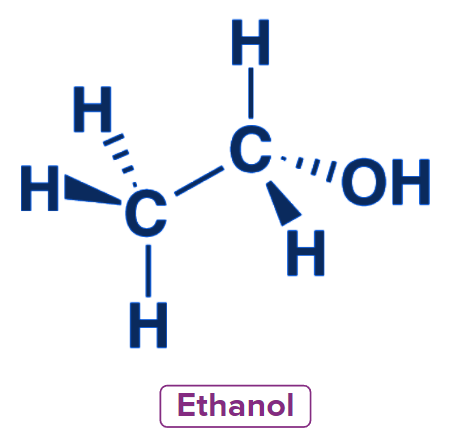
Ethanol has two carbon atoms and one oxygen atom in its chemical formula C2H6O. The structural formula for ethanol C2H5OH, adds a little more detail, indicating that the 2-carbon chain ends in a hydroxyl group (-OH).
Preparations of ethanol
1. By fermentation of carbohydrates in presence of anaerobic bacteria:
Ethanol is manufactured on an industrial scale by fermenting molasses. Molasses is the mother liquor left over when sugarcane juice crystallizes, and it contains roughly 60% fermentable sugar. The steps are as follows:
(a) Molasses dilution: Molasses is first diluted in a 1:5 (molasses: water) volume ratio with water.
(b) Ammonium sulfate fortification: Ammonium sulfate fortification supplies yeast with an appropriate source of nitrogen.
(c) Sulphuric acid addition: A little amount of sulphuric acid is added to the fortified molasses solution. This promotes yeast development while inhibiting the growth of harmful bacteria.
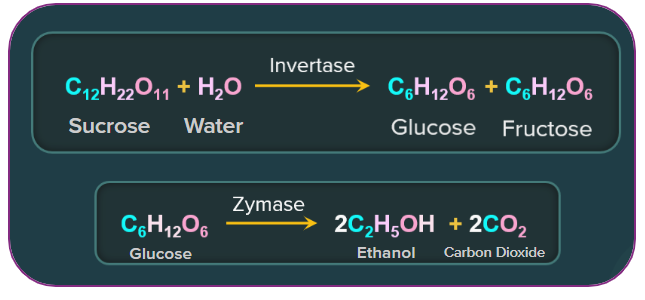
(d) Fractional distillation: The alcohol obtained during fermentation is known as "wash," and it is around 15% to 18% pure. It is turned into 92 percent pure alcohol known as rectified spirit or commercial alcohol via fractional distillation.
2. From Ethylene:
The hydration of ethylene is accomplished by passing a combination of ethylene and a substantial surplus of steam (H2O) over an acidic catalyst, such as a phosphoric acid catalyst, at high temperature (300oC) and pressure (60 atm).

3. Reaction of formaldehyde with grignard reagent:
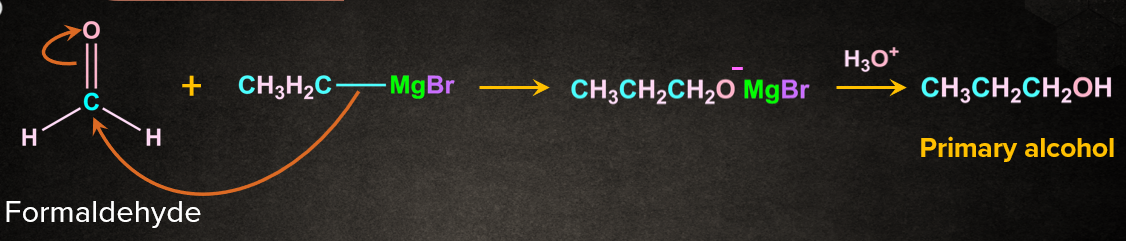
Formaldehyde on reaction with methyl magnesium bromide followed by hydrolysis gives primary alcohol ethanol.
Physical properties of ethanol
- Ethanol is a clear, colorless liquid.
- Ethanol has a distinct odor and a burning flavor.
- Ethanol has a boiling point of 351K which is higher than ethane.
- It is soluble in water, which means that it can be mixed with water in any amount.
- It is extremely flammable and volatile.
- It can be utilized in antifreeze products due to its low melting point of -114.5oC.
- It has a density of 789Kg/m3, which is nearly 20% less than water.
Chemical properties of ethanol
1. Conversion of Ethanol to Ethanal:
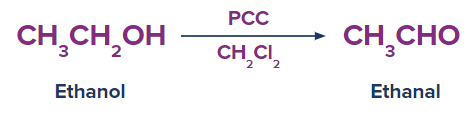
A molecule of hydrogen is removed during the conversion (oxidation) of ethanol to ethanal, and a C-O bond is transformed to a C=O bond. The hydroxyl group of alcohol is transformed to the carbonyl group of aldehyde during this reaction. Ethanal is transformed to ethanoic acid if it is oxidized further.
2. Reaction with sodium:
Ethyl alcohol on reaction with sodium metal will give sodium ethoxide and hydrogen gas.

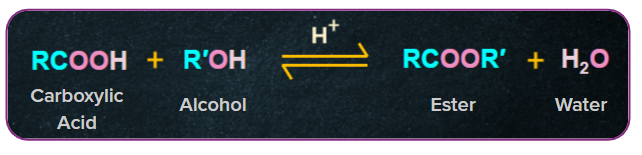
3. Esterification:
Esterification is a chemical reaction in which two reactants (alcohol and an acid) react to produce an ester as the reaction product. And they have the formula  (where R and R' are any organic groups), and they are made by reacting alcohols with carboxylic acids in the presence of hydrochloric acid or sulphuric acid.
Uses of ethanol
- Ethanol is used as an antiseptic, a polar solvent in chemical synthesis, a central nervous system depressant, a neurotoxic, a disinfectant, a teratogenic agent, and an Escherichia coli metabolite, among other things.
- In proper dilutions, ethanol is utilized in alcoholic beverages. Ethanol is also used as a reagent in organic chemistry and chromatography. It's also used as a solvent in industry.
- Denatured alcohol, medicines (rubbing compounds, lotions, tonics, colognes), perfumery, and as an octane enhancer in gasoline are all made with it.
- Ethanol is a powerful CNS depressant that increases the inhibitory effects of GABA at the GABA-A receptor. GABA stands for gamma-aminobutyric acid.
- It increases dopamine and serotonin production.
- A moderate amount of ethanol consumption reduces myocardial infarction risk.
Health hazards of ethanol:
- Vomiting, lethargy, ataxia, and recumbency are all symptoms of ethanol poisoning. Hypothermia, tremors, acidosis, diarrhea, seizures, disorientation, vocalization, hypotension, tremors, tachycardia, and coma are all symptoms that can lead to mortality in severe cases. Alcohol causes vomiting by irritating the stomach directly.
- Drinking too much alcohol raises the concentration of ethanol in the blood and causes emesis. High blood ethanol concentrations cause vomiting during intoxication. As a result, the muscle becomes paralyzed, increasing the risk of aspiration.
- Ethanol intoxication lowers peripheral oxygen delivery and induces mitochondrial oxidative dysfunction, leading to hypoxia.
- Hypothermia is caused by ethanol poisoning, which results in a drop in body temperature.
- Women who use a lot of ethanol have a higher risk of dying from cancer.
Practice problems
Q1. Which chemical is used in gasoline to keep engines free from knocking and to keep them drivable?
(A) Ethanol (B) water
(C) Ester (D) Vinegar
Answer: (A)
Solution: Ethanol is a clean fuel since it undergoes complete combustion. It produces carbon dioxide and water with a clean, smokeless flame, thus it does not contribute much to pollution.

Ethanol is commonly blended with gasoline to make "gasohol," which contains about 10% to 20% ethanol.
Q2. What is the product obtained when ethyl alcohol is heated at  in presence of sulphuric acid gives
(A) Alkane (B) Alkene
(C) Alkyne (D) Acid
Answer: (B)
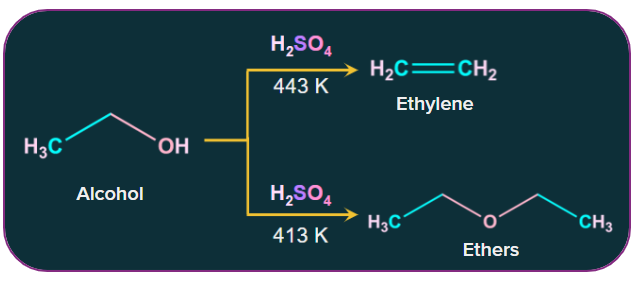
Solution: Alcohols undergo dehydration at higher temperature in the presence of protic acids (sulfuric acid, phosphoric acid) to yield alkenes and ethers under different conditions. The formation of reaction products depends on the reaction conditions.
For example, ethanol is dehydrated to ethylene at 413K in the presence of sulfuric acid. On the other hand, ethanol gives ethoxyethane in the presence of sulfuric acid at 413K.
Q3. Which of the following is soluble in water?
(A) Carbon disulphide (B) Ethyl alcohol
(C) carbon tetrachloride (D) none of the above
Answer: (B)
Solution: Ethyl alcohol is soluble in water due to its ability to form intermolecular hydrogen bonding with water.
Q4. At room temperature ethanol is
(A) Solid (B) liquid
(C) gas (D) None of the above
Answer: (B)
Solution: Ethanol is a liquid at normal temperature because the molecules are tightly bound together due to hydrogen bonding. This hydrogen bonding between the oxygen atoms of one molecule and the hydrogen atoms of a nearby ethanol molecule keeps the molecules strongly linked.
Frequently asked questions
Question 1. Which test is used to distinguish between ethanol and methanol?
Answer: The test used to distinguish between methanol and ethanol is the haloform test. Ethanol will give a positive haloform test and methanol will not give a haloform test. The reactions are given below:




 .
.
Question 2. Why is ethanol used as fuel?
Answer: Because the ethanol molecule contains oxygen, the engine can burn the fuel completely, resulting in less emissions. Ethanol is considered a renewable fuel because it is made from plants that harness the sun's energy. Because it does not leave sticky residues, ethanol-blended fuel maintains the fuel system clean for optimal performance. Ethanol acts as a gas-line antifreeze, preventing issues in the winter.
Question 3. What is the purpose of (95%) ethyl alcohol?
Answer: Distilled ethanol contains approximately 95% ethanol, which is usually sufficient for applications in the pharmaceutical, cosmetic, solvent, and chemical industries. Due to its azeotrope point with water, distillation cannot provide a higher concentration of ethanol.
Question 4. What is methylated spirit?
Answer: Denaturing ethanol is frequently done to prevent excessive alcohol consumption. This is accomplished by combining ethanol with methanol. Denatured ethanol, commonly known as methylated spirit, is toxic and unsafe for human consumption.
Because methylated spirit is flammable, it can be used in camping lanterns and stoves. It's also found in cleaning solutions for the home, most notably glass cleaners.
Related Topics:
|
Ethers-classification and preparations |
Pinacol-pinacolone rearrangement |
|
Lucas test |
Phenol |
|
Glycerin |
Methanol |

 Call Now
 Let's Chat
 Share
Share