-
Call Now
1800-102-2727


Equilibrium Constant

Equilibrium is a key concept in chemistry for comprehending how chemical reactions behave. We can measure the size of a chemical process at equilibrium thanks to the equilibrium constant, which is frequently written as K. This article explores the idea of the equilibrium constant, including its definition, variations, and applications. It also offers practice problems to help you understand the subject even better.
Table of Contents:
What is Equilibrium Constant?
The equilibrium constant, represented as K, is a quantitative measure that expresses the ratio of product concentrations to reactant concentrations at a particular point in a chemical reaction. It provides valuable insights into the composition of a system at equilibrium. The reaction's stoichiometry determines the equilibrium constant, independent of the initial concentrations. It can be calculated using the concentrations of species involved in the reaction or their partial pressures, depending on whether the reaction is in a homogeneous or heterogeneous phase.
Types of Equilibrium Constants
The knowledge of equilibrium constants is crucial to comprehending chemical equilibrium. Regarding the relative concentrations or partial pressures of the reactants and products at equilibrium, they offer useful information. There are various equilibrium constants, each with a particular function in describing chemical systems. Let's examine a few prevalent categories of equilibrium constants:
Kc (Concentration Equilibrium Constant):
The ratio of the concentrations of products to reactants at equilibrium is expressed by the equilibrium constant (abbreviated Kc). It is applicable to reactions taking place in homogenous systems, where each species is in the same phase (often solution). The molar concentrations of the reactants and products at equilibrium are measured in order to determine Kc.
Kp (Pressure Equilibrium Constant):
The equilibrium position of gaseous reactions is described by the pressure equilibrium constant, abbreviated as Kp. It is based on the reactants' and products' respective partial pressures. By measuring the partial pressures of the gases at equilibrium, which are often expressed in terms of atmospheres, Kp can be calculated.
Kw (Ion Product of Water):
The ion product of water, Kw, is a special equilibrium constant that describes the self-ionisation of water. In pure water, a small fraction of water molecules spontaneously dissociates into hydronium ions (H3O+) and hydroxide ions (OH-). The value of Kw at a given temperature is determined by the concentration of H3O+ and OH- ions in the water. At 25 degrees Celsius, Kw is approximately 1.0 10(-14).
Ka and Kb (Acid and Base Dissociation Constants):
Ka and Kb are equilibrium constants used to describe the strength of acids and bases. Ka, known as the acid dissociation constant, quantifies the extent of acid dissociation into its conjugate base and H+ ions. Conversely, Kb, the base dissociation constant, measures the extent of base dissociation into its conjugate acid and OH- ions. These constants provide insights into the acidity or basicity of a solution.
Ksp (Solubility Product Constant):
The solubility product constant, Ksp, describes the solubility of sparingly soluble salt in a solvent. It represents the equilibrium constant for the dissolution of the salt into its constituent ions in a saturated solution. Ksp is determined by measuring the concentrations or activities of the ions in the solution and is specific to each salt.
Examples of Equilibrium Constants:
Example of Kc (Concentration Equilibrium Constant):
Consider the reaction:
N2(g) + 3H2(g) ⇌ 2NH3(g)
The equilibrium constant expression for this reaction in terms of concentrations is:
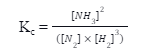
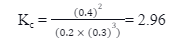
Suppose at a given temperature, the concentration of nitrogen, N2 is 0.2 M, and the concentration of hydrogen, H2, is 0.3 M at equilibrium. If we measure the concentration of ammonia, NH3, and find it 0.4 M, we can calculate the equilibrium constant, Kc, using the given concentrations.
Example of Kp (Pressure Equilibrium Constant):
Consider the reaction:
2SO2(g) + O2(g) ⇌ 2SO3(g)
The equilibrium constant expression for this reaction in terms of partial pressures is:
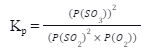
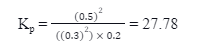
Suppose at a given temperature, the partial pressure of sulphur dioxide, SO2, is 0.3 atm, the partial pressure of oxygen, O2, is 0.2 atm, and the partial pressure of sulphur trioxide, SO3, is 0.5 atm at equilibrium. We can calculate the equilibrium constant, Kp, using these partial pressures.
Example of Ksp (Solubility Product Constant):
Consider the dissolution of silver chloride, AgCl, in water:
AgCl(s) ⇌ Ag+(aq) + Cl-(aq)
The equilibrium constant expression for this solubility equilibrium in terms of the solubility product constant, Ksp, is:
Ksp = [Ag+][Cl-]
Suppose at a given temperature, the concentration of silver ions, [Ag+], in a saturated solution of AgCl is  and the concentration of chloride ions, [Cl-], is also . We can calculate the solubility product constant, Ksp, using these concentrations.

Did You Know?
Equilibrium constants are temperature-dependent. The equilibrium constant's value may change as the temperature does. An increase in temperature can favour the creation of reactants in some situations while favouring the formation of products in others. To forecast how a reaction will vary when temperature varies, it is essential to comprehend how temperature affects equilibrium constants.
The equilibrium constants can reveal details about a reaction's stoichiometry. You can figure out the mole ratios of reactants and products at equilibrium by looking at the coefficients in a balanced chemical equation and the accompanying expression for the equilibrium constant. This knowledge helps in understanding the quantitative aspects of chemical equilibrium.
Equilibrium constants can be used to predict the direction of a reaction. If the value of the equilibrium constant is much greater than 1, it indicates that the reaction favours the formation of products at equilibrium. Conversely, if the value of the equilibrium constant is much less than 1, it suggests that the reaction favours the formation of reactants. The magnitude of the equilibrium constant provides insights into the relative concentrations of species at equilibrium.
Practice Problems:
Q1 : The equilibrium constant, Kc, for the reaction  . What can be concluded if the concentration of A is 0.2 M, B is 0.3 M, C is 0.4 M, and D is 0.1 M at equilibrium?
a. The reaction favours the formation of products.
b. The reaction favours the formation of reactants.
c. The reaction is at equilibrium.
d. The reaction cannot be determined from the given information.
Answer: A. The reaction favours the formation of products.
Explanation: Since the equilibrium constant, Kc, is significantly greater than 1

It indicates that the concentration of products is much higher compared to the reactants at equilibrium.
Therefore, the reaction favours the formation of products.
Q2: For the reaction N2(g) + 3H2(g) ⇌ 2NH3(g), the equilibrium constant, Kp, is 0.04 atm2. If the partial pressure of ammonia is 0.16 atm at equilibrium, what are the partial pressures of nitrogen and hydrogen, respectively?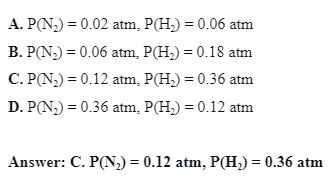
Explanation: According to the equilibrium constant expression, 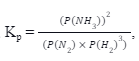
We can rearrange it to solve for the partial pressures of nitrogen and hydrogen.
Given that Kp = 0.04 atm2 and P(NH3) = 0.16 atm,
We can substitute the values and solve for P(N2) and P(H2).
We solve the equation, P(N2) = 0.12 atm and P(H2) = 0.36 atm.

a. 0.15 M
b. 0.2 M
c. 0.25 M
d. 0.3 M
Answer: B. 0.2 M
Explanation: We are given the equilibrium constant expression, the initial concentration of NOCl (0.2 M), and the equilibrium concentration of Cl2 (0.3 M).
We need to find the equilibrium concentration of NO.
By substituting the given values into the equilibrium constant expression and solving for [NO], we find that [NO] = 0.2 M.
Frequently Asked Questions:
Q1. Is the equilibrium constant temperature-dependent?
Answer: The equilibrium constant does indeed depend on temperature. The equilibrium constant's value can change as a result of temperature variations. An increase in temperature can favour the creation of reactants in some situations while favouring the formation of products in others. Therefore, while calculating the equilibrium constant for a process, it is crucial to take the temperature into account.
Q2. What relationship exists between the size of a reaction and the value of the equilibrium constant?
Answer: The equilibrium constant's value tells us how far a reaction has progressed towards equilibrium. The reaction favours product creation at equilibrium and has a high degree of conversion if the equilibrium constant, K, is big (greater than 1). In contrast, if K is low (less than 1), it indicates that the reaction favours the production of reactants and that there is only a limited amount of conversion to products.
Q3. Are there any mathematical relationships between equilibrium constants of reverse reactions?
Answer: Yes, a mathematical relationship exists between the equilibrium constants of reverse reactions. For a reversible reaction, if the forward reaction has an equilibrium constant of Kf, then the equilibrium constant for the reverse reaction, Kr, is the reciprocal of Kf. In other words,  This relationship arises from applying the law of mass action to the reverse reaction and is valid as long as the reaction is truly reversible.

NEET Related Links
JEE MAIN Related Links
JEE Advanced Related Links
JEE Advanced Eligibility Criteria
JEE Advanced Chemistry Syllabus
JEE Advanced Registration Dates
CUET Related Links
Important Topics
Anemometer : Measurement of Wind Speed
Angular Acceleration Atomic Theory Audible and Inaudible Sound Average Speed and Average Velocity Average Velocity Avogadros Number Avogadros Hypothesis Azimuthal Quantum Number Balanced Force Bar Magnet Biconvex Lens Boyles Law Buoyancy Calorimeter Carnot Engine Celestial Bodies Centripetal And Centrifugal Force Concave and Convex Lenses Concave Convex Mirrors Contact and Non Contact Force Controlled Thermonuclear Fusion Convection Currents Convex Lens Convex Mirror Destructive Interference Difference Between Conduction Convection and Radiation Difference Between Electric Field and Magnetic Field Difference Between Heat And Temperature Difference Between Series And Parallel Circuits Differences Between Acceleration And Velocity Distance and Displacement Distance Time Graph Electrical Force : Electric Forces and Their Types Electromagnetic Waves : Definition, Equation and Properties of Electromagnetic Waves Electromagnetism Electron Spin Fluid Flow : Bernoullis Equation Derivation and Fluid Mechanics Fluid Friction : Types and Factors of Fluid Friction Frames of Reference : Inertial and Non- Inertial Frame of Reference Frequency and Wavelength Frictional Force Importance of Hydrosphere Instantaneous Speed and Velocity Introduction to Motion Kinetic and Potential Energy Difference Law Of Conservation of Energy Layers of the Earth Light Energy Light Sources List of physics scientists and Their inventionsLoudness of Sound
Magnetic Dipole Moment Magnetic Field Non - Contact Force Non - Renewable Energy Ohms Law Optics P Wave Physics Symbols Plane Mirrors Poissons Ratio Projectile Motion Properties of Water : Anomalous Expansion of Water Radius of Gyration Reflection of Light Reflection of Waves Relative Density Resonance Reverberation Rolling Friction Rotation and Revolution Screw Gauge Semiconductors and Insulators Sliding Friction Speed Time Graphs Static Friction Stefan Boltzmann Law Stress Tension Tension Force Thermometer: Clinical Laboratory Thermometer Types of Rocks Types of Waves Uniform Motion and Non Uniform Motion Unit of Voltage Uses of Convex Lens Uses Of Convex Mirror Uses of Electromagnet Uses of Optical Fibre Wave Wavelength of Light What is Scattering of Light Working of Electric Bell Conventional and Non-conventional Sources of Energy Buoyant Force Bulk Modulus of Elasticity Bernoulli’s Principle Angular Momentum Difference Between Speed And Velocity ForceUnit of Heat
Difference between Distance and Displacement Simple Microscope Derivation Of Equation Of Motion Thermometer: Clinical & Laboratory Thermometer Difference between Concave and Convex LensDerivation Of Lens Maker Formula
Unit Of Pressure Velocity Uses of Plane Mirror
Wave Theory of Light
Unit of Density Unit of Light Unit of Force Unit of Magnetic Field Unit of wavelength Unit of Viscosity Uses of Electroplating Young's Modulus
What is the Scattering of Light
Lenz Law Space Wave Propagation Schrodinger Wave Equation Relation between Fahrenheit and Celsius Refractive Index Potentiometer Working Pascal Law Oscillatory Motion Optical Instruments Newton's Laws of Motion - First Law Modulation and Demodulation Magnetic Flux Lens Formula and Magnification Kaleidoscope Faradays Law Epsilon Naught Value Energy Bands Electrostatics Electroscope AC Generator Unit of Current Lithosphere Bending Equation Derivation Difference Between Pound and Kilogram Semiconductor Devices OTEC - Ocean Thermal Energy Conversion Hall Effect Rectilinear Propagation of Light Difference Between Ammeter and Voltmeter Coefficient of Linear Expansion Ampere’s Law Cyclone and Thunderstorm Save The Environment From Pollution Particle Nature of Light Types of DC Motor Uses Of Transistor Derivation of Phase Rule Unit of Humidity

 Call Now
 Let's Chat
 Share
Share