-
Call Now
1800-102-2727


Temperature Dependence of Enzyme Activity- Enzyme, Enzyme Classification, Factors Affecting Enzyme Activity, Temperature and Enzyme Activity, Practice Problems & FAQs

You might have studied the manufacture of some important chemicals like ammonia, sulphuric acid, polymers etc. Most of such important synthetic products are produced at a specific high temperature, high pressure and in the presence of a special catalyst developed for that particular change.
But do you know which is the most important industry in the world? Our body is the biggest and most complicated chemical industry anywhere in the world. The uniqueness lies in the number of varieties of reactions taking place and the simple conditions of reactions, such as room temperature of around 25° C and atmospheric pressure required for them.
Do you know how it becomes possible? These reactions are all catalytic reactions occurring with the help of proteins called enzymes.
You must have heard about people having heart attacks as having 80 % 90% blood clots in their artery vessels. Then why all people do not get it? It is because, generally, the blood clot gets dissolved in the blood vessel by an enzyme. Streptokinase enzyme is derived from homolytic bacteria such as Streptococcus. It is genetically modified and used to dissolve blood clots in blood vessels for people who have had a heart attack.
Chemical reactions are involved in all cell functions. Every chemical reaction within the cells is completed in a series of steps, each of which is regulated by a selective enzyme. Some of the 22,000 known enzymes are also used for industrial purposes
Let us learn more about enzymes and factors responsible for enzyme activity in this article.
Table of Content
- Introduction to Enzyme
- Enzyme Classification
- Factors Affecting Enzyme Activity
- Temperature Dependence of Enzyme
- Function of Enzymes
- Practice Problems
- Frequently Asked Questions-FAQs
Introduction to enzyme
Enzymes are biological proteins (amino acid polymers) that catalyse biochemical reactions."
A large percentage of proteins are catalytic enzymes active in a variety of processes. A collection of enzymes, which are required for life, carry out metabolic activities and other chemical reactions in the cell. The amino acid arrangement is extremely precise and unique, involving hundreds and thousands of amino acids.
Different types of enzymes are found in different types of cells, depending on the performance of the cells of the body. All metabolic reactions in the body are catalysed by enzymes. A large number of life's critical processes are carried out by enzymes.
Except for ribozymes, most of the enzymes are proteins (composed of RNA). They have a distinct three-dimensional quarternary structure. After repeated folding or supercoiling, the quarternary structure of peptide chains takes the form of fissures or pockets. The nooks and crannies where the substrate fits are referred to as "active sites." The substrate-binding site is the area of the active site where the substrate is bound. Because the active site of an enzyme is substrate-specific, a specific substrate can bind to it via weak interactions and get converted into products.. Protein structure and function are determined by the amino acid composition. As a result, a change in the amino acid sequence alters the structure and active site of the enzyme.


Classification of Enzymes
According to the International Union of Biochemists (I U B) in 1961, enzymes are classified into six functional classes based on the type of reaction they catalyse.
|
Enzyme Types |
Biochemical Property |
|
Oxidoreductases |
The enzyme Oxidoreductase catalyses the oxidation reaction in which electrons tend to move from one form of a molecule to the other. |
|
Transferases |
Facilitate the movement of functional groups between acceptors and donors. |
|
Hydrolases |
Are a group of enzymes that catalyse the hydrolysis reaction by cleaving the bond and hydrolyzing it with water. |
|
Lyases |
Water, carbon dioxide, or ammonia is added or removed across double bonds to form new ones. |
|
Isomerases |
Catalyse structural alterations in a molecule which result in the change in the shape of the molecules. |
|
Ligases |
Ligase enzymes have been implicated in the catalysis of ligation (combination) reactions. |
Factors Affecting the Enzyme Activity
The activity of an enzyme depends on the amino acids present, structure and stability at different temperatures and pH conditions, compatibility of the substrate, poisons present, etc.
- Active site: Each enzyme has a small unique active core in the entire protein of amino acid side chains where the reaction is facilitated. The substrate is bound to that portion of the active site of the enzymes, like a right key fitting into the lock and undergoes chemical changes. The active site is regularly a slit or a pocket formed by catalytic and substrate-binding amino acids.
- Temperature and pH: Each enzyme works best at a specific temperature and pH level. The optimal temperature or pH is the temperature or pH at which a substance exhibits maximum activity. As previously stated, enzymes are protein molecules. If the temperature or pH is higher than ideal, the molecular structure of enzymes will be altered. The ideal pH range for enzymes is thought to be between 5 and 7.
- Product concentration: The accumulation of enzymatic reaction products within the cell gradually slows down and eventually inhibits the enzyme's activity.
- Enzyme Concentration: Generally enzymatic action does not directly depend on the enzymatic concentration. When the enzymatic concentration increases the rate of reaction also increases up to a certain amount of concentration of enzyme.
- Enzyme-substrate complex: Each enzyme possesses a substrate-binding site known as an active site in its molecule which forms a highly reactive complex known as enzyme-substrate complex that finally dissociates into products. The higher the affinity of an enzyme for substrate more will be the catalytic activity.
E+S ⇌ ES E+S
- Activators: Certain enzymes, along with coenzymes, require a metal ion to function properly. Metal ions such as- Zn2+, Ca2+, Co2+ etc act as activators and are referred to as cofactors, and they speed up the rate of enzyme activity
- Poisons, Inhibitor and radiation: Poison, such as cyanide, substrates similar inhibitors and radiation, such as UV rays, damage the quarternary structure of enzymes, rendering them inactive.
Temperature Dependence of Enzyme Activity
Like any other catalytic reaction, enzyme activity also is typically accelerated as temperature rises. This is because of the increased molecular collisions between the substrate and catalytic sites.
Because enzymes function in cells, moderate temperatures are the best conditions for nearly all enzymes. At higher temperatures, given a specific point, there is a significant decrease in activity due to enzyme denaturation.
Enzymes, as proteins, are thermolabile (Very sensitive to temperature change). The rate of activity increases from 0 to 35 degrees Celsius, but after that, the rate begins to decline and the enzymes are inactivated above 60 degrees Celsius. As a result, the optimal temperature for most enzymes is (35-40) degrees Celsius.
The graphical representation of the relative activity of the enzyme and temperature in degrees centigrade is bell shape curve because when the temperature is increased from 0 degrees centigrade the activity of the enzyme increases till it reaches the optimum temperature after which the enzyme becomes inactive at a higher temperature.
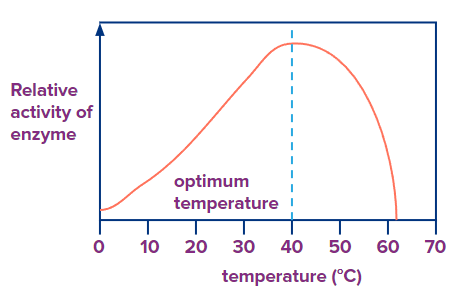
Till an optimum (T°) temperature range, which is around 35°- 40°C, in the case of the human body, the enzyme, maintains its quarternary structure and active site intact for its catalytic property. When it is heated or the temperature increases beyond optimum (T°), the peptide bonds and as well the structure stabilising hydrogen and sulphur bonds in the protein get disturbed, collapsing ultimately at higher temperatures, the entire quaternary structure of the protein and by that the catalytic activity of the enzyme. The enzyme is said to be denatured.
Functions of Enzymes
Enzymes perform a variety of functions in the human body. Among them are the following:
- Enzymes help with signal transduction. The most common enzyme used in the process is protein kinase, which catalyses protein phosphorylation.
- They convert large chemicals into small molecules that the body can easily absorb.
- They help the body produce energy. ATP synthase enzymes are involved in energy synthesis.
- It regulates ion movement across the plasma membrane.
- Enzymes use a variety of biochemical reactions such as oxidation, reduction, hydrolysis, and others to eliminate non-nutritive substances from the body.
- They control cellular processes by reorganising the cell's internal structure.
Practice Problems
Q1. Which of the following is correct about the enzymes?
a. Enzymes are biological polymers that catalyse biochemical reactions
b. All metabolic reactions in the body are catalysed by enzymes
c. Except for ribozymes, most of the enzymes are proteins (composed of RNA)
d. All of the above
Answer: (D)
Solution: Enzymes are made from polymer chains of amino acid with specific quarternary structure. Among the proteins, some with unique catalytic sites for substrates act as catalysts called biological polymer catalysts. Each cell depending on the metabolic process they undertake have selective enzymes.
While enzymes are pure proteins, ribozymes are a combination of protein and ribonucleic acids Therefore, option (D) is correct.
Q2. Which of the given factor does not affect the activity of enzymes?
a. Pressure
b. Temperature
c. Activators
d. Hydrogen ion Concentration
Answer: (A)
Solution: Enzyme activity is measured in units that represent the rate of the reaction catalysed by that enzyme in micromoles of substrate converted (or product formed) per minute. Enzyme activity is affected by different factors which include temperature, substrate concentration, hydrogen ion concentration, product concentration, activators etc but it is not affected by pressure. Therefore, option (A) is correct.
Q3. Which of the following options is correct with respect to the effect of temperature on enzyme activity?
a. The rate of activity decrease from 0 to 35 degrees Celsius, but after that, the rate begins to increase.
b. The graphical representation of the relative activity of the enzyme and temperature in degrees centigrade is a straight line curve.
c. Enzymes function in cells, high temperatures are the best conditions for nearly all enzymes
d. At higher temperatures, given a specific point, there is a significant decrease in activity due to enzyme denaturation.
Answer: D
Solution: The activity of the enzyme against temperature is a bell-shaped curve showing the maximum activity in a temperature range between 35°- 40°C. From a lower temperature, the activity increases with the increase of temperature reach a maximum at an optimum temperature and then decreases. So the correct option is D.
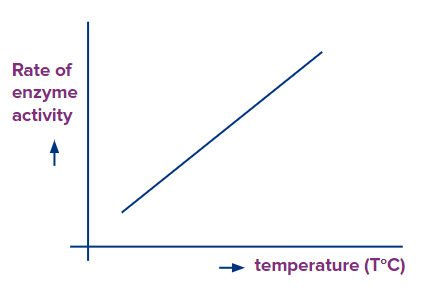
Q4. Select the correct option for the correct graphical representation of the effect of temperature on enzyme activity.
A)
B)
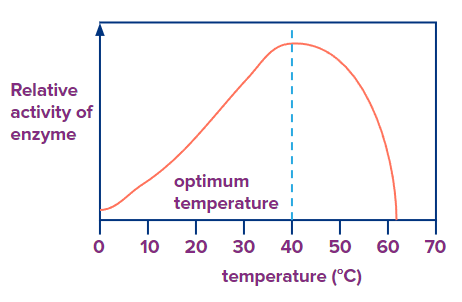
C)
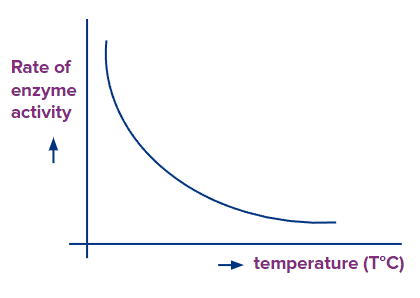
D)
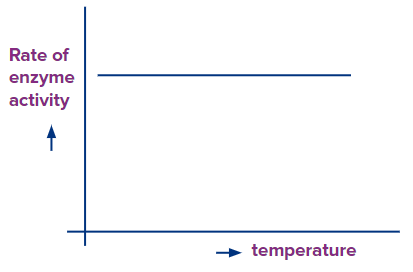
Answer: (B)
Solution: The graphical representation of the relative activity of the enzyme and temperature is a bell-shaped curve because when the temperature is increased from 0 degrees centigrade the activity of the enzyme increases till it reaches the optimum temperature after which the enzyme becomes inactive at a higher temperature. Therefore, option (B) is correct.
Frequently Asked Question-FAQs
Q1. What is the difference between an inorganic catalyst and an enzyme?
Answer:
|
Inorganic Catalyst |
Enzymes |
|
It can catalyse a variety of chemical reactions including non-biological reactions. |
It can only catalyse the biological reaction only. |
|
It generally has a low molecular weight. |
They generally have high molecular weight. |
|
These are simple mineral ions or simple molecules. |
They generally have complex three-dimensional structures of amino acids |
|
They are generally less sensitive to changes in temperature and changes in pH. |
They are comparatively more sensitive to changes in temperature and change in pH. |
Q2. What is the importance of enzymes?
Answer: There are some important enzymes which include:
- Diastase is used to treat people who have insufficient digestive juices.
- Protease is used in detergents and washing powder to make clothes brighter.
- Streptokinase is a blood clotting enzyme.
- Urease is used to treat wastewater by breaking down urea into CO2 and H2O.
- Amylase is a protein that is found in dishwashers.
- To prepare predigested baby food, trypsin is added.
- Fruit juices are cleared using pectinase.
Q3. How was the enzyme discovered?
Answer: Enzymes were discovered by accident in 1897 by a german scientist named Eduard Buchner, who discovered that yeast extract he prepared went bad and that when sugar was added to prevent spoilage, it fermented into alcohol. Previously, Pasteur discovered that living yeast cells promote fermentation. Kuhne coined the term enzyme in 1878, which originally referred to yeast but was later applied to all biocatalysts.
Q4. What is the difference between intracellular and extracellular enzymes?
Answer: Intracellular enzymes are enzymes that remain and function within the cell and are generally found in the cytoplasmic matrix or are enclosed in cell organelles such as mitochondria, lysosomes, and so on. Extracellular enzymes or exoenzymes are enzymes that are released outside of the cell. Salivary amylase and pancreatic lapse, for example, are secreted by the salivary gland and pancreas, respectively.

 Call Now
 Let's Chat
 Share
Share