-
Call Now
1800-102-2727


Standard Enthalpy of NeutralizationneutHo - Enthalpy of Neutralization, Dissociation of acid and base, their strength, Practice problems and FAQs

Matches between strong teams, irrespective of the game draw a huge crowd. Within the strong team, there will be better understanding, and unison of activities giving their best output. Similarly, when two extroverted people become friends. Is easy for both of them to understand each other. But when either of them is an introvert or both are introverts, it becomes complicated to understand each other because introverts always hesitate to share their feelings.
A similar case happens in neutralization, when a strong acid and a strong base react, their reaction called a neutralization reaction is really simple and the energy involved (enthalpy of neutralization) is always the same as ―57.1 KJmol-1 , irrespective of the chemical nature of the acid and base.
But, if one of them is weak or both acid and base are weak, the enthalpy of neutralization becomes less than ―57.1 KJmol-1. Let’s discuss why this happen.
Table of Contents
- Standard Enthalpy of NeutralizationneutHo
- Dissociation of acid and base
- Strength of acids and bases
- Practice Problems
- Frequently Asked Questions
Standard Enthalpy of 
An acid reacts with a base to form a salt and water. The reaction is exothermic. The heat energy liberated during this process of neutralization is called enthalpy of neutralization, which is always negative..
Let’s take an example to understand the enthalpy of neutralization. A beaker filled with HCl is attached to a thermometer. NaOH is taken in a test tube and is added slowly into the HCl solution in the beaker. HCl and NaOH will undergo a neutralization reaction and the heat is released in this process that increases the thermometer reading.
The base NaOH(aq), the acid HCl(aq), and the salt formed are completely dissociated in aqueous solution resulting in ions as-

The H2O formed in the neutralization reaction will remain unionized (i.e., undissociated).
So, ultimately neutralization of an acid and a base is a reaction between hydrogen ion and hydroxide ion to form an undissociated water molecule. T

Standard enthalpy of neutralization  is the amount of heat released when one mole of H+in dilute solution combines with one mole of OH-to give rise to undissociated water at 1 bar pressure and 298 K. It can also be defined as the amount of heat released in the formation of one mole of water when an acid is neutralized by a base at 1 bar and 298 K
Neutralization reaction is given as
H+(aq)(1mol)+OH-(aq)(1mol)H2O(l)(1 mol)
Standard enthalpy of neutralization in this process = ―57.1 kJmol-1
= ―13.7 kcalmol-1
Since the strong acid and strong base are almost 100% ionized, the energy liberated is solely due to the reaction between Hydrogen ion and hydroxide ion and will be maximum.
SO irrespective of the acid Hydrochloric sulphuric or nitric acid or sodium hydroxide, potassium hydroxide, or calcium hydroxide the standard heat of neutralization is maximum of ―57.1 kJmol-1
Dissociation of acid and base
Acids, such as HCl, HNO3 and CH3COOH, produce H+ ions when they dissociate. It can be written as follows:
 will constitute the anionic part (A-).
On dissociation, bases such as NaOH, KOH, NH4OH, and others produce OH- ions. It can be written as follows:
 will constitute the cationic part (B+).
Strength of acids and bases
Strong acid and weak acid
A strong acid, such as HCl, will entirely dissociate into its constituent ions H+ and Cl-. Thus, acids that dissociate completely into their constituent ions are known as strong acids. However, acids like CH3COOH will show partial dissociation (i.e., incomplete dissociation) into their constituent ions CH3COO- and H+. Thus, acids that dissociate partially into their constituent ions are known as weak acids.
Strong base and weak base
A strong bases like NaOH will dissociate entirely into their constituent ions Na+ & OH-. Those bases that completely dissociate into their constituent ions are known as strong bases. Bases like NH4OH will not completely dissociate into their constituent ions NH4+ & OH- and are known as weak bases.
Consider the reaction between a strong acid (HCl) and a strong base (NaOH).

The weak species are not completely ionized in solutions. Some of the heat liberated during the initial neutralization reaction is consumed in ionizing more of the unionized weak species. This heat is known as the enthalpy of ionization. So, what will be measured will be the enthalpy of neutralization less of enthalpy of ionization.
For a better understanding, consider a neutralization reaction between a weak acid and a strong
base where the energy liberated is around ―50 kJmol-1. The enthalpy of neutralization was expected to be approximately equal to ―57.1 k. Thus, it can be concluded that 7.1 kJmol-1 of energy was utilized in the ionization of the weak acid. Hence, the enthalpy of ionization, in this case, is 7.1 KJmol-1.
The enthalpy of neutralization is less than 57.1 KJmol-1. whenever a weak acid (monobasic) or weak base (monoacidic) is involved in the neutralization reaction.
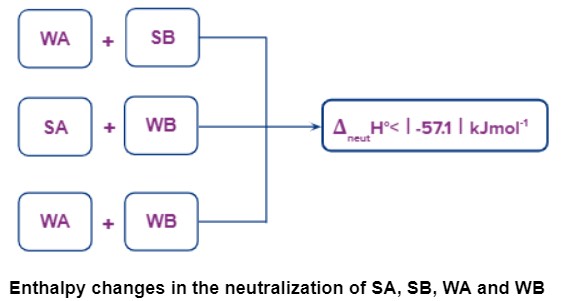
Important Points
- As the magnitude of increases, the acidic strength of the acid increases.
- Consider two acids being neutralized with the same base. The acid with the higher magnitude of is a stronger acid as that particular acid will require only a lesser amount of energy for ionization.
- Similarly, as the magnitude of increases, the basic strength of the base increases.
- In the case of a neutralization reaction between a weak acid and a weak base, the exact prediction of energy required for their ionization is not possible at this level.
Practice Problems
Q 1. The enthalpy of neutralization of HCl by NaOH is –57.1 kJmol-1, while the enthalpy of neutralization by NH4OH is –51.1 kJmol-1. Calculate the NH4OH dissociation enthalpy.
a. 14 kJmol-1
b. 6kJmol-1
c. 8kJmol-1
d. 10kJmol-1
Answer: When NaOH (strong base) neutralizes HCl (strong acid),
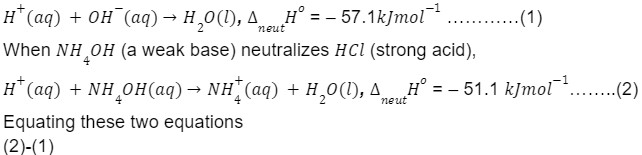

As a result, the dissociation enthalpy of NH4OH is 57.1 + (–51.1) = 6 kJmol-1
Hence, the correct option is (B).
Q 2. The enthalpy of neutralization of NaOH by HCl is –57.1kJmol-1, while the enthalpy of neutralization by CH3COOH is -50.6 kJmol-1. Calculate the CH3COOH dissociation enthalpy.
a. 9.5 kJmol-1
b. 6 kJmol-1
c. 8.5kJmol-1
d. 6.5kJmol-1
Answer: When NaOH (strong base) neutralizes HCl (strong acid),
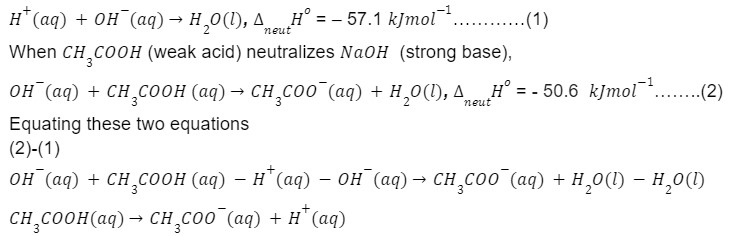
As a result, the dissociation enthalpy of NH4OH is 57.1 + (- 50.6 ) = 6.5 kJmol-1
Hence, the correct option is (D).
Q 3. In which of the following pair, the exact prediction of energy required for their ionization is not possible?
a. CH3COOH & NaOH
b. HCN & NaOH
c. CH3COOH & NH4OH
d. HCl & NH4OH
Answer: In the case of a neutralization reaction between a weak acid and a weak base, the exact prediction of energy required for their ionization is not possible at this level.
CH3COOH & NaOH is a pair of a weak acid and a strong base
HCN & NaOH is a pair of a weak acid and a strong base
CH3COOH & NH4OH is a pair of a weak acid and a weak base
HCl &NH4OH is a pair of a strong acid and a weak base
Hence, the correct option is (C).
Q 4. In which of the following pair, the exact prediction of energy required for their ionization is not possible?
a. CH3COOH & C5H5N
b. HNO3 & NH4OH
c. H2SO4 & NH4OH
d. HCN & KCN
Answer: In the case of a neutralization reaction between a weak acid and a weak base, the exact prediction of energy required for their ionization is not possible at this level.
CH3COOH & C5H5N is a pair of a weak acid and a weak base
HNO3 & NH4OH is a pair of a strong acid and a weak base
H2SO4 & NH4OH is a pair of a strong acid and a strong base
HCN & KCN is a pair of a weak acid and a strong base
Hence, the correct option is (A).
Frequently Asked Questions
Q 1. Why does the enthalpy of neutralization of a strong acid by a strong base always remain constant?
Answer: This is because unionized water molecules are usually formed by combining one gramme equivalent of H+ ions with OH– ions.
Q 2. What causes the HCl and NaOH reaction being exothermic?
Answer: The reaction between HCl and NaOH is a neutralization reaction that produces NaCl + H2O as a consequence. The ΔH is negative in this reaction because there is more bond formation than bond breaking, indicating that it is more exothermic.
Q 3. What factors influence the neutralization enthalpy?
Answer: The heat change of the neutralization process is influenced by three factors:
1. Acid and alkali concentrations
2. The basicity of acids and alkali
3. Strength of acid and alkali
Q 4. What is the nature of neutralization?
Answer: A neutralization reaction is irreversible since the products (salt and water) cannot be converted back to the reactants (acid and base). It's a chemical reaction that turns salt and water from an acid and a base.
Related Topics
|
Bond Enthalpy |
Enthalpy of Combustion |
|---|---|
|
Enthalpy of solvation |
Thermodynamic Processes |

 Call Now
 Let's Chat
 Share
Share